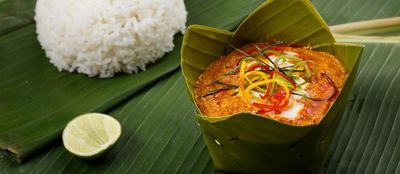
Amok Trey

Amok Trey

Cambodia's national dish, the centrepiece of any Khmer feast and the proper-occasion food across the country. You start by pounding kroeung fresh in a mortar (the paste of lemongrass, galangal, turmeric, garlic, shallots, kaffir lime zest and coriander root that defines Khmer cooking, and that no shop-bought paste comes close to matching). The kroeung fries briefly to bloom its aromatics, coconut cream and stock loosen it, and eggs whisk in to set the eventual custard. Chunks of firm white fish fold through with chopped greens (traditionally noni leaves, with spinach or chard standing in), and the whole mix spoons into banana-leaf cups (or small ramekins). Twenty minutes in a steamer turns the custard just-set around the soft fish, and the banana leaves perfume everything. Served from the parcels with steamed rice and a wedge of lime.
Cambodian 55 minutes Serves4
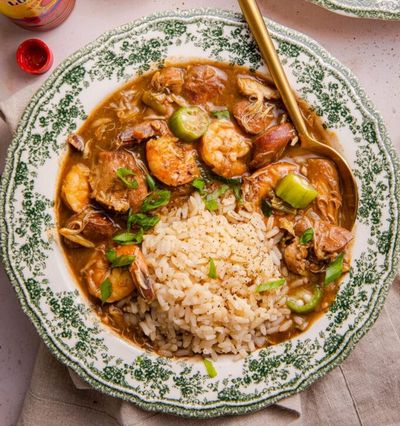
Authentic Cajun Gumbo

Authentic Cajun Gumbo

The "everything" Louisiana gumbo, chicken thighs, andouille, lump crab and shrimp all in one pot, and the dish where the technique matters more than the recipe. The roux is the single defining step and the line between Cajun gumbo and every other stew on earth: a full cup of oil and a full cup of flour cooked at medium-low for around 30 minutes, stirred without stopping, until the colour goes from blond to peanut butter to milk chocolate to dark chocolate. That's not flavour theatre; the long-cooked roux produces a deeply nutty, slightly bitter, profoundly savoury base that thickens the gumbo and gives it the distinctive almost-charred note no shortcut can replicate. Around the roux: the Cajun "holy trinity" of onion, bell pepper and celery; filé powder (ground sassafras leaves) added off heat as a second thickener; okra adding a third (and contributing its own slight slip); plus the four proteins, each adding a different layer. Flavour is dark, smoky, herbaceous, and slightly briny from the seafood. Smell is the roux toasting. Not difficult on technique but tremendously demanding on patience and attention; 30 minutes of unbroken stirring is the gateway, and if you walk away or rush it the roux burns and you start over. A dish that runs deep through Cajun and Creole Louisiana, with origins in the French settlers, the Choctaw (who contributed filé), West Africans (who contributed okra), and Spanish colonial traditions of Louisiana from the 1700s onwards.

Cajun 1 hour 45 minutes Serves8-10
Crawfish Étouffée

Crawfish Étouffée

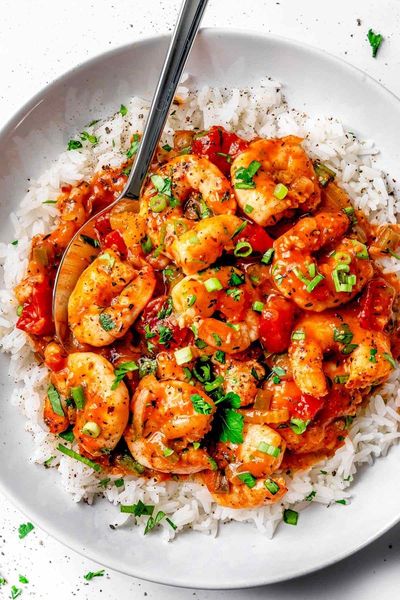
A Louisiana classic, the dish whose name means "smothered" in French, and that's exactly what's happening at the table: tender crawfish tails smothered in a rich gravy spooned over white rice. You start with a blond roux (butter and flour cooked just to the colour of peanut butter, lighter than gumbo's nearly-burnt mahogany), then soften the Cajun trinity of onion, celery and bell pepper in it until everything goes glossy. Tomato paste, Cajun spice and stock loosen the mixture, and the lot simmers down to a thick velvety gravy. Crawfish tails (or prawns if you can't find them) go in near the end and cook just briefly so they stay tender rather than turning rubbery. Spring onion and parsley scatter over at the finish. Ladled over white rice in a bowl, with crusty bread and a glass of cold beer alongside.

Cajun 1 hour Serves4
Doenjang Jjigae

Doenjang Jjigae

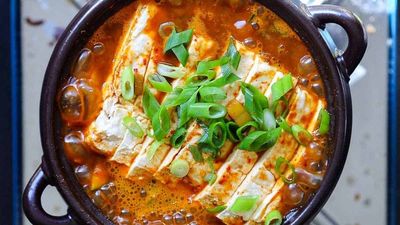
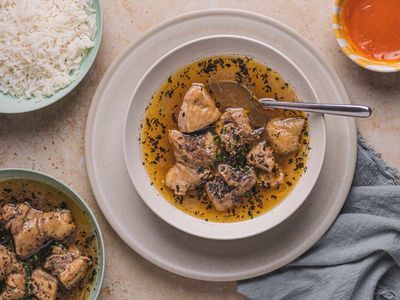
A quick anchovy-and-kelp stock makes the broth backbone (the Korean kitchen standard, taking 10 minutes). Doenjang (about 3 tablespoons) whisks into the hot stock with a small spoonful of gochujang for warmth, never aggressive heat. The vegetables go in by sturdiness: potato first, then courgette and mushrooms, then onion and chilli, finally cubed tofu and clams (or anchovies) at the end. Simmers for 12-15 minutes total. A little minced garlic stirs in at the very end so it doesn't dull. Brought to the table in the cooking pot, still bubbling.

Korean 40 minutes Serves4
Egusi Soup

Egusi Soup

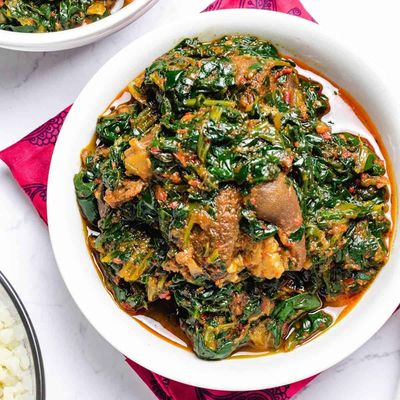
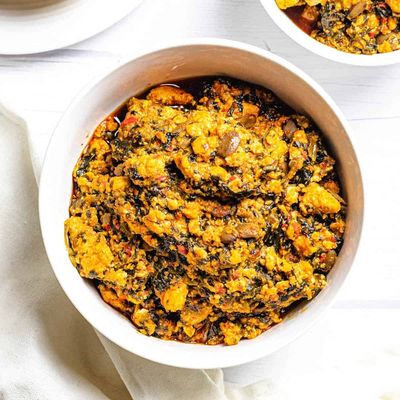
Beef or goat is parboiled with onion, stock cube and salt to make a base stock. Smoked fish hydrates in hot water and is picked clean. Egusi seeds are ground (or already-ground egusi powder is used) into a thick paste with a little water. Onion, garlic, ginger and Scotch bonnet blitz into a hot pepper paste. Palm oil heats until just smoking; the pepper paste fries in it 5 minutes. Egusi paste goes in and "fries" 10 minutes until it forms small clumps. Stock and meat join; everything simmers for 20 minutes. Smoked fish, ground crayfish and locust beans add depth. Chopped spinach (or bitter leaf) goes in for the last 5 minutes. Salt to season.

Nigerian 1 hour 40 minutes Serves6
Gai Yang

Gai Yang

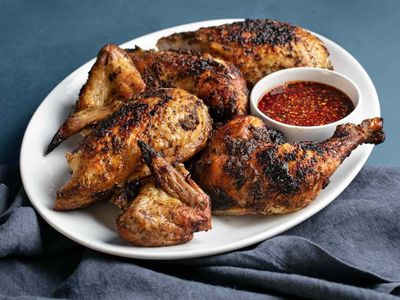
Gai yang ("grilled chicken") is one of the cornerstones of Isaan cooking, the cuisine of north-eastern Thailand that has spread across the whole country and into Thai restaurants worldwide. The defining flavour is coriander root, an ingredient barely used in Western cooking but central to Thai marinades. Pounded in a granite mortar with garlic, white peppercorns and a pinch of salt, it forms an aromatic paste that's then mixed with fish sauce, oyster sauce and a touch of sugar. The chicken is butterflied (spatchcocked) so it lies flat on the grill, marinated for at least 4 hours, then cooked slowly over moderate charcoal. The proper Isaan technique is patient: 30 minutes or more, turning often, sometimes pressed flat between two bamboo splints, so the skin slowly crisps and the meat takes on smoke without burning. The flavour is savoury-funky from fish sauce, peppery-warm from white pepper, deeply garlic-and-herb from the paste, with no chilli in the marinade itself; heat comes from the dipping sauce. Difficulty is low for the home cook: a good mortar or a small food processor makes the paste in 2 minutes, butterflying a chicken is a single cut down the backbone, and any covered grill or kettle does the cooking. Eaten by hand with balls of sticky rice and dipped into nam jim jaew, the toasted-rice-and-tamarind dipping sauce.

Thai 5 hours Serves4
Gimbap

Gimbap

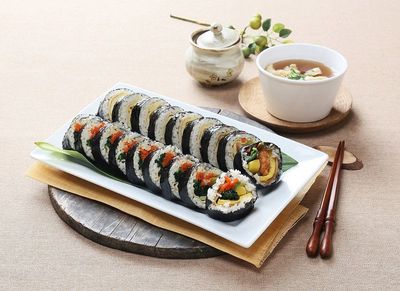
Rice cooks, dresses with sesame oil and salt while still warm. Fillings prep separately: carrots julienne and stir-fry briefly with salt; spinach blanches, drains, dresses with garlic, salt and sesame oil; egg cooks as a thin omelette, slices into strips; pickled yellow radish (danmuji) cuts into long strips; protein (ham, beef bulgogi, tuna mayo, fishcake) preps to size. Each gim sheet (toasted seaweed) lays on a bamboo mat; rice spreads thin over two-thirds of the sheet; fillings line in the centre; the mat rolls everything tightly. Cut into 12 slices per roll. Brushed with sesame oil; sprinkled with sesame seeds.

Snacks 1 hour 25 minutes Serves4
Mohinga

Mohinga

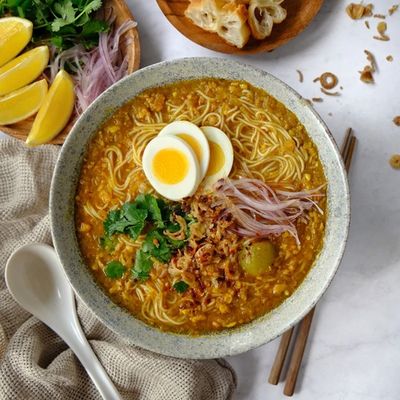
Myanmar's national breakfast, the rice-noodle soup that streetcorner stalls in every city open before dawn for. You cook catfish (or any firm white fish) in spiced water first, then shred the cooked flesh and turn the cooking liquid into the soup base. A spice paste of shallot, garlic, ginger, lemongrass and turmeric fries in oil; a chickpea-flour slurry thickens the broth to a silky consistency; banana-stem (or hearts of palm or cabbage as substitute) softens in. Fish sauce, paprika and lime balance the seasoning. Rice vermicelli portions into bowls, broth ladles over, and a heavy plate of garnishes arrives at the table: crispy split peas, halved boiled eggs, lime wedges, fresh herbs, chilli flakes. Each diner builds the bowl to their own taste. The morning meal of Myanmar.

Burmese 1 hour 30 minutes Serves6
Samkeh Harra

Samkeh Harra

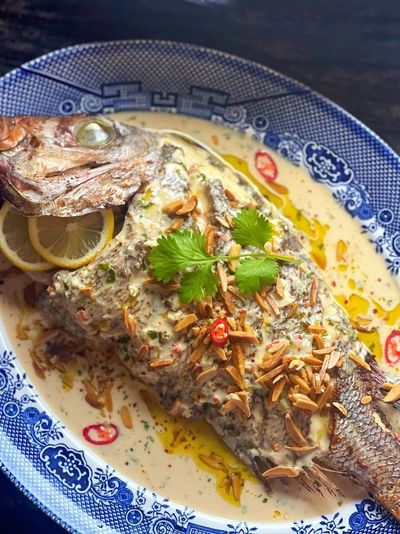
A whole fish is rubbed with salt, lemon, garlic and olive oil inside and out. While it rests, a sauce of tahini, lemon juice, water, garlic and chopped fresh coriander whisks together, adjusted with more water until the texture of pourable double cream. Diced red onion, Aleppo pepper, cumin and a pinch of cayenne fry briefly in olive oil. The tahini sauce stirs in; warms gently to a velvety consistency. The fish nestles on top in an oven dish; the sauce surrounds it; covered with foil; baked for 20 minutes; uncovered another 5-10 minutes. Topped with toasted pine nuts, pomegranate seeds and extra coriander at the table.

Palestinian 50 minutes Serves4
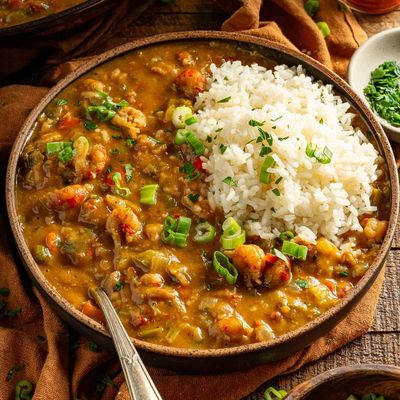
Shellfish Gumbo

Shellfish Gumbo

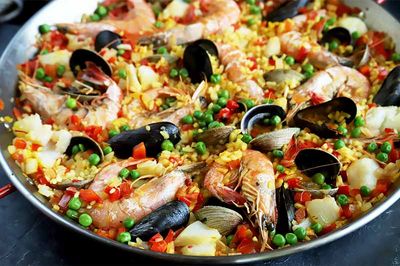
A shellfish gumbo, lighter than the full Cajun "everything" version but built on the same foundations - a deep roux, the holy trinity of onion, celery and sweet pepper, and a slow-simmered broth that ties everything together. You cook a roux in oil until it goes to a peanut-butter brown (lighter than the full-Cajun chocolate roux but darker than blond), then soften the trinity in it before stock and herbs go in to build the soup. Mussels, prawns and crab go in towards the end and cook just briefly so they stay tender. A modern touch of fresh chilli lifts the heat across the back. Eaten over white rice in deep bowls, with hot sauce on the table and crusty bread to mop the last of the broth.

Cajun 1 hour 29 minutes Serves6
← Prev Page 1 of 2 Next →