Desserts

3 recipes

Mishti Doi

Mishti Doi

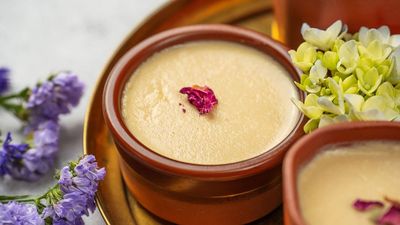
Mishti doi (literally "sweet yoghurt") is the great quiet sweet of Bengal: not as showy as rasgulla, not as rich as sandesh, but possibly the most loved of all. The technique is built on three reductions. First, the milk is boiled down by about a third to concentrate its sugars and proteins, which makes the eventual yoghurt thick enough to hold a spoon upright. Second, a portion of jaggery (date palm jaggery, nolen gur, in winter; cane jaggery, akher gur, year-round) is melted and cooked further until it caramelises to a deep amber. This is the move that defines mishti doi, it isn't simply sweetened yoghurt, it is yoghurt sweetened with caramelised jaggery, and the colour, the toffee notes and the depth come entirely from that caramel. Third, the seasoned milk is poured into porous unglazed clay pots (matka or bhar) and inoculated with a spoonful of live yoghurt before being left to set in a warm place for 8-12 hours. The clay pot is not decorative: it absorbs whey through its walls, producing a denser set than a glass or plastic container ever can, and it cools the doi by evaporation so it stays at fridge temperature even on a Kolkata summer afternoon. Mishti doi is the closer to a Bengali feast, after fish, after rice, after rasgulla even, eaten with a small spoon directly from the pot. It is also a winter speciality when made with nolen gur, the fragrant first-tap date palm jaggery that arrives in Bengal markets in December and disappears by February; that version, payesh doi or nolen gurer doi, is one of the great seasonal sweets of the subcontinent.
16 hours 50 minutes Serves6
Rasgulla

Rasgulla

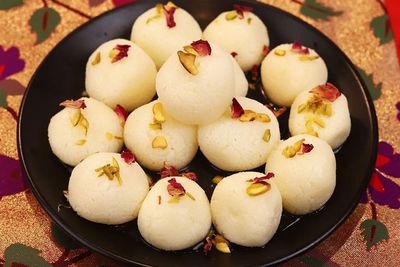
Rasgulla is one of the great technical sweets of South Asia, and there is no shortcut. Everything depends on the chhena, the fresh, soft curd cheese made by curdling whole milk with an acid (lemon juice or whey from a previous batch), straining off the liquid and gently kneading the curds until they are smooth, supple and just slightly oily. Get the chhena right and the rasgulla will be light, spongy, white, and will double in size when boiled in syrup. Get it wrong and you have dense rubbery balls that sit in sugar water without absorbing it. The rules are unforgiving: use full-fat whole milk (never reduced fat, never UHT), curdle gently with the heat off so the curds stay tender, drain only until the chhena holds together (not bone dry), and knead the chhena thoroughly with the heel of your hand on a clean surface for 8-10 minutes until it transforms from crumbly to silky. The syrup must be light, around the consistency of water with sugar dissolved in it, not a heavy syrup, because the rasgulla needs to drink up syrup as it expands. A wide pan with a lid is essential: the balls need room to puff to twice their size, and the lid traps steam that helps them rise. The result, served chilled with a few strands of saffron or a pinch of cardamom, is the defining Bengali sweet. Origin claims are intensely disputed: Odisha argues the sweet was offered at the Jagannath Temple in Puri for centuries; West Bengal credits Nobin Chandra Das of Bagbazar with inventing the modern spongy form in 1868. Both received Geographical Indication status. Either way, the sweet belongs to the Bengali-speaking world.

1 hour 5 minutes Serves6
Sandesh

Sandesh

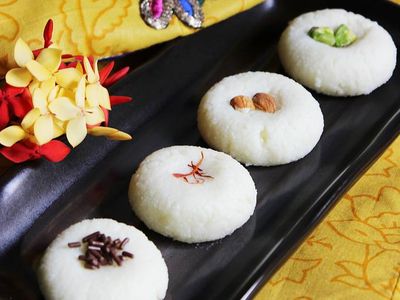
Sandesh is the most refined sweet in the Bengali misti repertoire: where rasgulla is showy and mishti doi is humble, sandesh is poised. It is also the most ancient of the chhena sweets, predating rasgulla by centuries and appearing in Bengali household recipes as far back as the early 1700s. The structure is almost shockingly simple: chhena (fresh curd cheese), sugar (or jaggery in winter), and gentle heat. The technique, however, is exacting. The chhena must be kneaded to perfect smoothness before cooking, and the cooking itself must be brief and well-judged, just enough to bind the chhena and the sugar into a soft, pliable dough, but not so long that the moisture evaporates and the texture turns dry and grainy. There are two main schools. Norom paak ("soft cooking") gives a tender, slightly moist sandesh that melts on the tongue; karaa paak ("hard cooking") cooks longer and yields a firmer, denser sandesh that holds its shape in elaborate moulds. The winter version, made with nolen gur (first-tap date palm jaggery), is one of the seasonal jewels of Bengal: the jaggery's smoky-toffee notes turn the chhena a pale honey colour and give the sweet an almost wine-like depth. Sandesh is traditionally pressed into small carved wooden moulds called sandesh chhaanch, shaped like fish (a Bengali symbol of fortune), conches, lotuses or hearts. At home a simple disc pressed flat with a thumbprint is perfect. Served at room temperature or just slightly chilled, never iced.

50 minutes Serves6