Snacks

4 recipes

Mutabbaq

Mutabbaq

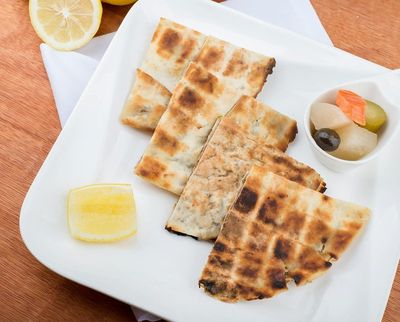
The Saudi street snack that almost every food court and roadside griddle in the kingdom has running through service. You make a stretchy oil-rich dough and let it rest for a full hour so it develops the pliability that mutabbaq depends on (the trick is that the dough has to stretch translucent without tearing). While it rests you cook a filling of ground beef or lamb with onion, leek, garlic and baharat, cool it, then mix in beaten eggs and chopped parsley just before folding. The eggs go in raw and cook inside the pastry as it griddles. Each dough ball gets oiled heavily and pulled by hand on an oiled surface into a 35 cm square thin enough to see through, with the filling spread in a 15 cm square in the centre. The edges fold in to enclose, and the whole parcel griddles on a hot pan with a glug of oil for two or three minutes per side until it's amber-crisp on the outside and the egg has set inside. Cut into quarters, eaten warm at the counter or carried home wrapped in paper.
1 hour 55 minutes Serves4
Samboosa

Samboosa

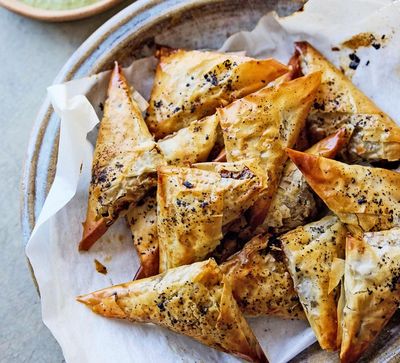
The Saudi Ramadan staple, the snack that breaks the fast in households across the Gulf when the call to maghrib sounds. You brown minced beef (or chicken) with diced onion and garlic, lifted with a generous spoonful of Saudi spice mix (baharat, black pepper, cumin, coriander, cardamom, cinnamon, allspice), then fold in toasted pine nuts, chopped parsley and a hit of lemon zest, and let the filling cool fully before you assemble. Spring-roll wrappers or samboosa pastry sheets fold into the traditional triangular packets with the long-strip-into-stacked-triangle technique that every Khaleeji household teaches its children, sealed with a flour-and-water paste at the edge. Deep-fried at 180°C in three or four centimetres of oil until they're amber-gold and shattering-crisp. Drained on paper, eaten warm with the first dates of iftar and a glass of laban.

45 minutes Serves6
Sambousek Bil Lahm

Sambousek Bil Lahm

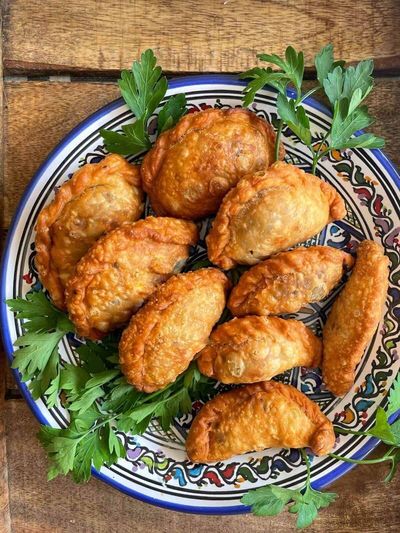
The meat-filled half-moon that sits next to the cheese version on every Levantine-Arabian table. You roll a soft butter-and-yogurt dough thin, stamp it into nine-centimetre rounds, and place a teaspoon of spiced lamb mince in the centre of each. The lamb is fragrant with baharat, onion, toasted pine nuts and a touch of pomegranate molasses that adds a sweet-sharp depth you can't quite place. The rounds fold into half-moons and crimp with a fork. From there they go either route: deep-fried at 170°C for three or four minutes per side, or baked at 200°C for eighteen to twenty minutes with an egg wash for shine. The pastry blisters lightly, the filling stays juicy. Eaten warm with a wedge of lemon, often as part of a meze spread alongside hummus, mutabbal, salata and warm flatbread.

1 hour 55 minutes Serves6
Sambousek Jibneh

Sambousek Jibneh

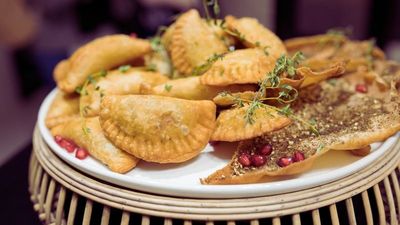
The Levantine-Arabian cheese half-moon, the milder vegetarian cousin to the meat sambousek. You roll a smooth pliable dough from oil, yogurt and flour and let it rest briefly while you build the filling: grated akkawi (desalted by soaking for thirty minutes) or a mix of low-moisture mozzarella and halloumi, crumbled feta, chopped parsley, scallion, mint, an egg yolk to bind and a touch of ground black pepper. The dough rolls to three millimetres, cuts into eight-centimetre rounds, gets a spoon of filling in the centre, folds into a half-moon and is crimped sharp with a fork. From there it's either deep-fried at 175°C for two minutes a side until golden, or brushed with egg wash, scattered with sesame seeds and baked at 200°C for fifteen to eighteen minutes. The cheese melts inside the sealed shell, the pastry browns. Eaten warm with labneh or a chilli-lemon dip on the side.

1 hour 20 minutes Serves4