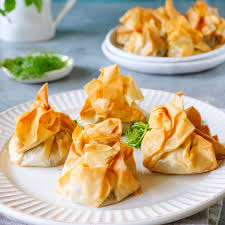
Filo Pastry
Filo is the paper-thin sheet behind baklava, spanakopita, bourekas, strudel. Almost nobody makes their own (and you don't need to either; the shop-bought sheets are excellent). The real skill is in handling them. We'll cover the layering, the buttering, and the small list of moves that make filo behave.
Overview
Filo (phyllo, phylo, yufka, yufak: same dough across the Mediterranean and Middle East) is the thinnest pastry in any tradition. A single sheet, properly stretched, is translucent. Twenty sheets stacked are about 5 mm thick. Baked, they shatter into the most delicate flaky crust.
The dough itself is just flour, water, salt and a little oil. It is the stretching that takes skill: a small ball is rolled, then stretched over the back of the hands until it is as wide as a tablecloth and thin enough to read newsprint through. The traditional Turkish yufka maker can do this in 90 seconds. A first-time home cook would take 30 minutes and probably tear the sheet.
For this reason, almost no one makes their own filo. Shop-bought is excellent, comes in 400 g packs of 12-15 sheets, costs little, and is the standard in every Greek-Turkish-Lebanese-Levantine kitchen. The skill that matters is the assembly: handling the fragile sheets, layering with butter or oil, and baking to the right colour.
Where to Buy
Look in the chilled or frozen section of supermarkets, or Middle Eastern and Greek delis. The most common UK brand is "Jus-Rol", though specialist brands (Antoniou, Tipiak, the various Turkish brands) are noticeably better. Indian shops sometimes carry hand-stretched filo of remarkable quality.
The pack contains roughly 12-15 sheets, each about 30 x 50 cm. Thawed filo keeps 4-5 days in the fridge; once opened it dries out within a day.
If you want to make it yourself, see Filo Pastry recipe. Use a clean cloth-covered table and a long thin rolling pin (oklava in Turkish).
The Core Rule: Keep It Covered
This is the single most important thing to know. Filo sheets dry out in about 3 minutes once exposed to air. A dry sheet crumbles, cracks and tears the moment you try to fold it.
Workflow:
- Open the pack of filo on the counter.
- Cover with a slightly damp clean tea towel (not wet; just damp).
- Peel off one sheet at a time as you need it.
- Re-cover the stack between sheets.
No exceptions. Even taking three sheets at once will partially dry the third while you handle the first.
The Brush: Butter or Oil
Each filo sheet needs a thin coat of fat between it and the next sheet. The fat keeps the sheets distinct during the bake (so they stay flaky) and seasons the pastry.
Butter: the classic choice for Greek and Turkish sweet pastries (baklava, kataifi, galaktoboureko). Melt 100-150 g unsalted butter, brush each sheet thinly. Some recipes use clarified butter (ghee or sade yag) for a higher-temperature bake without burning.
Olive oil: the classic for savoury Greek and Levantine pies (spanakopita, tyropita, bourekas). Use the best olive oil you can; it is a major flavour. About 100 ml total for a tray.
Mixed: half olive oil, half butter. Common for "modern" pastries that want some butter flavour but less weight.
Apply with a soft brush, lightly. Heavily-buttered filo bakes greasy, not crisp.
Three Assembly Patterns
1. Tray-Layered (Baklava, Galaktoboureko, Spanakopita)
The dish is filled with stacked sheets of filo on either side of a filling.
- Brush the base of a baking dish with butter.
- Lay one sheet of filo in the dish, fold or trim to fit. Brush with butter.
- Repeat for 8-10 sheets. This is the base layer.
- Add the filling (nut paste for baklava, custard for galaktoboureko, spinach-and-feta for spanakopita).
- Lay another 8-10 sheets on top, each brushed.
- Trim or tuck overhanging edges.
- Score the top into portions before baking (otherwise the bake-set pastry tears the filling apart when cut).
2. Cigar / Pinwheel (Bourekas, Cigars, Roulade)
A long thin filo sheet rolled around a filling.
- Lay one filo sheet on the bench, brush with butter.
- Fold in half along the long edge (a double-thick rectangle).
- Place a thin line of filling along one short edge, leaving 2 cm clear at top and bottom.
- Fold the short sides in.
- Roll up tightly from the filling edge to form a cigar 12-15 cm long.
- Place seam-side down on a tray.
3. Triangular Parcels (Spanakopita Triangles, Sambousek)
Filo sheet cut into long strips and folded into triangles like a flag.
- Lay one filo sheet, brush with butter.
- Cut into long strips 8 cm wide.
- Place a teaspoon of filling on the bottom-right corner of a strip.
- Fold the filling corner up to the left edge, creating a triangle.
- Fold straight up.
- Fold the new bottom corner to the right edge, making another triangle.
- Continue folding flag-style up the strip until you reach the end.
- Brush the outside with butter, place seam-side down on a tray.
Baking
Filo bakes at moderate heat. Too hot and the outer layers burn before the centre cooks; too cool and the layers do not crisp.
- Tray-layered: 170-180 C for 30-45 minutes (longer for big trays with wet fillings).
- Cigars and triangles: 180-190 C for 20-25 minutes.
- Brush the top with extra butter halfway through for deep colour.
For sweet pastries that get a syrup (baklava, galaktoboureko): pour the cooled syrup over the pastry while the pastry is still hot from the oven. The contrast between hot pastry and cool syrup gives the best soak; reversed (cold pastry, hot syrup) produces a soggy result.
Filo vs Puff: When to Use Which
| Filo | Puff | |
|---|---|---|
| Texture | Many distinct flaky layers, shatters | Tall puffed layers, lifts dramatically |
| Skill | Easy if you can keep sheets covered | Hard; full lamination is a half-day project |
| Suitable for | Pies, tarts, wrapped fillings, baklava | Vol-au-vents, mille-feuille, palmiers, sausage rolls |
| Buttering | Brush each sheet | Built into the dough |
| Bake heat | Moderate, 170-180 C | High, 200-220 C |
| Rise | Minimal (it gets crispy, not tall) | Major (4-5x rise) |
In short: filo for layered flatness, puff for height.
Common Mistakes
The filo cracked when folded. Dried out. Cover the stack with a damp towel and work faster.
The pastry came out greasy. Too much butter brushed on each sheet. Apply a thin coat; you should see the sheet through the butter, not the butter over the sheet.
The baklava is soggy. Hot syrup on hot pastry, or pastry that did not fully bake before saturation. Cool the syrup completely; bake the pastry to deep gold first.
The pie filling leaked. Too few base layers. Wet fillings need at least 8 layers underneath them to prevent leak-through.
The middle is pale, the edges are dark. Oven runs hot at the edges. Rotate the tray halfway through; reduce temperature by 10 C.
The pastry has soggy patches between crispy ones. Uneven buttering. Brush each sheet edge-to-edge, including the corners.
The pastry tastes oily, not buttery. Used regular salted butter without clarifying it (or used poor-quality olive oil for a butter recipe). Use unsalted butter; consider clarifying for sweet pastries.
Where Next
- Puff and Rough Puff: the laminated alternative.
- Baklava: the canonical layered filo dessert.
- Spanakopita: the spinach-and-feta classic.
- Filo Pastry recipe: if you want to make your own.
- Pastry Course landing: back to the main course.
Recipes mentioned here
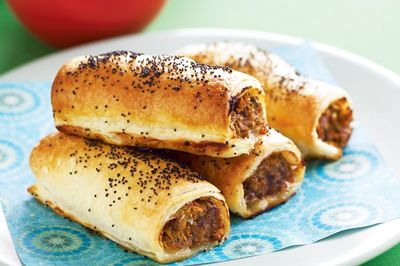
Sausage Rolls
Sausagemeat (or sausage casings squeezed) mixes with herbs, mustard and breadcrumbs for a lighter texture. The mixture pipes onto strips of puff pastry, the pastry rolls over and seals, and the long rolls cut into bite-sized pieces. Egg wash, sesame seeds, bake.
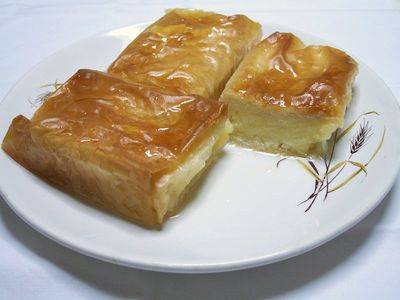
Galaktoboureko
A semolina custard is simmered on the stove, milk, semolina, sugar, lemon zest, eggs, until thick. Off heat, butter and vanilla are stirred in. A 30 × 22 cm tin is layered with 10 sheets of buttered filo on the bottom. The custard is poured in. 8 more buttered filo sheets cover. The top is scored into diamonds. Baked for 45 minutes at 180°C till deep gold. While baking, a syrup of sugar, water, lemon juice and cinnamon stick simmers. The HOT syrup is poured over the just-OUT-OF-OVEN galaktoboureko. Rested for 4 hours minimum (overnight ideal) before cutting.
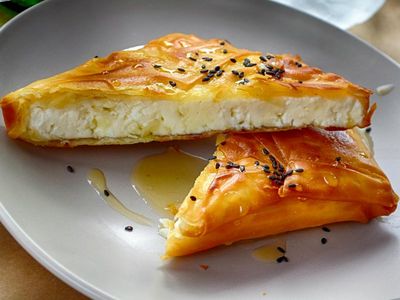
Tyropita
Feta crumbles into a bowl with ricotta, egg, dill, mint, nutmeg and black pepper. Filo sheets keep covered with a damp tea towel (they dry instantly). Each sheet halves lengthways. A spoon of filling sits at one end of each strip; the strip folds flag-style up and across to form a triangle, layer by layer. Triangles brush with melted butter; bake for 25 minutes at 180°C till deep gold and puffed.
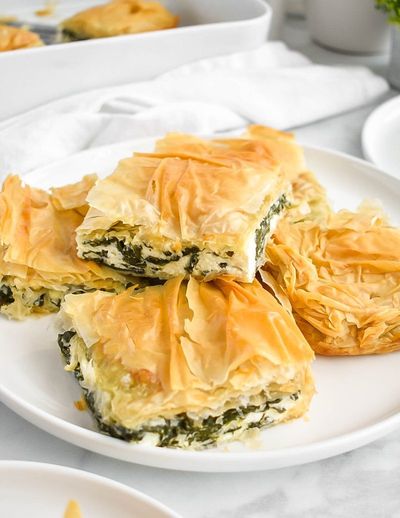
Spanakopita
Spinach wilts and squeezes dry; mixes with crumbled feta, ricotta, eggs, dill and spring onions. The filling goes between layers of filo brushed with melted butter; baked until the top shatter-crisps.
More like this
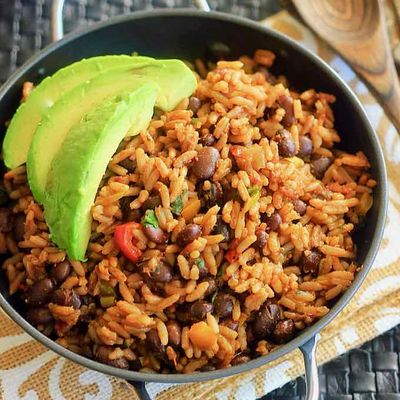
Moros Y Cristianos
Black beans simmer with bay and oregano until tender. Sofrito (onion, pepper, garlic, cumin) cooks in olive oil; the cooked beans plus their liquid join in; rice is stirred through and steamed in the bean broth until tender and tinted.
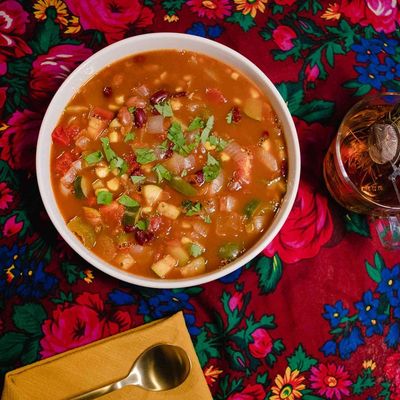
Three Sisters Stew
Diced onion and garlic sweat in sunflower oil. A whole butternut squash, peeled and cubed, browns briefly to caramelise the edges. Dried sage and ground sumac (or a squeeze of lemon) season. Stock and tomatoes go in; everything simmers for 30 minutes until the squash is collapsing. Drained pinto beans and hominy (or sweetcorn) join for the last 15 minutes. A splash of maple syrup at the end balances. Garnished with toasted pumpkin seeds and fresh sage.
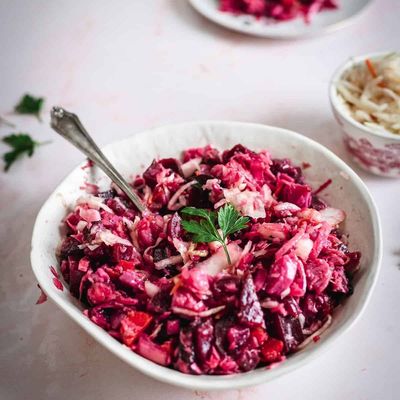
Vinaigrette Salad
Beetroot, potatoes and carrots boil in their skins. Once cool, they're peeled and diced into 1 cm cubes. Sauerkraut is squeezed dry; pickled cucumbers are diced; spring onions and dill chopped. Everything tosses with sunflower oil, vinegar, salt and pepper. Best after a few hours' rest in the fridge.
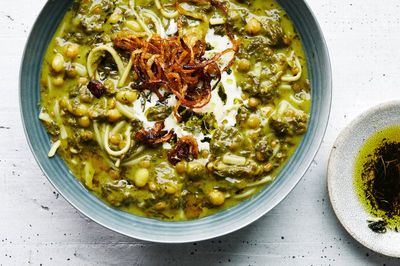
Ash Reshteh
Dried beans (chickpeas + kidney beans + green lentils, OR the popular cheat of mixing all dried into one pot) soak overnight. Onion fries in oil; turmeric, salt and the soaked-and-drained beans go in with stock; simmers for 1 hour 15 minutes until tender. A heaping double handful of finely chopped fresh herbs (parsley, coriander, dill plus blanched spinach) goes in. Reshteh noodles (Persian flat egg noodles, sold at Iranian shops) add for the last 10 minutes. The bowl finishes with a sour-fermented kashk drizzle, dried-mint-and-garlic-in-oil sizzle, deep-fried golden onion, and a swirl of yogurt. Garnishes are not optional.