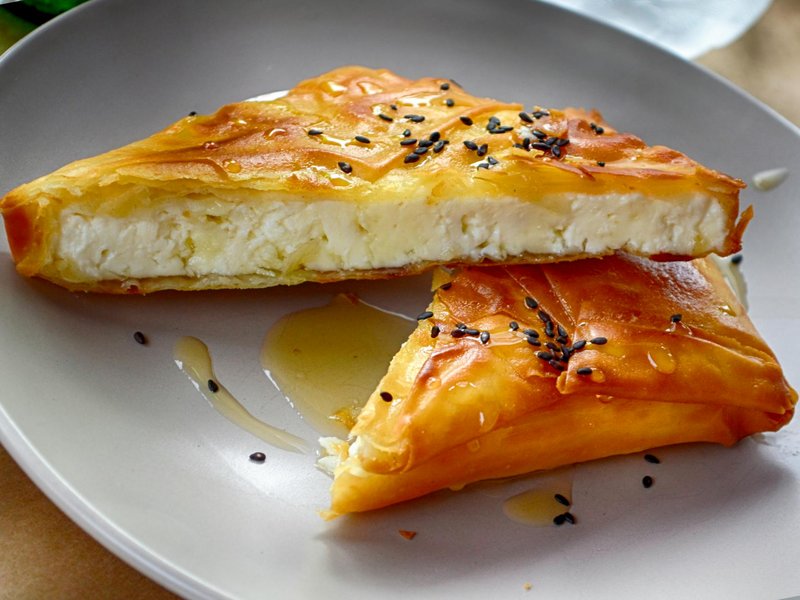
Tyropita
Greece's bakery pastry: buttery filo triangles wrapped around a creamy filling of feta, ricotta and egg. The eternal Greek travel food.
Overview
Feta crumbles into a bowl with ricotta, egg, dill, mint, nutmeg and black pepper. Filo sheets keep covered with a damp tea towel (they dry instantly). Each sheet halves lengthways. A spoon of filling sits at one end of each strip; the strip folds flag-style up and across to form a triangle, layer by layer. Triangles brush with melted butter; bake for 25 minutes at 180°C till deep gold and puffed.
Ingredients
Filling
- 250 g feta cheese (crumbled)
- 200 g ricotta cheese (drained if very wet)
- 50 g parmesan cheese (or kefalotyri, finely grated)
- 1 egg (large)
- 2 tablespoons fresh dill (chopped)
- 1 tablespoon fresh mint (chopped)
- ¼ teaspoon ground nutmeg
- ½ teaspoon ground black pepper
- (no extra salt - the feta is salty enough)
Pastry
- 12 sheets filo pastry (about 30 × 25 cm each; thaw fully if frozen)
- 150 g unsalted butter (melted)
Glaze
- 1 tablespoon sesame seeds
- 1 tablespoon nigella seeds (optional)
Method
Stage 1 - Filling
- In a wide bowl, combine the crumbled feta, ricotta and grated parmesan.
- Add the egg, chopped dill and mint, nutmeg and black pepper.
- Mix with a fork until uniform and slightly sticky. The mixture should hold its shape when scooped.
- Cover; refrigerate while you prep the filo.
Stage 2 - Filo prep
- Heat the oven to 180°C (160°C fan).
- Line two baking trays with parchment.
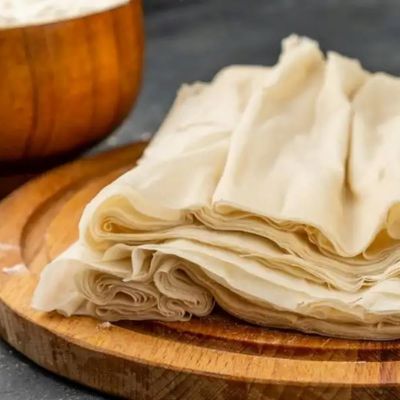
- Unroll the filo; cover the unused stack with a slightly damp tea towel (filo dries to brittle shards in minutes).
- Melt the butter.
Stage 3 - Shape
- Take one filo sheet; lay it flat on the work surface.
- Brush lightly with melted butter; lay a second sheet on top; brush again.
- Cut the double-layer sheet lengthways into 4 strips, each about 7 cm wide.
- Place 1 heaped tablespoon of filling at the near end of each strip.
- Fold the bottom corner up over the filling to form a triangle (flag-fold style).
- Continue folding up the strip, maintaining the triangle shape, until you reach the end.
- Place seam-down on a baking tray.
Stage 4 - Repeat
- Continue with the remaining filo sheets, brushing-and-stacking each pair, cutting into strips, folding into triangles.
- You should get 16 triangles from 12 sheets (4 strips × 3 pairs).
Stage 5 - Bake
- Brush the tops generously with melted butter.
- Sprinkle with sesame and nigella seeds.
- Bake 22-25 minutes until the triangles are deep golden and the filo is crisp.
Stage 6 - Serve
- Cool on the tray 3-4 minutes (the filling is molten straight from the oven).
- Serve warm or at room temperature.
Notes
- Keep the filo covered: dried-out filo cracks and tears. A damp tea towel is non-negotiable.
- Two sheets per strip: the double-thickness gives crispness without becoming pastry-heavy. A single sheet tears; three sheets goes leathery.
- Drain wet ricotta: if your ricotta is the very wet supermarket kind, sit it in a sieve 30 minutes before using. Wet filling leaks into the filo and the triangles go soggy at the seams.
- Triangle fold direction: the "flag fold" maintains a triangle as you walk up the strip. Each fold is a 45° flip.
Storage
- Best within 4 hours of baking.
- Keep 2 days refrigerated; reheat in a 180°C oven 6-8 minutes (microwaving turns the filo gummy).
- Freeze unbaked triangles on a tray, then bag; bake from frozen at 180°C 28-30 minutes.
More like this
Bourekas
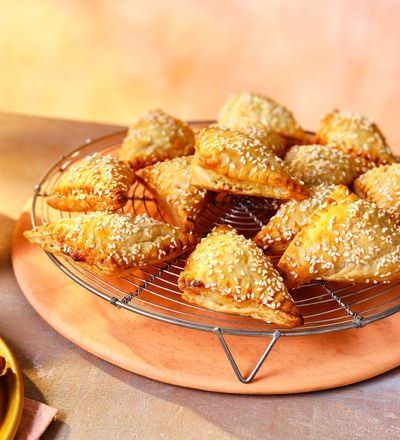
Ready-rolled all-butter puff pastry cuts into 12 squares (about 12 × 12 cm). Cheese filling: feta + ricotta + egg + parsley + nutmeg + pepper, mashed to a thick paste. Filling spoons onto each square; corners fold across to a triangle; edges crimp with a fork. Brushes with egg wash; sprinkles with sesame and nigella seeds. Bakes for 25 minutes at 200°C till deep gold and puffed.
Feteer Meshaltet
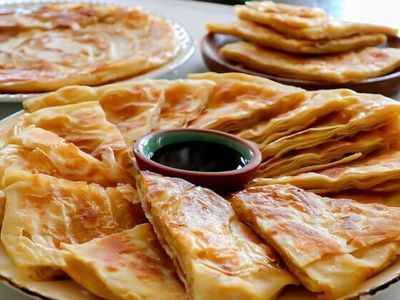
A soft elastic dough rests; divides into 2 balls. Each ball stretches paper-thin on a heavily-oiled / ghee-buttered surface (similar to msemen or yufka, translucent dough). Layered with melted ghee between folds: stretch → ghee → fold into thirds → quarter-turn → stretch → ghee → fold. Repeated 3 times per ball. The two folded packets place stacked on top of each other in a buttered round dish (about 24 cm). Baked at 220°C 25-30 minutes until amber, golden, and the layers have separated dramatically. Served warm with honey, soft cheese, or molasses-and-tahini (the Egyptian classic dip).
Goghal
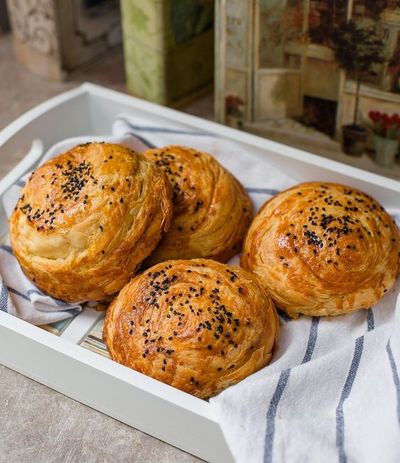
A spiced flaky pastry from Azerbaijan's tea table, traditionally baked for Novruz alongside pakhlava and shekerbura, eaten with strong sweet tea any time of year. You make a yeasted milk-and-egg dough and let it rest for an hour, while you build a savoury-sweet spice mix from black pepper, caraway, fennel, saffron and a hard cheese-like crumble (Azerbaijani gurut, or a substitute). The dough rolls thin, brushes with butter, gets a scatter of spice; folds, rolls, sprinkles again, repeated three times in the same lamination motion you'd use for puff pastry. The final dough rolls to a centimetre thick, cuts into rounds with the rim of a glass, takes an egg wash for shine, and bakes at 180°C for twenty-five minutes until deep golden. Eaten with sweet black tea and a small dish of jam on the side.
Gougères
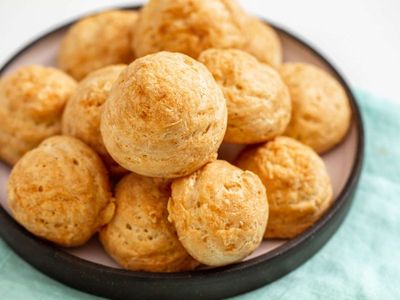
Choux dough cooks on the stovetop: milk + water + butter + salt come to a rolling boil; flour is dumped in all at once; cooked for 1-2 minutes until the dough comes together as a ball that pulls away from the pan walls. Cooled slightly. Eggs whisk in one at a time to a smooth thick pipe-able paste. Grated Gruyère, Comté and a touch of Dijon mustard fold through. Piped or spooned into small mounds on a baking tray; brushed with egg wash; sprinkled with more cheese. Baked at 220°C for 10 minutes then 200°C for 15 more, the puffs rise dramatically, crack, and turn deep golden. Served warm.