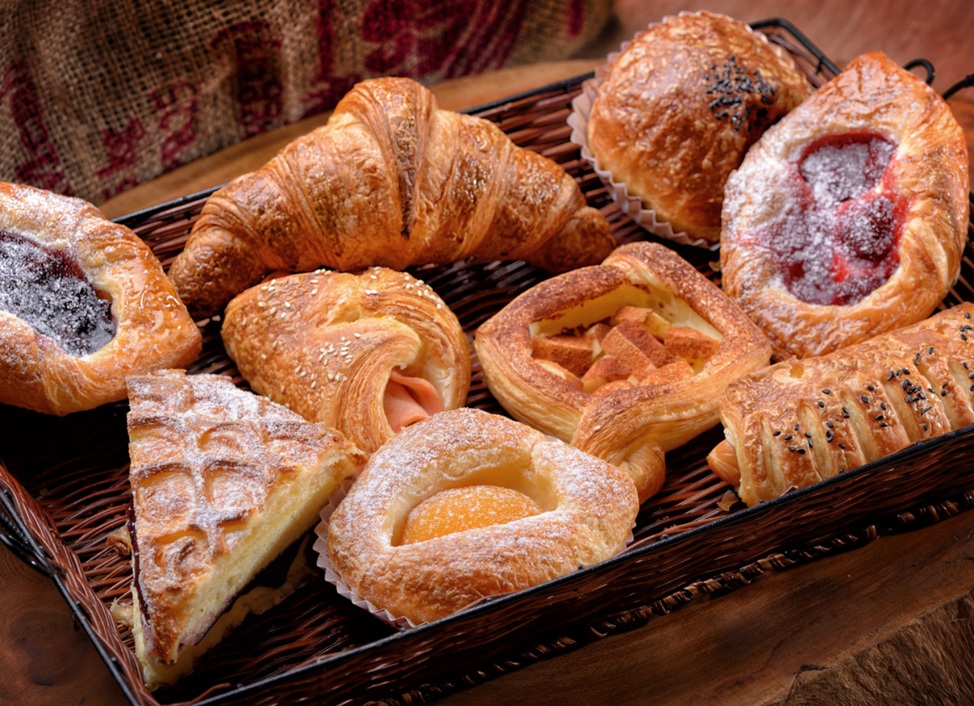
Croissant and Danish
Croissants are puff pastry's softer, breakfast-eating cousin. Add yeast, eggs, milk and sugar to a laminated dough and you get the family of pains: croissant, pain au chocolat, pain aux raisins, danish. It's a three-day project that asks for patience and a cool kitchen, and warm from the oven there's nothing quite like them.
Overview
Croissant dough is a special case of laminated pastry. The base dough is a sweet yeasted dough (a brioche-adjacent enrichment with milk, sugar, egg and butter), folded with a butter block, and laminated through three turns. The yeast in the base dough does most of the rising work; the lamination produces the layered crumb that defines the finished pastry.
Three things make croissant harder than puff:
- The base dough is alive (yeasted), so it needs proper proves alongside the lamination rests.
- Three turns instead of six (any more and the layers tear), so each turn must be perfect.
- The final proof must be at exactly the right temperature, or the butter melts and the lamination collapses.
The pay-off is the layered, honeycombed interior with a glossy mahogany crust that is impossible to fake.
The Schedule
This is a three-day project. The active time is maybe 4-5 hours total, but it is spread across waits.
Day 1 evening:
- Make the detrempe (base dough), 20 min active.
- Cold ferment overnight in the fridge, 12-16 hours.
Day 2 morning:
- Make the butter block, 5 min.
- Enclose butter in dough, 10 min.
- Three turns with 30-min rests between, total 2 hours.
- Roll out, cut, shape into croissants/pains au chocolat, 30 min.
Day 2 afternoon/evening:
- Final proof at 24 C, 2-3 hours.
- Egg-wash and bake, 25 min.
You can collapse this into Day 1 (mix detrempe, lamintate same day, proof, bake) but the cold ferment is what builds the deep flavour. Skip it only when speed matters more than the result.
The Recipe
For 12 croissants or 8 pains au chocolat.
The Detrempe (Base Dough)
- 500 g strong bread flour
- 300 ml warm whole milk
- 60 g caster sugar
- 50 g unsalted butter (softened)
- 12 g instant yeast
- 10 g fine sea salt
- 1 medium egg
The Butter Block
- 300 g unsalted butter (good quality, high-fat European; 82% fat minimum)
Egg Wash
- 1 egg yolk
- 1 tablespoon milk
Method
Day 1 - Make the Detrempe
- Warm the milk to lukewarm (about 35 C). Stir in the yeast. Wait 5 minutes for the surface to froth.
- In a large bowl, combine the flour, sugar, salt and softened butter.
- Add the milk-yeast mixture and the egg.
- Mix to a rough dough. Knead briefly (5 min) on a lightly floured bench until smooth but slightly tacky.
- Place in an oiled bowl, cover, refrigerate 12-16 hours.
Day 2 Morning - Make the Butter Block
- Take 300 g cold butter from the fridge. Place between two sheets of greaseproof paper.
- Beat with a rolling pin into a 20 x 20 cm square. The butter should be cold but pliable.
- Refrigerate 15 minutes while you set up.
Day 2 - Enclose and Laminate
- Turn the cold detrempe out onto a floured bench. Roll into a 30 x 30 cm square.
- Place the butter block in the centre, rotated 45 degrees so the corners point at the dough's mid-edges.
- Fold the four corners of the dough over the butter so it is completely enclosed. Pinch the seams together.
- Press gently with the rolling pin to seal the edges. You should have a roughly 25 x 25 cm parcel.
Turn 1 (single/letter fold):
- Roll the parcel into a long rectangle, 60 cm long x 25 cm wide. Roll firmly but evenly; do not push so hard that butter pokes through.
- Fold in thirds: bottom third up, top third down over it. You now have a 20 x 25 cm rectangle with three layers.
- Wrap, refrigerate 30 minutes.
Turn 2 (single fold):
- Rotate the dough 90 degrees so the open edge is on the right.
- Roll out again, 60 x 25 cm. Fold in thirds.
- Refrigerate 30 minutes.
Turn 3 (final single fold):
- Rotate 90 degrees, open edge on the right.
- Roll out, fold in thirds.
- Refrigerate 1 hour.
Three turns is enough. More turns tear the layers because the dough is enriched (which makes it more fragile than puff).
Cut and Shape
- Roll the dough out to 3 mm thick and about 40 cm wide (variable length).
For croissants:
- Cut into long isoceles triangles, base 10 cm wide, sides 25-30 cm long.
- Stretch each triangle gently.
- Roll up from the base, finishing with the point underneath.
- Curve the ends inward slightly for the classic crescent shape (optional; straight croissants are also traditional in some regions).
For pains au chocolat:
- Cut into rectangles 8 x 15 cm.
- Lay 1-2 batons of dark chocolate (or 1 tsp chocolate chips) along one short edge.
- Roll up from the chocolate edge.
- Place seam-side down.
For pains aux raisins:
- Roll the dough out larger (40 x 60 cm).
- Spread with vanilla creme patissiere.
- Scatter with soaked sultanas.
- Roll up tightly into a log.
- Slice into 2 cm pinwheels.
Final Proof
This step is where most home croissants fail.
- Place shaped pastries on a lined baking sheet, well spaced (they will double).
- Cover loosely with cling film or a damp tea towel.
- Proof at 24 C (not warmer) for 2-3 hours.
24 C is the magic number. Above 27 C and the butter melts and seeps out of the layers; the pastry will bake greasy and flat. Below 22 C and the yeast moves too slowly; you will wait 5 hours and the pastry will still under-rise.
How to get 24 C without a proving oven: in winter, put them near (not on) a warm radiator. In summer, find the coolest corner of the kitchen. A turned-off oven with the light on usually sits at 25-27 C; check with a thermometer.
When properly proofed: the pastries are nearly doubled, light and jiggly when the tray is shaken, and you can see distinct layers at the cut edge if you peek.
Bake
- Heat the oven to 200 C (180 fan).
- Mix the egg yolk and milk. Brush the proofed pastries lightly with the egg wash. Avoid the cut edges (sealing them with egg stops the rise).
- Bake 18-22 minutes, until deeply mahogany. Pale croissants are under-baked.
- Cool on a wire rack 10 minutes before serving warm.
Common Mistakes
The pastries are dense and bread-like. Under-proofed, or the butter melted out during lamination (no layers left). Both produce a dense, doughy interior. Check the proof temperature next time; aim for 24 C.
The pastries are flat and greasy. Butter melted during proof (too warm) or during the bake (oven not hot enough at first). Drop the proof temperature; preheat the oven properly.
The pastries leaked butter during the bake. The lamination failed somewhere. Either the butter block was too cold and shattered into chunks, or the rolling was uneven and butter poked through the dough.
The crumb is uniformly dense with no honeycomb. Over-rolled (the layers smushed into one), or the dough was too warm during turns (layers merged). The honeycomb is the visual signature of correct lamination.
The crust is pale. Under-baked, or the egg wash was too thin. Bake another 3-5 minutes; brush the wash slightly thicker next time.
The bottoms are dark, tops pale. Oven shelf too low, or fan oven blasting the top with cool air. Move to the middle rack; reduce fan speed if your oven allows.
Where Next
- Puff and Rough Puff: laminated pastry without yeast.
- Brioche Dough: enriched, not laminated. The closest cousin in the bread family.
- Bread course / Enriched Doughs: the relationship between butter, eggs and yeast that croissant inherits.
- Croissant Dough recipe: canonical recipe.
- Pastry Course landing: back to the main course.
Recipes mentioned here
Brioche Dough
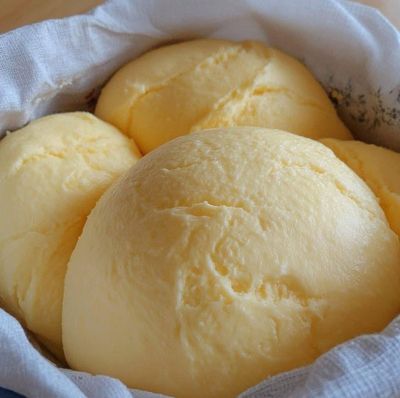
The quintessential French enriched yeast dough featuring butter and eggs for unmatched richness and tender crumb. This silky, golden dough is the foundation for elegant brioches, pastries, and breakfast breads. The long refrigeration develops flavor and makes the dough easier to shape. A showstopper on any breakfast or dessert table.

Croissants
Croissant dough is a laminated dough that requires patience and precise technique to achieve its characteristic flaky layers. The interplay between enriched dough and butter layers, combined with careful folding and resting, creates the golden, buttery texture that defines a perfect croissant. This dough demands attention to temperature control and timing throughout its preparation.
Pains au Chocolat
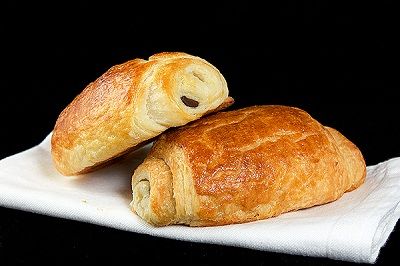
Pains au chocolat are French pastries made from laminated croissant dough enclosing dark chocolate sticks. The butter-layered dough creates a crispy, flaky exterior while the chocolate melts into the warm pastry. They're ideal for breakfast or afternoon tea, and freezing capability makes them practical for baking in advance.
More like this

Acar Timun
Cucumber, carrot, shallot, chilli prep into thin slices or matchsticks. Salt rests for 10 minutes to draw moisture, drains. A simple dressing of vinegar, sugar, water and ginger whisks together. Vegetables toss with the dressing; rest for 1 hour at room temperature. Eats cool, never refrigerated cold; the texture suffers.
Adobong Sitaw
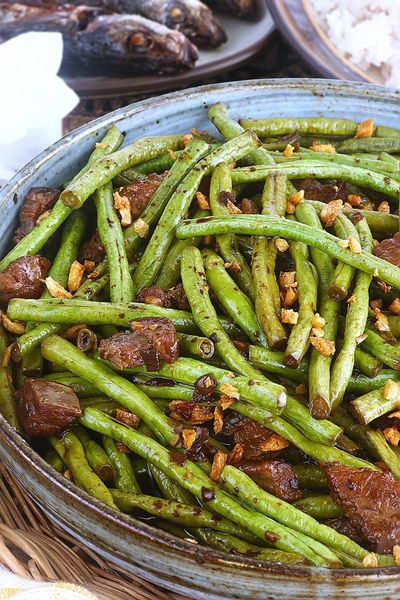
Garlic browns in oil; long beans toss in to colour briefly. Soy and vinegar pour in with bay and peppercorns; the beans braise covered until tender. Lid off; the liquid reduces to a glaze. Salt at the end, not the start, since soy is salty enough.
Ajad
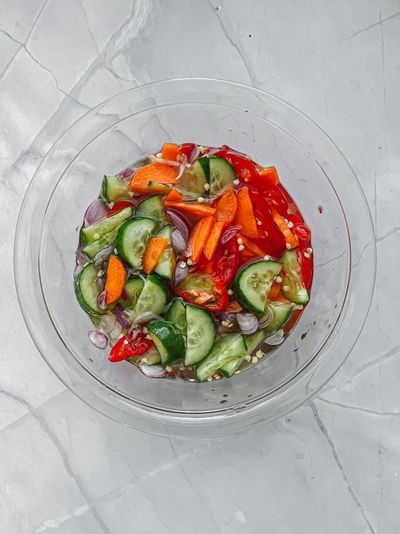
A simple syrup of rice vinegar, palm sugar, water and salt is brought to a gentle simmer to dissolve the sugar, then cooled. Cucumber, shallot and chilli are sliced thin and combined in a small bowl. The cooled syrup is poured over. Rested for 10-15 minutes for the vegetables to wilt slightly into the dressing. Served in small individual ramekins as a dip, OR in a larger bowl as a side, with peanuts sprinkled on top.

Atchara
Green papaya is peeled, seeded and shredded on a coarse grater. Carrot, ginger, garlic, red pepper, onion and raisins are all prepared in matching shreds. The vegetables are salted and rested for 1 hour to draw water; rinsed and squeezed dry. A syrup of cane vinegar, sugar and whole peppercorns simmers for 5 minutes. Hot syrup is poured over the vegetables in a sterilised jar. The jar is sealed, cooled and refrigerated overnight before eating. Improves over the following week.