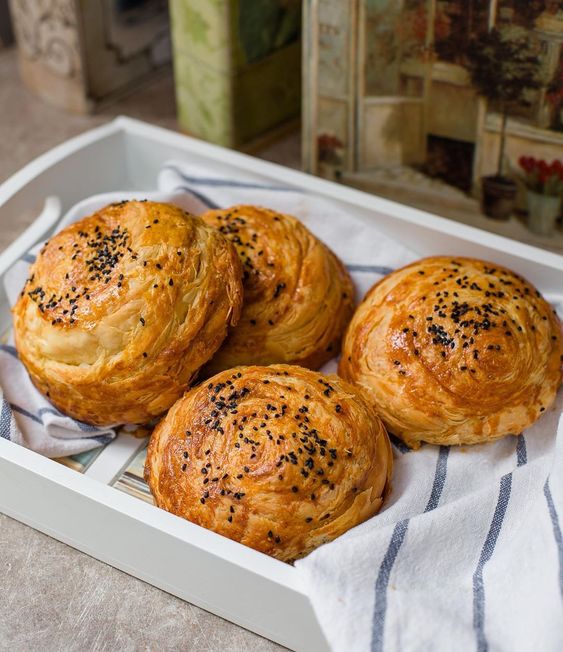
Goghal
Azerbaijan's spiced flaky pastry: laminated dough layered with butter and a heady mix of black pepper, caraway and saffron. Eaten with sweet tea.
Overview
A spiced flaky pastry from Azerbaijan's tea table, traditionally baked for Novruz alongside pakhlava and shekerbura, eaten with strong sweet tea any time of year. You make a yeasted milk-and-egg dough and let it rest for an hour, while you build a savoury-sweet spice mix from black pepper, caraway, fennel, saffron and a hard cheese-like crumble (Azerbaijani gurut, or a substitute). The dough rolls thin, brushes with butter, gets a scatter of spice; folds, rolls, sprinkles again, repeated three times in the same lamination motion you'd use for puff pastry. The final dough rolls to a centimetre thick, cuts into rounds with the rim of a glass, takes an egg wash for shine, and bakes at 180°C for twenty-five minutes until deep golden. Eaten with sweet black tea and a small dish of jam on the side.
Ingredients
Dough
- 500 g plain flour
- 7 g instant yeast (1 sachet)
- 1 teaspoon salt
- 1 teaspoon caster sugar
- 250 ml warm milk
- 2 eggs (large)
- 50 g unsalted butter (melted, plus extra for laminating)
Spice paste
- 80 g unsalted butter (softened)
- 1 tablespoon coarse-ground black pepper
- 1 teaspoon caraway seeds (lightly crushed)
- 1 teaspoon fennel seeds (lightly crushed)
- 1 teaspoon ground turmeric
- 1 pinch saffron threads (steeped in 1 tablespoon hot water)
- 50 g aged sheep's cheese, grated (or pecorino as a substitute)
Glaze
- 1 egg yolk
- 1 tablespoon milk
- 1 teaspoon black caraway (or nigella seeds, kalonji)
- 1 teaspoon sesame seeds
Method
Stage 1 - Dough
- In a wide bowl, whisk the flour, yeast, salt and sugar.
- In a jug, combine warm milk, eggs and melted butter.
- Pour wet into dry; mix to a shaggy mass.
- Knead 8-10 minutes (or 6 in a stand mixer) until smooth and elastic.
- Rest in a lightly oiled bowl, covered, 1 hour or until doubled.
Stage 2 - Spice paste
- Mash the softened butter with the black pepper, caraway, fennel, turmeric, saffron infusion and grated cheese.
- The paste should be spreadable.
Stage 3 - Laminate
- Punch the dough down; turn onto a lightly floured surface.
- Roll to a rectangle 40 × 30 cm, 5 mm thick.
- Spread a third of the spice paste over the rectangle.
- Fold into thirds like a letter (long-side fold).
- Roll out again to 40 × 30 cm; spread another third; fold.
- Repeat once more with the last of the paste.
Stage 4 - Cut and shape
- Roll the final folded dough to a rectangle 1 cm thick.
- Cut into 12 rounds with a 7 cm glass or cutter.
- Place on a parchment-lined baking tray, spaced 3 cm apart.
- Rest 15 minutes (the layers relax).
Stage 5 - Bake
- Heat the oven to 180°C (160°C fan).
- Whisk the egg yolk with milk; brush the tops.
- Scatter nigella and sesame seeds.
- Bake 25 minutes until deep gold; the layers should visibly puff and separate at the edges.
Stage 6 - Serve
- Cool 10 minutes on the tray.
- Serve warm with strong sweet tea.
Notes
- Cold butter for lamination: if the butter softens too much during folding, chill the dough 15 minutes between turns.
- Crushed pepper, not ground: the cracked pepper gives little nuggets of heat that ground pepper lacks. Use a mortar.
- Aged sheep's cheese gives goghal its bite: pecorino romano works well as a substitute for Azeri gurut.
Storage
- Keep 3 days at room temperature in an airtight container.
- Warm briefly in a 150°C oven 5 minutes before serving to revive the flaky layers.
- Freezes 2 months in a sealed bag; thaw at room temperature, then warm as above.
More like this
Kete (Azerbaijani Herb-Stuffed Flatbread)
A bread from the mountain villages of Azerbaijan and the wider Caucasus, the kind of thing a family bakes on a Saturday morning and eats through the week with cheese, with stew, on its own with tea. You make a simple yeasted milk-and-egg dough and let it rise for an hour, while you slowly soften onions in butter until they're pale gold and sweet. The onions cool and mix with chopped fresh coriander, dill, mint, spring onion and a knob more butter for the filling. The dough divides into six balls, each rolls flat, gets a heap of filling, gathers up into a purse, presses flat to a twelve-centimetre disc, then rolls under a pin to a centimetre thick. Pan-fry on a dry hot skillet for four minutes per side, or bake at 200°C for fifteen minutes if you'd rather a more even browning. Eaten hot, torn and shared, with a glass of buttermilk or strong tea.
Feteer Meshaltet
A soft elastic dough rests; divides into 2 balls. Each ball stretches paper-thin on a heavily-oiled / ghee-buttered surface (similar to msemen or yufka, translucent dough). Layered with melted ghee between folds: stretch → ghee → fold into thirds → quarter-turn → stretch → ghee → fold. Repeated 3 times per ball. The two folded packets place stacked on top of each other in a buttered round dish (about 24 cm). Baked at 220°C 25-30 minutes until amber, golden, and the layers have separated dramatically. Served warm with honey, soft cheese, or molasses-and-tahini (the Egyptian classic dip).
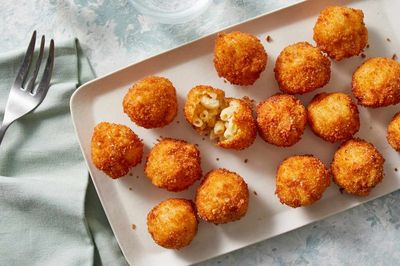
Mac 'n' Cheese Bites
Make a stiff mac-and-cheese, sharp cheddar, parmesan, a touch of mustard, just enough béchamel to bind, no more. Spread in a parchment-lined 20×20 cm tin; level; chill 4+ hours till firm. Lift out; cut into 3 cm cubes. Each cube dips in flour → egg → seasoned panko. Deep-fries for 2-3 minutes at 175°C until amber-gold. Drains briefly. Eats hot with ranch or chipotle mayo.
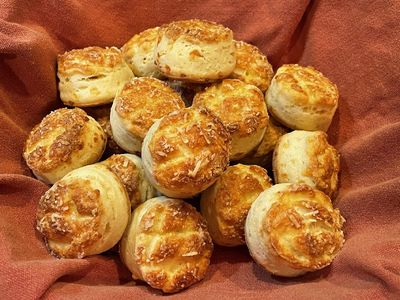
Pogácsa
A yeast-leavened, fat-rich dough rests cold so the fat stays solid in flaky layers. The dough is rolled, folded and rolled again like a rough puff pastry, then cut into rounds, scored, brushed with egg and baked at high heat until golden and crisp on the outside, tender inside. Cheese is added by folding grated cheese into the dough and showering more on top.