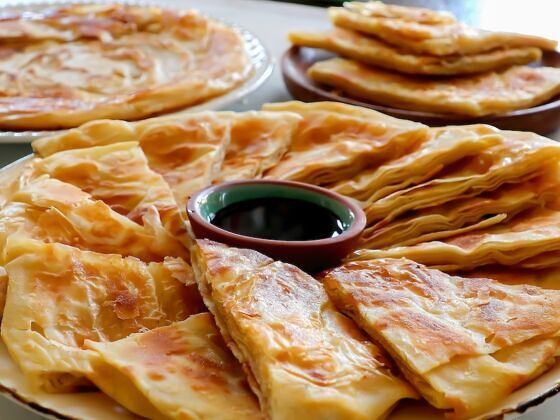
Feteer Meshaltet
Egypt's pillowy pastry: paper-thin dough folded with ghee into a square and baked till amber, the layers steaming soft inside.
Overview
A soft elastic dough rests; divides into 2 balls. Each ball stretches paper-thin on a heavily-oiled / ghee-buttered surface (similar to msemen or yufka, translucent dough). Layered with melted ghee between folds: stretch → ghee → fold into thirds → quarter-turn → stretch → ghee → fold. Repeated 3 times per ball. The two folded packets place stacked on top of each other in a buttered round dish (about 24 cm). Baked at 220°C 25-30 minutes until amber, golden, and the layers have separated dramatically. Served warm with honey, soft cheese, or molasses-and-tahini (the Egyptian classic dip).
Ingredients
Dough
- 400 g plain flour
- ½ teaspoon salt
- 1 teaspoon caster sugar
- 1 egg (large)
- 60 ml whole milk (warm)
- 200 ml water (warm)
- 1 teaspoon fast-action yeast (optional; some recipes skip; gives slightly puffier result)
For laminating
- 150 g ghee (or unsalted butter, melted, Egyptian feteer traditionally uses samna, which is clarified butter / ghee)
Sweet topping (choose one or assemble at the table)
- Honey (or date molasses)
- A drizzle of tahini whisked with the molasses
- Soft white cheese (like a mild Egyptian areesh, or substitute ricotta)
- Sweetened condensed milk
- Powdered sugar dusting
Savoury topping (optional - for the assembled meshaltet)
- 150 g feta cheese (crumbled)
- 50 g melting cheese (mozzarella, grated)
- 2 tablespoons fresh dill (chopped)
Method
Stage 1 - Dough
- Whisk flour, salt, sugar and (if using) yeast in a wide bowl.
- Whisk milk + water + egg in a jug.
- Add wet to dry; mix to a soft sticky dough.
- Knead 10 minutes by hand - the dough should be very soft and elastic. Add a tablespoon of water if too dry, or a tablespoon of flour if unmanageably wet.
- Rest in an oiled bowl, covered, 30 minutes.
Stage 2 - Divide and oil
- Divide into 2 balls.
- Cover each with a generous layer of melted ghee. Let stand 10 minutes (the ghee softens the dough surface for stretching).
Stage 3 - Stretch first time
- Heavily ghee a wide work surface.
- Take one ball; flatten gently with palms; pull and stretch outward into a paper-thin square / circle 40 cm across (similar technique to filo / yufka - translucent in the centre).
- Drizzle 2 tablespoons of melted ghee across the surface; spread with fingers.
Stage 4 - Fold (lamination)
- Fold the stretched dough into thirds (like a letter): left edge over centre, right edge over.
- Drizzle 1 tablespoon ghee.
- Quarter-turn (90°).
- Stretch again into a smaller rectangle (about 30 cm × 20 cm).
- Drizzle ghee.
- Fold into thirds the other way.
- Drizzle ghee.
- You should now have a thick packet about 12 cm square.
Stage 5 - Repeat with second ball
Stage 6 - Final assembly
- Heat oven to 220°C (200°C fan).
- Ghee a 24 cm round oven dish (or baking tin).
- Place one folded packet in the centre.
- Gently flatten with your palm into a disc 20 cm across.
- Drizzle ghee.
- Stack the second packet on top; flatten to match.
- Drizzle ghee generously over the top.
Stage 7 - Bake
- Bake 22-28 minutes until deep golden brown on top, with visible flaky layers at the edges and dramatic puffing.
Stage 8 - Serve
- Cool 5 minutes.
- Cut into wedges with a sharp knife.
- Set out toppings: honey, date molasses, tahini, ricotta-style cheese.
- Tear and dip, or layer toppings inside the warm wedges.
Notes
- Stretch paper-thin: The signature of feteer is the dramatic flaky-layered cross-section. That happens only if each ball is stretched truly translucent - you should see your hand through the dough. Tears are fine; they fold over.
- Ghee, generously: Don't be timid with the fat between layers. Feteer is rich by design; sparingly-oiled feteer is flat and bread-like.
- Hot oven, short bake: 220°C is right. Lower temperatures give pale, undercooked layers. The bake is short (~25 min) because the dough is already thin.
Storage
- Best within 4 hours of baking.
- Refrigerate 2 days; warm at 200°C 6 minutes (microwave makes it soggy).
- The layers stale relatively fast; freeze cooked feteer wrapped tightly 1 month; warm at 200°C 12 minutes from frozen.
More like this
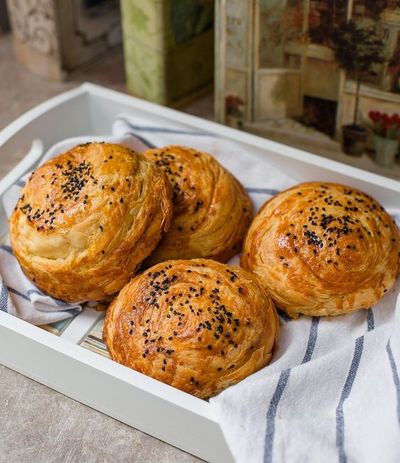
Goghal
A spiced flaky pastry from Azerbaijan's tea table, traditionally baked for Novruz alongside pakhlava and shekerbura, eaten with strong sweet tea any time of year. You make a yeasted milk-and-egg dough and let it rest for an hour, while you build a savoury-sweet spice mix from black pepper, caraway, fennel, saffron and a hard cheese-like crumble (Azerbaijani gurut, or a substitute). The dough rolls thin, brushes with butter, gets a scatter of spice; folds, rolls, sprinkles again, repeated three times in the same lamination motion you'd use for puff pastry. The final dough rolls to a centimetre thick, cuts into rounds with the rim of a glass, takes an egg wash for shine, and bakes at 180°C for twenty-five minutes until deep golden. Eaten with sweet black tea and a small dish of jam on the side.
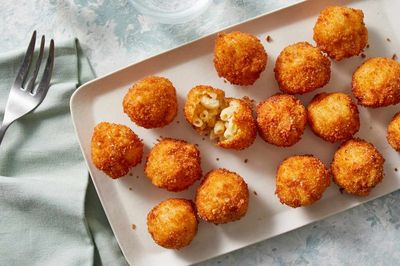
Mac 'n' Cheese Bites
Make a stiff mac-and-cheese, sharp cheddar, parmesan, a touch of mustard, just enough béchamel to bind, no more. Spread in a parchment-lined 20×20 cm tin; level; chill 4+ hours till firm. Lift out; cut into 3 cm cubes. Each cube dips in flour → egg → seasoned panko. Deep-fries for 2-3 minutes at 175°C until amber-gold. Drains briefly. Eats hot with ranch or chipotle mayo.
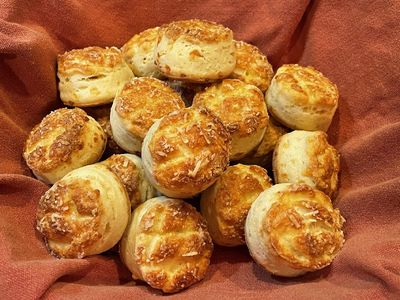
Pogácsa
A yeast-leavened, fat-rich dough rests cold so the fat stays solid in flaky layers. The dough is rolled, folded and rolled again like a rough puff pastry, then cut into rounds, scored, brushed with egg and baked at high heat until golden and crisp on the outside, tender inside. Cheese is added by folding grated cheese into the dough and showering more on top.
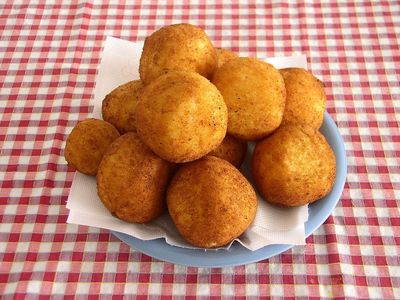
Arancini
Cold risotto (saffron Milanese-style is traditional in arancini "alla Milanese"; plain works too) is mixed with grated parmesan and beaten egg to bind. Filling, a stew of beef-and-pork ragù with peas, OR a cube of mozzarella, sits in the centre of each ball. Hands wet with water shape the rice around the filling into a tight orange-sized ball (or cone, for the Catania style). Each ball is rolled first in flour, then in beaten egg, then in fine breadcrumbs (or in the doubled-up "panata" mix of flour + water for the Sicilian original). Deep-fried at 180°C in 4-5 cm of oil for 4-6 minutes per ball until deep gold. Drained on kitchen paper; eaten warm.