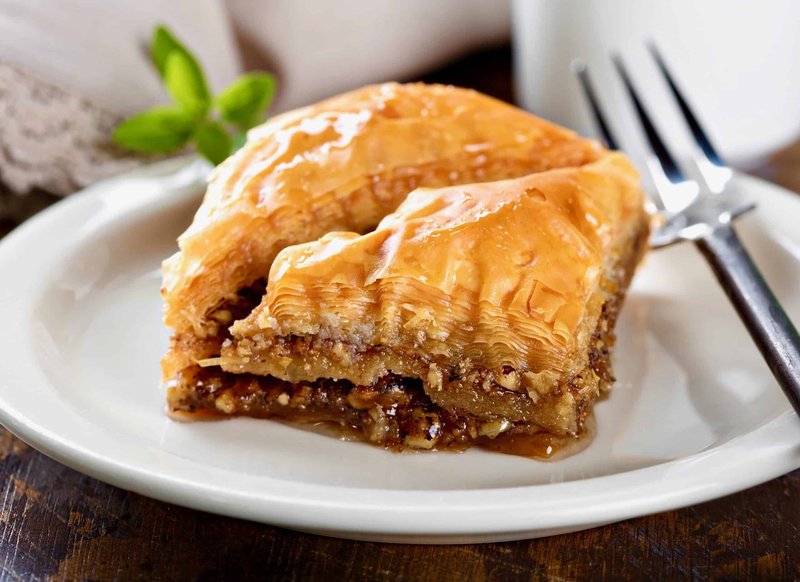
Greek Baklava
Greece's defining filo dessert: layered pastry packed with walnut and cinnamon, soaked in lemon-honey syrup. A clove pegs each diamond square.
Overview
A 30 × 22 cm tin is built in layers: 8 buttered filo sheets on the bottom; walnut-cinnamon filling; 4 buttered filo sheets; more walnut; 4 more filo; walnut; finally 8 more buttered filo on top. The top is scored into squares; a clove is pressed into the centre of each. Baked for 45 minutes at 180°C till amber. Syrup of honey, sugar, water, lemon and cinnamon stick simmers separately. The COOL syrup is poured over the HOT baklava. Rested overnight, non-negotiable.
Ingredients
Filling
- 600 g walnuts (roughly chopped, not powdered - a coarse grind keeps texture)
- 100 g caster sugar
- 2 teaspoons ground cinnamon
- ½ teaspoon ground cloves
- 1 teaspoon orange zest (optional)
Pastry
- 24 sheets filo pastry (approx 30 × 22 cm)
- 250 g unsalted butter (melted)
Topping
- 24 whole cloves
Syrup
- 250 g caster sugar
- 200 ml water
- 200 g clear honey
- 1 strip lemon peel
- 1 cinnamon stick
- 2 tablespoons lemon juice
Method
Stage 1 - Filling
- Chop the walnuts coarse with a knife (don't use a food processor - it pulverises). The texture should be like coarse couscous.
- In a bowl, mix the walnuts with the sugar, cinnamon, cloves and optional orange zest.
Stage 2 - Syrup (made first to cool)
- Combine sugar, water, honey, lemon peel and cinnamon stick in a saucepan.
- Bring to a simmer; cook 10 minutes.
- Stir in the lemon juice; remove from heat.
- Cool completely (this is the cold side of the temperature gap).
Stage 3 - Build the pastry
- Heat the oven to 180°C (160°C fan).
- Brush a 30 × 22 cm baking tin with melted butter.
- Lay 8 sheets of filo in the tin, brushing each with butter (don't be stingy - every layer needs butter).
- Sprinkle one-third of the walnut mixture evenly.
- Add 4 more buttered filo sheets.
- Sprinkle another third of the walnut mixture.
- Add 4 more buttered filo sheets.
- Sprinkle the final third of the walnut mixture.
- Add the final 8 buttered filo sheets.
- Brush the top with the remaining butter.
Stage 4 - Score and clove
- With a sharp thin knife, score the top into squares - long cuts at 4 cm intervals, cross cuts at 4 cm intervals.
- Important: cut all the way down through every layer (different from galaktoboureko).
- Press a whole clove into the centre of each square.
Stage 5 - Bake
- Bake 45-50 minutes until the top is amber-gold and the layers visibly puffed.
Stage 6 - Pour syrup
- Remove from oven.
- Slowly pour the COOL syrup evenly over the HOT baklava.
- The syrup will hiss; the temperature gap drives absorption into the layers.
Stage 7 - Rest
- Cool completely in the tin (about 2 hours).
- Rest overnight at room temperature, UNCOVERED.
Stage 8 - Serve
- The pre-cut squares lift out cleanly with a small palette knife.
- Pluck the clove out before eating (or leave for the diner to remove).
- Serve with strong Greek coffee.
Notes
- Walnuts, not pistachios: Greek baklava is walnut-forward. The Turkish pistachio version is excellent but different.
- Cut all the way down BEFORE baking: unlike galaktoboureko, baklava is cut through. This is what gives the syrup absorption path.
- COOL syrup on HOT baklava: the Greek convention is opposite to galaktoboureko. Hot-on-hot makes a sticky mess; cool-on-hot drives the syrup into the layers cleanly.
- Overnight rest: every Greek grandmother insists. The flavours fuse, the syrup distributes, the texture sets. Cut too early and you get a soggy crumbly mess.
- Don't refrigerate: baklava sweats in the fridge and the filo softens. Room temperature only.
Storage
- Keeps 2 weeks at room temperature in a sealed tin.
- The texture peaks on day 2-3.
- Freezes 3 months pre-cut between parchment; thaw at room temperature.
Recipes mentioned here
Filo Pastry
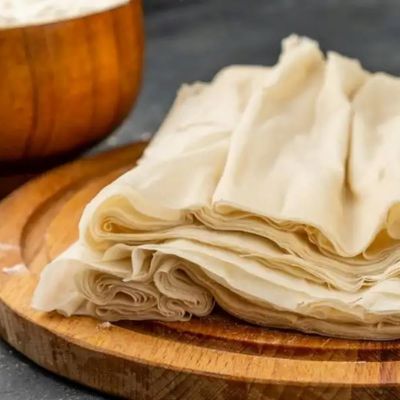
Filo pastry is an extraordinarily thin, delicate dough that requires skill and patience to master but rewards the effort with its ethereal, crispy layers. Unlike laminated doughs, filo is stretched by hand to transparent thinness, creating a unique texture. Its versatility allows it to be used for both sweet and savory preparations, showcasing fillings visually while providing a delicate crunch.
Galaktoboureko
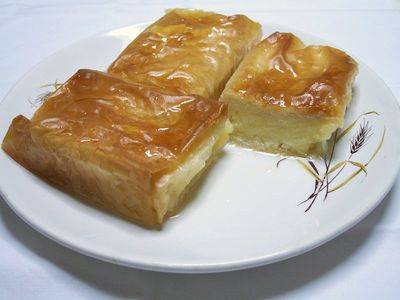
A semolina custard is simmered on the stove, milk, semolina, sugar, lemon zest, eggs, until thick. Off heat, butter and vanilla are stirred in. A 30 × 22 cm tin is layered with 10 sheets of buttered filo on the bottom. The custard is poured in. 8 more buttered filo sheets cover. The top is scored into diamonds. Baked for 45 minutes at 180°C till deep gold. While baking, a syrup of sugar, water, lemon juice and cinnamon stick simmers. The HOT syrup is poured over the just-OUT-OF-OVEN galaktoboureko. Rested for 4 hours minimum (overnight ideal) before cutting.
Baklava
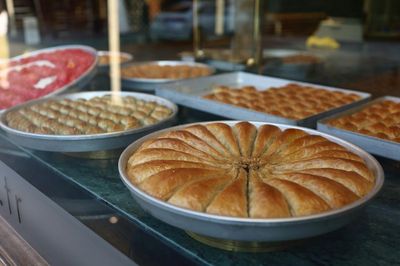
A Middle Eastern delicacy of honey-soaked, crispy-layered filo pastry studded with pistachios and warm spices, cut into diamonds and served at room temperature. This globally beloved pastry achieves its legendary texture through careful assembly and the crucial overnight soaking that allows the honey syrup to penetrate all layers while maintaining crispness.
More like this
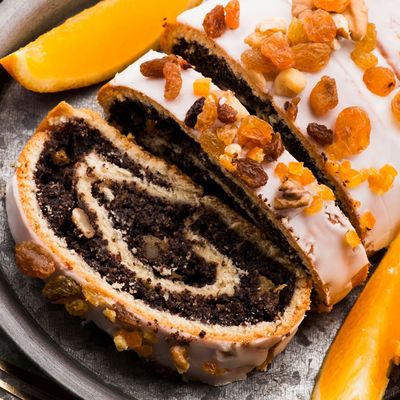
Makowiec
The filling starts the night before: poppy seeds soak then simmer in milk and cook to a thick paste with honey, butter, vanilla, raisins, walnuts and candied peel. The next day, an enriched yeast dough rolls into a thin rectangle, spreads thickly with the cold poppy filling, and rolls into a tight log. After a final prove, it bakes in a long tin until the dough is bronze. Once cool, a thin lemon glaze drizzles across the top and a scatter of candied peel finishes it.
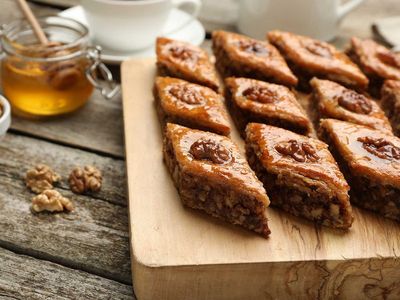
Pakhlava (Azerbaijani)
The Azerbaijani take on the pan-Caucasus pastry that goes by half a dozen names across the region. You make an enriched dough from flour, butter, milk, egg yolks and yeast, then roll it into eight layers stacked with a heavy filling of crushed walnuts spiced with cardamom and saffron between each one. The top gets scored in the traditional diamond pattern, brushed with saffron-tinted egg yolk so it bakes to a deep amber, and a single walnut pressed into the centre of each diamond as a marker. Forty-five minutes at 180°C, then a saffron-honey syrup poured generously over while it's still hot from the oven. The trick the recipe insists on is the overnight rest before slicing; that's when the syrup absorbs fully and the layers set so the diamonds cut cleanly. Eaten at Novruz, weddings and feast days, with strong black tea on the side.
Galaktoboureko
A semolina custard is simmered on the stove, milk, semolina, sugar, lemon zest, eggs, until thick. Off heat, butter and vanilla are stirred in. A 30 × 22 cm tin is layered with 10 sheets of buttered filo on the bottom. The custard is poured in. 8 more buttered filo sheets cover. The top is scored into diamonds. Baked for 45 minutes at 180°C till deep gold. While baking, a syrup of sugar, water, lemon juice and cinnamon stick simmers. The HOT syrup is poured over the just-OUT-OF-OVEN galaktoboureko. Rested for 4 hours minimum (overnight ideal) before cutting.
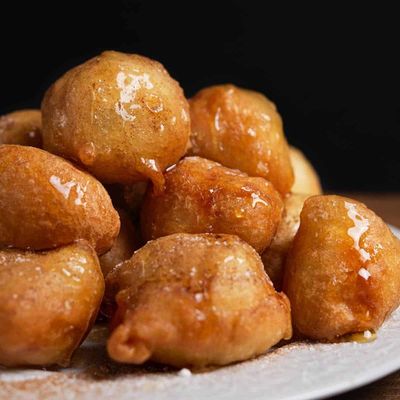
Loukoumades
A wet yeasted batter, flour, warm water, yeast, salt, sugar, rests for 1 hour. A small syrup of honey, water, lemon and cinnamon stick simmers for 5 minutes. Oil heats to 175°C. The cook scoops a tablespoon of batter at a time from a wet hand, dropping into the oil, the puff is roughly walnut-sized. Fries for 2-3 minutes till deep gold, turning once. Drains briefly; tumbles into the warm syrup; lifts onto plates; showers with walnuts and cinnamon. Eats immediately.