
Pakhlava (Azerbaijani)
Azerbaijan's pakhlava: butter-laminated layers packed with cardamom-and-saffron walnuts, glazed with saffron honey and cut into diamonds.
Overview
The Azerbaijani take on the pan-Caucasus pastry that goes by half a dozen names across the region. You make an enriched dough from flour, butter, milk, egg yolks and yeast, then roll it into eight layers stacked with a heavy filling of crushed walnuts spiced with cardamom and saffron between each one. The top gets scored in the traditional diamond pattern, brushed with saffron-tinted egg yolk so it bakes to a deep amber, and a single walnut pressed into the centre of each diamond as a marker. Forty-five minutes at 180°C, then a saffron-honey syrup poured generously over while it's still hot from the oven. The trick the recipe insists on is the overnight rest before slicing; that's when the syrup absorbs fully and the layers set so the diamonds cut cleanly. Eaten at Novruz, weddings and feast days, with strong black tea on the side.
Ingredients
Dough
- 500 g plain flour
- 7 g instant yeast
- 1 teaspoon salt
- 50 g caster sugar
- 200 ml warm milk
- 3 egg yolks (large)
- 150 g unsalted butter (melted, cooled)
Layer butter
- 200 g unsalted butter (melted, kept warm)
Filling
- 500 g walnuts (medium-ground)
- 250 g caster sugar
- 2 teaspoons ground cardamom
- 1 pinch saffron threads (ground, steeped in 1 tablespoon hot water)
Glaze and toppers
- 1 egg yolk (large)
- 1 pinch saffron threads (steeped in 1 tablespoon hot water)
- 24 whole almonds
Syrup
- 200 g caster sugar
- 200 ml water
- 100 g clear honey
- 1 small pinch saffron threads
- 1 tablespoon lemon juice
Method
Stage 1 - Dough
- In a wide bowl, whisk flour, yeast, salt and sugar.
- Combine warm milk, egg yolks and 150 g melted butter in a jug.
- Pour wet into dry; knead 8 minutes to a smooth elastic dough.
- Rest in a covered bowl 1 hour.
Stage 2 - Filling
- Grind walnuts to medium-fine in a food processor (not paste).
- Stir in caster sugar, cardamom and saffron infusion.
Stage 3 - Build the layers
- Heat the oven to 180°C (160°C fan).
- Butter a 28 × 22 cm baking tin.
- Knock back the dough; divide into 8 equal portions.
- Roll the first portion to fit the tin; lay it in; brush generously with melted butter.
- Sprinkle a generous handful of walnut filling evenly.
- Roll the next portion; lay on top; brush with butter; sprinkle filling.
- Repeat for layers 3 through 7.
- Roll the eighth and final portion; lay on top; brush with butter.
Stage 4 - Score, glaze, top
- With a sharp thin knife, score the top layer (cutting through ONLY the top layer, not all the way down) in a diamond pattern: parallel diagonal lines 4 cm apart, then crossing diagonal lines 4 cm apart.
- Whisk the saffron infusion into the egg yolk; brush over the top.
- Press a whole almond into the centre of each diamond.
Stage 5 - Bake
- Bake 45-50 minutes until deeply golden on top and the layers separate cleanly when you tap the side.
- Remove from oven.
Stage 6 - Syrup
- While the pakhlava bakes, combine sugar, water, honey and saffron in a small pan.
- Bring to a simmer; cook 10 minutes until lightly thickened.
- Stir in the lemon juice; remove from heat.
Stage 7 - Pour and rest
- While the pakhlava is still hot, slowly pour the warm syrup evenly over the entire surface - about ½ small ladle per diamond.
- The syrup will hiss, foam briefly and absorb.
- Cool fully in the tin.
- Rest overnight at room temperature, uncovered.
Stage 8 - Slice and serve
- Re-trace the scored diamond lines with a sharp knife, cutting all the way down through the layers.
- Lift each diamond out with a small palette knife.
- Serve with strong tea.
Notes
- Score only the top layer before baking: cutting all the way down separates the layers and the syrup runs out during the bake.
- Hot pakhlava, warm syrup: the temperature difference drives absorption. Cold syrup on hot pakhlava is fine; cold syrup on cold pakhlava sits on top.
- Overnight rest is mandatory: cutting too early means crumbly diamonds and uneven syrup distribution.
- 8 layers is the Azeri count: Turkish baklava uses 30+ paper-thin filo sheets; Azeri pakhlava uses fewer, thicker, butter-laminated layers. Each layer is its own piece of dough, not a sheet of filo.
Storage
- Keeps 2 weeks in an airtight tin at room temperature.
- Freezes 3 months pre-cut, separated by parchment; thaw at room temperature 2 hours.
- Don't refrigerate - moisture turns the layers soggy.
More like this
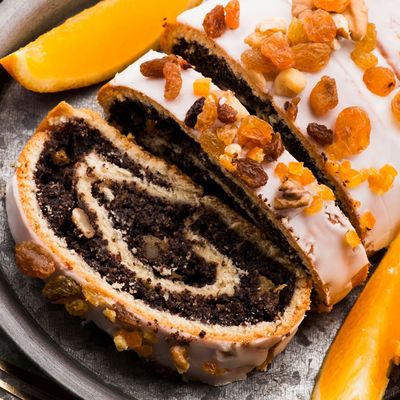
Makowiec
The filling starts the night before: poppy seeds soak then simmer in milk and cook to a thick paste with honey, butter, vanilla, raisins, walnuts and candied peel. The next day, an enriched yeast dough rolls into a thin rectangle, spreads thickly with the cold poppy filling, and rolls into a tight log. After a final prove, it bakes in a long tin until the dough is bronze. Once cool, a thin lemon glaze drizzles across the top and a scatter of candied peel finishes it.
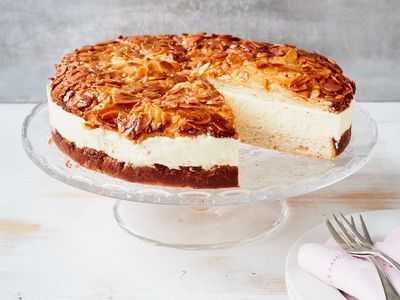
Bienenstich
A milk-and-butter enriched yeast dough proves to soft and pillowy. A honey-almond topping (butter, honey, sugar, cream, flaked almonds) cooks on the stovetop until thickly bubbling, then spreads on the proved dough and bakes together: the dough rises, the topping caramelises golden and chewy. Once cooled, the cake splits horizontally and fills with thick vanilla pastry cream (Konditorcreme) lightened with whipped cream.
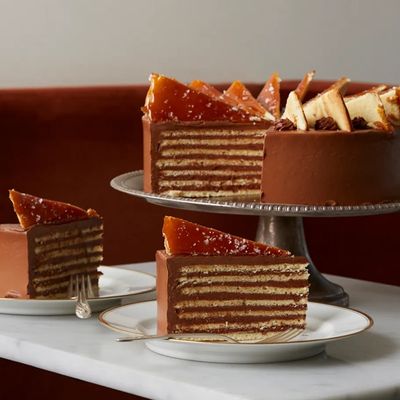
Dobos Torte
Six thin sponge discs are baked separately at high heat for 6-8 minutes each. Five are layered with a French-style chocolate buttercream made from a hot sugar syrup whipped into yolks then enriched with butter and melted dark chocolate. The sixth disc gets glazed with hard caramel while still warm, marked into twelve wedges before it sets, and crowns the cake. Sides masked with more buttercream and dusted with toasted chopped hazelnuts.
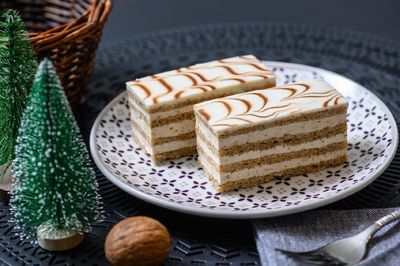
Eszterházy Torte
Five thin discs of almond-meringue (a French dacquoise) bake low and slow. They sandwich with a cognac and vanilla French-style buttercream (a pâte à bombe enriched with butter). The top is sealed with a thin layer of buttercream then iced with white fondant; melted dark chocolate is piped in concentric circles into the wet fondant and pulled into a spider-web with a skewer. Sides masked with toasted flaked almonds.