Makowiec
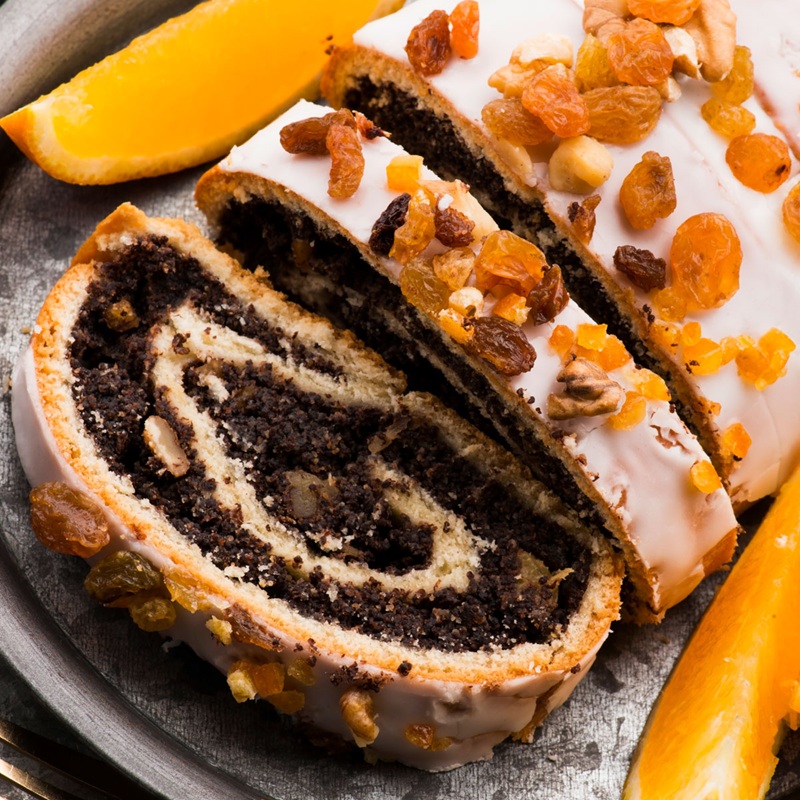
Poland's poppy-seed rolled cake: a yeasted dough spread with a sweetened poppy-seed paste flecked with raisins, walnuts and candied orange. Iced.
Overview
The filling starts the night before: poppy seeds soak then simmer in milk and cook to a thick paste with honey, butter, vanilla, raisins, walnuts and candied peel. The next day, an enriched yeast dough rolls into a thin rectangle, spreads thickly with the cold poppy filling, and rolls into a tight log. After a final prove, it bakes in a long tin until the dough is bronze. Once cool, a thin lemon glaze drizzles across the top and a scatter of candied peel finishes it.
Ingredients
Poppy-seed filling (make the night before)
- 300 g blue poppy seeds (whole; ground if you can get them, see Notes)
- 500 ml whole milk
- 100 g unsalted butter
- 120 g caster sugar
- 80 g runny honey
- 80 g raisins
- 80 g chopped walnuts
- 50 g candied orange peel (finely chopped)
- 2 tablespoons rum (or dark rum, optional)
- 1 teaspoon vanilla extract
- 1 lemon (zest)
- 2 egg whites (large)
- A pinch of salt
Yeast dough
- 400 g strong white flour
- 7 g instant dried yeast (1 sachet)
- 60 g caster sugar
- 1 teaspoon salt
- 150 ml warm whole milk
- 2 egg yolks (large)
- 80 g unsalted butter (soft)
- ½ lemon (zest)
Egg wash
- 1 egg yolk
- 1 tablespoon milk
Lemon glaze
- 150 g icing sugar
- 2 tablespoons lemon juice (plus more to thin)
- 2 tablespoons finely chopped candied orange peel (to decorate)
Method
Stage 1 - Soak and grind the poppy seeds (night before)
- Place the poppy seeds in a bowl; cover with boiling water; leave 1 hour.
- Drain through fine muslin or a coffee filter (regular sieves let them through). Press out excess water.
- Tip into a heavy pan with the milk; simmer on low for 25-30 minutes until the milk is mostly absorbed.
- Once cooled, grind in batches in a clean coffee grinder, food processor or mortar until pasty. (Pre-ground poppy seeds skip steps 1-4: simmer them in the milk for 10 minutes, that's enough.)
- Refrigerate overnight.
Stage 2 - Finish the filling
- Melt the butter, sugar and honey together in a wide pan over low heat.
- Stir in the cooked poppy seeds, raisins, walnuts, candied peel, rum if using, vanilla and lemon zest.
- Cook on low for 10 minutes, stirring constantly, until thickened and smelling toasty.
- Cool to room temperature.
- Whisk the 2 egg whites with a pinch of salt to firm peaks; fold into the cool filling. This lightens it so it doesn't tear the dough.
Stage 3 - Yeast dough
- Whisk the flour, yeast, sugar, salt and lemon zest in a bowl.
- Beat the warm milk and egg yolks together; pour in.
- Mix to a shaggy dough; turn out and knead 8 minutes.
- Add the soft butter piece by piece, kneading in. Continue kneading 4-5 minutes more until silky and elastic.
- Cover; prove 1 hour in a warm place until doubled.
Stage 4 - Shape
- Line a 30 x 12 cm loaf tin with parchment, paper hanging over the long sides.
- Knock the dough back; roll on a lightly floured surface to a 35 x 30 cm rectangle (3 mm thick).
- Spread the cool poppy filling across, leaving a 2 cm clear border on all sides.
- Starting from a long edge, roll up tightly into a log, pinching the seam closed.
- Place seam-side down in the tin (curve to fit if needed).
- Cover loosely; prove 45 minutes in a warm place.
Stage 5 - Bake
- Heat the oven to 180°C (160°C fan).
- Whisk the egg yolk with the milk; brush over the log.
- Bake 40-45 minutes until deep golden and a skewer pushed in comes out clean.
- Cool in the tin 15 minutes; lift out by the parchment; cool completely on a rack.
Stage 6 - Glaze
- Whisk the icing sugar with the lemon juice to a thick but pourable consistency. Add a teaspoon more juice if needed.
- Drizzle across the top of the cooled log in thick lines.
- Scatter chopped candied peel along the wet glaze.
- Let the glaze set 30 minutes before slicing.
Stage 7 - Serve
- Slice into 2 cm rounds with a serrated knife. Each slice shows a dark spiral of poppy paste through the pale dough.
Notes
- Poppy seeds need cooking: Raw poppy seeds are bitter and hard. Soaking and simmering (or buying pre-ground) is essential. Pre-ground are sold as "mak mielony" in Polish shops or online; they save 90 minutes of work.
- Don't overfill: A thick spread is right; too thick and the roll splits. Leave the 2 cm border or filling oozes everywhere.
- Cool completely before glazing: A warm cake melts the glaze into the bread.
Variations
Walnut filling: Replace half the poppy seeds with ground walnuts for a milder makowiec-style cake. With candied citron: Use candied citron instead of orange; old-fashioned, Krakow style.
Serving
Serve with: A glass of strong tea or coffee. On the Christmas Eve table, makowiec sits alongside piernik (honey-spice cake) and kompot z suszu (dried-fruit compote).
Storage
- Keeps 5 days at room temperature, wrapped tightly.
- Freezes 2 months whole or sliced; defrost wrapped.
More like this
Pakhlava (Azerbaijani)
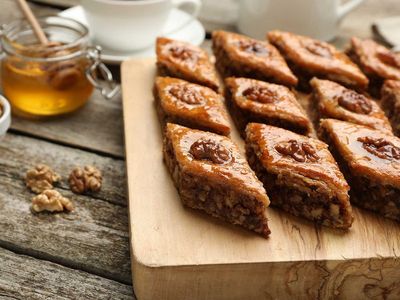
The Azerbaijani take on the pan-Caucasus pastry that goes by half a dozen names across the region. You make an enriched dough from flour, butter, milk, egg yolks and yeast, then roll it into eight layers stacked with a heavy filling of crushed walnuts spiced with cardamom and saffron between each one. The top gets scored in the traditional diamond pattern, brushed with saffron-tinted egg yolk so it bakes to a deep amber, and a single walnut pressed into the centre of each diamond as a marker. Forty-five minutes at 180°C, then a saffron-honey syrup poured generously over while it's still hot from the oven. The trick the recipe insists on is the overnight rest before slicing; that's when the syrup absorbs fully and the layers set so the diamonds cut cleanly. Eaten at Novruz, weddings and feast days, with strong black tea on the side.
Chocolate Babka
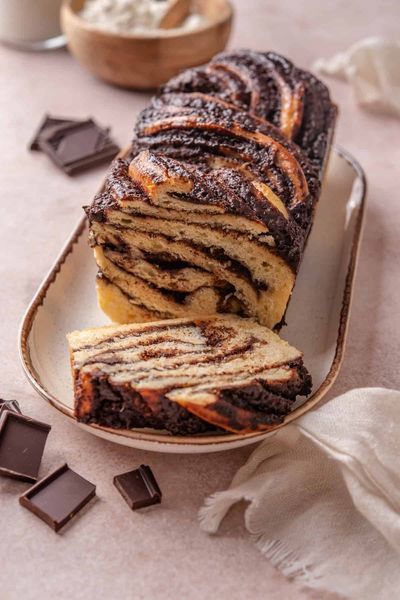
A rich enriched dough is mixed and kneaded; first rise overnight in the fridge for the best flavour and easier handling. The next day, the cold dough rolls into a wide rectangle; chocolate filling spreads thick to the edges; rolls into a tight log. The log is sliced lengthwise, twisted into a braid (cut sides facing up to expose the chocolate), tucked into a loaf tin and proofed. Bakes; brushes with sugar syrup hot from the oven.
Sernik
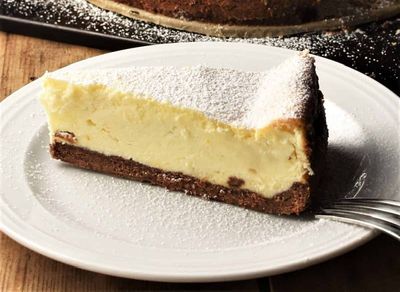
A buttery shortcrust pastry is pressed into a tin; a small piece is reserved for a lattice. Twaróg (the dry, tangy Polish curd cheese) is blended with butter, sugar, egg yolks, vanilla, lemon zest and a little semolina or cornflour. Whipped egg whites are folded in for lightness. The filling is poured onto the pastry, the lattice is criss-crossed on top, and it bakes at a moderate heat until just set. The cooling matters: rapid cooling cracks the top.
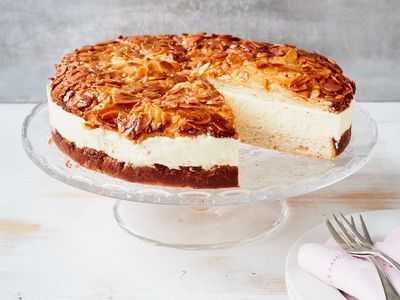
Bienenstich
A milk-and-butter enriched yeast dough proves to soft and pillowy. A honey-almond topping (butter, honey, sugar, cream, flaked almonds) cooks on the stovetop until thickly bubbling, then spreads on the proved dough and bakes together: the dough rises, the topping caramelises golden and chewy. Once cooled, the cake splits horizontally and fills with thick vanilla pastry cream (Konditorcreme) lightened with whipped cream.