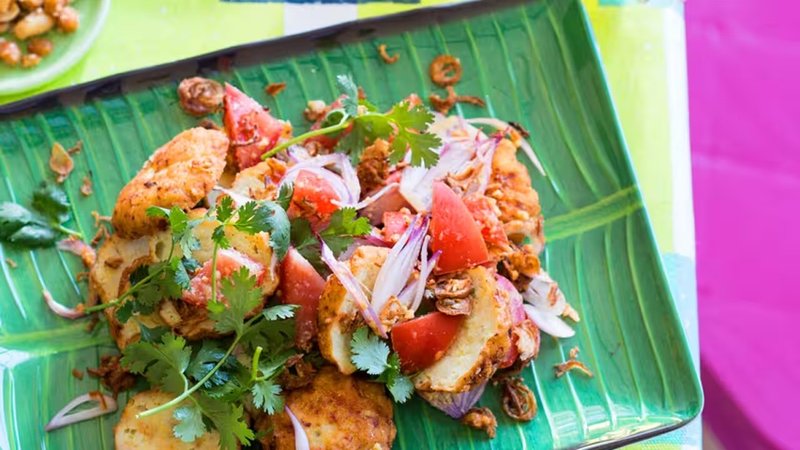
Nga Hpe (Burmese Fish Cakes)
Burma's teashop fish cakes: white fish minced with shallot, garlic, fish sauce, lime, chilli and curry leaves, shaped small and shallow-fried gold.
Overview
The Burmese fish cakes that arrive at lahpet-thoke salad tables and street snack stalls alike, bright with lime and curry leaf. You cube skinless firm fish fillets and pulse them in a food processor with shallot, garlic, ginger, lime, fish sauce and a small egg into a sticky paste. A spoon of beaten cornflour binds it. Curry leaves, sliced spring onion, chopped cilantro and a fresh chilli go in for fragrance and bite. Patties form by hand (keep your hands slightly damp so the mixture doesn't stick), then shallow-fry in batches at 170°C for two or three minutes per side until they're deep gold and crisp at the edges. Eaten warm with a sour-sweet tamarind dipping sauce.
Ingredients
- 500 g firm white fish fillets (cod, haddock, hake or pollock, skin and bones removed, cubed)
- 4 shallots (or 1 small red onion - finely chopped)
- 4 garlic cloves
- 1 thumb fresh ginger (grated)
- 1 lime (juice)
- 2 tablespoons fish sauce
- 1 egg (small)
- 3 tablespoons cornflour
- ½ teaspoon ground turmeric
- 1 small handful fresh curry leaves (chopped, or 1 small handful cilantro if curry leaves unavailable)
- 4 spring onions (sliced thin)
- 1 small handful fresh cilantro (chopped)
- 2 green chillies (finely chopped)
- ½ teaspoon ground black pepper
- ½ teaspoon salt
- 200 ml vegetable oil for shallow frying
To serve
- Lime wedges
- Sweet chilli sauce (or sahawiq-style green sauce)
- Sliced cucumber
Method
Stage 1 - Process
- Place the fish, shallot, garlic, ginger, lime juice, fish sauce and egg in a food processor.
- Pulse to a coarse paste - some texture is welcome. Don't run it smooth.
Stage 2 - Mix in herbs
- Tip into a bowl. Stir in cornflour, turmeric, curry leaves, spring onions, cilantro, green chillies, pepper and salt.
- Mix thoroughly with a spoon to a sticky, holding mixture.
Stage 3 - Shape
- Wet your hands. Form into 4 cm patties (about 2 tablespoons each); place on a tray.
- Refrigerate 10 minutes to firm up.
Stage 4 - Fry
- Heat 1 cm of oil in a wide pan to 170°C.
- Fry the patties in batches of 5-6, 2-3 minutes per side, until deep gold.
- Drain on kitchen paper.
Stage 5 - Serve
- Stack on a plate. Serve hot with lime, sweet chilli or green sauce, and cucumber.
Notes
- Don't over-process: A textured paste is right. Smooth fish paste gives a rubbery, bouncy cake; chunky paste gives a flakier, more interesting one.
- Curry leaves: The Burmese signature. If you can't find them, use a small handful more cilantro; the dish is fine but less distinctively Burmese.
- Damp hands: The mix is sticky; wet hands handle it cleanly.
Storage
- Best fresh. Refrigerate 2 days; re-crisp at 200°C 6 minutes.
- Freeze uncooked patties 2 months; fry from frozen, adding 2 minutes per side.
More like this
Mohinga
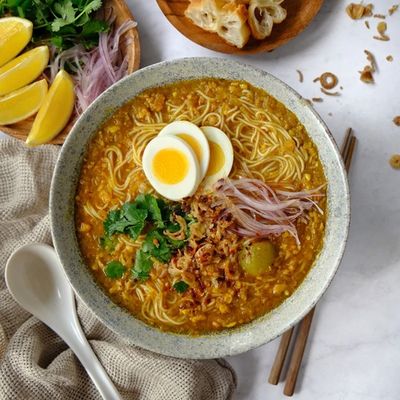
Myanmar's national breakfast, the rice-noodle soup that streetcorner stalls in every city open before dawn for. You cook catfish (or any firm white fish) in spiced water first, then shred the cooked flesh and turn the cooking liquid into the soup base. A spice paste of shallot, garlic, ginger, lemongrass and turmeric fries in oil; a chickpea-flour slurry thickens the broth to a silky consistency; banana-stem (or hearts of palm or cabbage as substitute) softens in. Fish sauce, paprika and lime balance the seasoning. Rice vermicelli portions into bowls, broth ladles over, and a heavy plate of garnishes arrives at the table: crispy split peas, halved boiled eggs, lime wedges, fresh herbs, chilli flakes. Each diner builds the bowl to their own taste. The morning meal of Myanmar.
Octopus Curry (Cari Ourite)
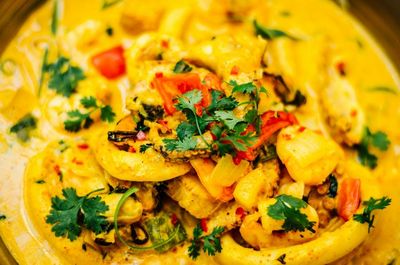
Cari ourite is the dish that turns up at every Mauritian fisherman's Sunday lunch, and at every Creole restaurant on the south coast. The technique is to braise octopus low and slow in a tomato-and-onion masala that leans on fresh thyme and a finishing pinch of garam masala instead of the heavier dried-spice masalas you find in cari boeuf or cari poulet. Octopus has a sweet, slightly mineral flavour that needs space, so the seasoning is restrained: thyme for aroma, tomato for body, ginger and garlic for the base, mild curry powder for depth, garam masala right at the end for top-note warmth. The tentacles cook for around 45 minutes (small octopus) to an hour (larger). The biggest variable is the octopus itself; small frozen octopus, sold cleaned at most fishmongers and many supermarkets, is reliable and the freezing actually helps tenderise the flesh. Difficulty is moderate; the cook is mostly passive once the masala is built. Serve with plain steamed rice and a satini cotomili (coriander chutney) or a spoon of pickled chilli. A simple green salad with vinaigrette on the side keeps it honest.
Ohn No Khao Swè
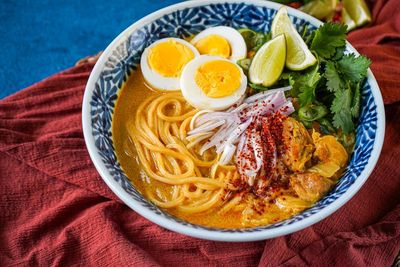
Myanmar's coconut-chicken noodle soup, the dish closest in spirit to a Thai khao soi but with its own Burmese identity. You poach chicken thighs in stock with shallot, garlic, ginger and turmeric for twenty-five minutes, lift them out and shred the meat. The stock cooks down with coconut milk, fish sauce and paprika, thickened with a slurry of chickpea flour and water into a silky soup. Yellow egg noodles cook separately. Everything piles into the bowl at the end: noodles first, soup ladled over, shredded chicken in the middle, then heaping garnishes (sliced shallot, crispy fried shallot, halved boiled egg, lime wedges, cilantro, chilli flakes). The garnishes are half the dish; eat with chopsticks in one hand and a spoon in the other.
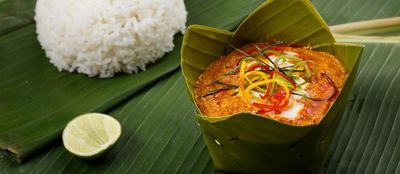
Amok Trey
Cambodia's national dish, the centrepiece of any Khmer feast and the proper-occasion food across the country. You start by pounding kroeung fresh in a mortar (the paste of lemongrass, galangal, turmeric, garlic, shallots, kaffir lime zest and coriander root that defines Khmer cooking, and that no shop-bought paste comes close to matching). The kroeung fries briefly to bloom its aromatics, coconut cream and stock loosen it, and eggs whisk in to set the eventual custard. Chunks of firm white fish fold through with chopped greens (traditionally noni leaves, with spinach or chard standing in), and the whole mix spoons into banana-leaf cups (or small ramekins). Twenty minutes in a steamer turns the custard just-set around the soft fish, and the banana leaves perfume everything. Served from the parcels with steamed rice and a wedge of lime.