Samusa Thoke
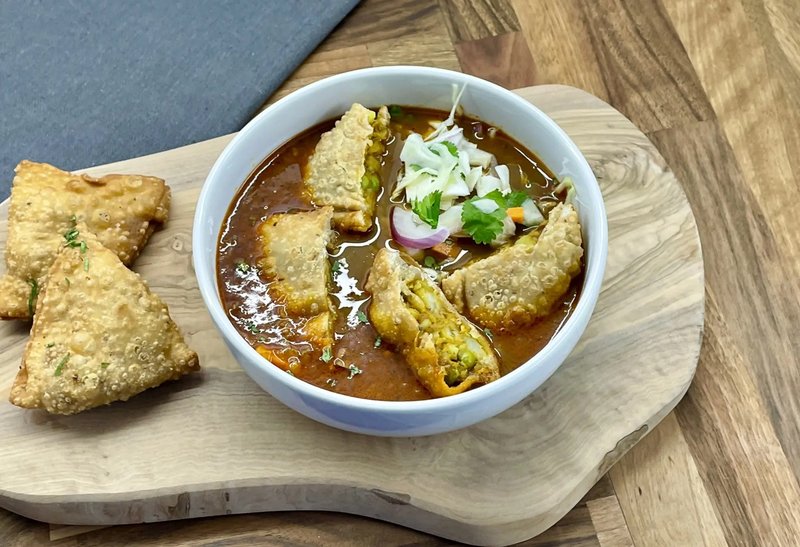
The Burmese street salad: broken samusas tossed in a thick yellow split-pea broth with crispy bits, raw onion, lime and coriander. A meal in a bowl.
Overview
A Yangon street-stall snack and the lunch office workers queue for at midday: broken samosas tossed in a hot yellow-pea soup at the bowl with raw onion, lime and crispy bits. You cook yellow split peas with turmeric and salt into a thick soup, season it with fried sliced onion, garlic, paprika and fish sauce. Small Burmese samosas (filo or thin pastry triangles with a lamb mince filling) are pre-fried or warmed. The construction in the bowl is fast: a heap of broken samosa, a ladle of hot pea soup, a tangle of raw red onion, a small mound of crispy gram-flour bits, chopped cilantro, a wedge of lime, chilli to taste. Toss at the table and eat while everything is hot.
Ingredients
Yellow pea soup
- 250 g yellow split peas (chana dal or yellow split peas - soaked 4 hours, drained)
- 1.4 litres water
- 1 ½ teaspoons ground turmeric
- 1 ½ teaspoons salt
- 4 tablespoons vegetable oil
- 1 onion (large, chopped)
- 6 garlic cloves (crushed)
- 1 tablespoon paprika
- 2 tablespoons fish sauce
- 1 dried red chilli (broken)
Samusas
- 12 Burmese-style samusas (small, use the keema-samosa recipe, scaled down, OR buy frozen Indian / Burmese mini samosas)
- 500 ml vegetable oil for frying
Crispy bits (sin-don)
- 80 g gram (chickpea) flour
- 60 ml water
- ½ teaspoon salt
- ¼ teaspoon ground turmeric
Garnish
- 1 red onion (small, sliced thin)
- 1 small handful fresh cilantro (chopped)
- 2 spring onions (sliced)
- 2 limes (cut into wedges)
- 1 teaspoon dried chilli flakes
- 1 tablespoon crispy fried shallots (optional)
Method
Stage 1 - Pea soup
- Place soaked split peas in a pot with the water, turmeric and salt.
- Bring to a boil; reduce to simmer; cover partially.
- Cook 50 minutes-1 hour until peas are very soft and breaking down.
- Whisk to break the peas into a thick soup. Keep warm.
Stage 2 - Onion masala for the soup
- In a wide pan, heat the oil; soften onion 8 minutes.
- Add garlic and paprika; cook 1 minute.
- Stir into the pea soup along with the fish sauce and dried chilli.
- Simmer combined 10 minutes; adjust salt.
Stage 3 - Crispy bits (sin-don)
- Whisk gram flour with water, salt and turmeric to a thick smooth batter.
- Heat 1 cm of oil in a small pan to 175°C.
- Drizzle the batter through your fingers or a fork into the hot oil in random shapes.
- Fry 2 minutes until deep gold and crisp. Lift onto paper.
Stage 4 - Samusas
- If using frozen, fry or oven-bake according to packet.
- If made fresh, fry at 170°C 3-4 minutes until deep gold.
Stage 5 - Assemble
- In each wide bowl, break 3 samusas into bite-sized pieces.
- Ladle hot pea soup over the top (about 200 ml per bowl).
- Top with a small handful of crispy bits, sliced red onion, spring onion and cilantro.
- Sprinkle with chilli flakes.
- Place a lime wedge alongside.
Stage 6 - Eat
- Toss everything at the table with a fork; squeeze in lime; eat hot.
Notes
- Soup texture: The pea soup should pour but be thick enough to coat a spoon - like a loose dal.
- Don't pre-mix: Bring the components to the table separately so the textures stay distinct - crispy bits go soggy if mixed in advance.
- Salad or soup? Neither - it's a Burmese category of its own. Some bowls are wet and soupy; others are drier and more salad-like. Adjust the soup to noodle ratio to taste.
Storage
- Pea soup keeps 4 days; reheats well.
- Crispy bits keep 1 week in a sealed jar.
- Samusas keep 2 days refrigerated; re-crisp at 200°C 6 minutes.
- Assemble fresh.
Recipes mentioned here
Samosas
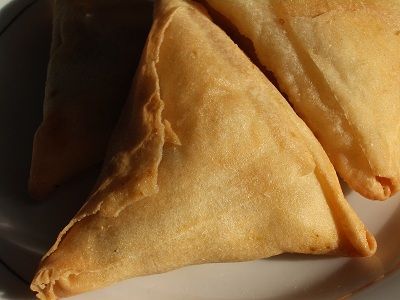
Samosas are the ultimate Indian snack: crispy, angular parcels of golden filo pastry enclosing spiced, fragrant filling. The technique is simple yet satisfying, triangular folding, egg wash sealing, and oven-baking creates a light, shattering crust. Unlike deep-fried versions, these are baked for a lighter result while maintaining crispness. Serve warm with chutney, raita, or lemon juice. These are elegant enough for entertaining, casual enough for snacking.
Samosa
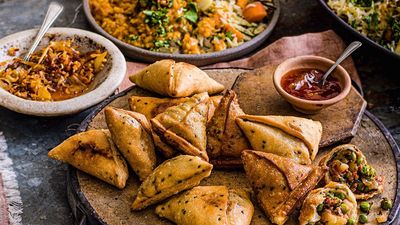
A stiff oil-rich plain-flour dough (maida) rolls thin and crisps in the fryer with the characteristic blistered surface. The filling is dry: boiled potato, peas, ginger, green chilli, cumin, coriander seed, garam masala and amchur (dried mango powder) for sourness. The pastry is rolled into ovals, halved into semicircles, formed into cones, stuffed, sealed and fried in two stages: low-temperature first to set the pastry without browning, then a hot finish to blister and crisp.
More like this
Mohinga
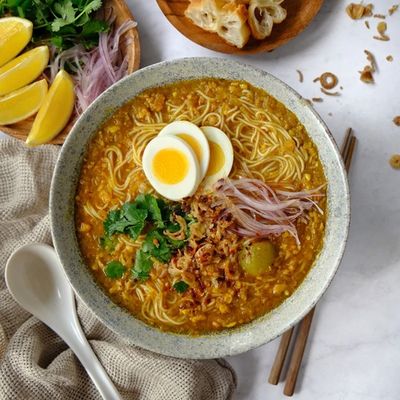
Myanmar's national breakfast, the rice-noodle soup that streetcorner stalls in every city open before dawn for. You cook catfish (or any firm white fish) in spiced water first, then shred the cooked flesh and turn the cooking liquid into the soup base. A spice paste of shallot, garlic, ginger, lemongrass and turmeric fries in oil; a chickpea-flour slurry thickens the broth to a silky consistency; banana-stem (or hearts of palm or cabbage as substitute) softens in. Fish sauce, paprika and lime balance the seasoning. Rice vermicelli portions into bowls, broth ladles over, and a heavy plate of garnishes arrives at the table: crispy split peas, halved boiled eggs, lime wedges, fresh herbs, chilli flakes. Each diner builds the bowl to their own taste. The morning meal of Myanmar.
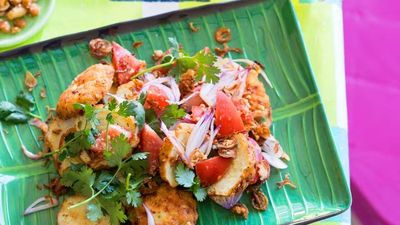
Nga Hpe (Burmese Fish Cakes)
The Burmese fish cakes that arrive at lahpet-thoke salad tables and street snack stalls alike, bright with lime and curry leaf. You cube skinless firm fish fillets and pulse them in a food processor with shallot, garlic, ginger, lime, fish sauce and a small egg into a sticky paste. A spoon of beaten cornflour binds it. Curry leaves, sliced spring onion, chopped cilantro and a fresh chilli go in for fragrance and bite. Patties form by hand (keep your hands slightly damp so the mixture doesn't stick), then shallow-fry in batches at 170°C for two or three minutes per side until they're deep gold and crisp at the edges. Eaten warm with a sour-sweet tamarind dipping sauce.
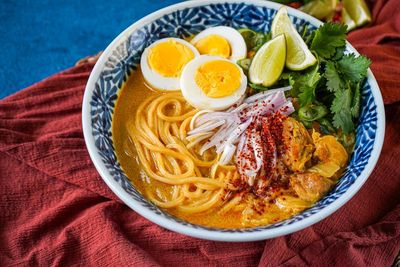
Ohn No Khao Swè
Myanmar's coconut-chicken noodle soup, the dish closest in spirit to a Thai khao soi but with its own Burmese identity. You poach chicken thighs in stock with shallot, garlic, ginger and turmeric for twenty-five minutes, lift them out and shred the meat. The stock cooks down with coconut milk, fish sauce and paprika, thickened with a slurry of chickpea flour and water into a silky soup. Yellow egg noodles cook separately. Everything piles into the bowl at the end: noodles first, soup ladled over, shredded chicken in the middle, then heaping garnishes (sliced shallot, crispy fried shallot, halved boiled egg, lime wedges, cilantro, chilli flakes). The garnishes are half the dish; eat with chopsticks in one hand and a spoon in the other.
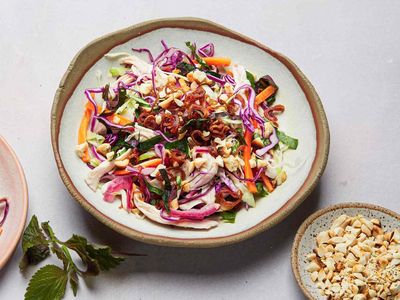
Gỏi Bắp Cải
Poached chicken is shredded and tossed with finely shredded cabbage, carrot and onion that has been softened in a light vinegar bath. A bright nước chấm style dressing brings everything together and toasted peanuts and fried shallots finish the top. The trick is balance: the salad should be crunchy, not waterlogged, and the dressing should taste sharp on its own before it hits the salad.