In season

May produce

Tap any item to find recipes that use it.

Asparagus 0Rhubarb 0Peas 0Broad beans 0Radish 0Lettuce 0New potato 0Spring onion 0Watercress 0Sorrel 0
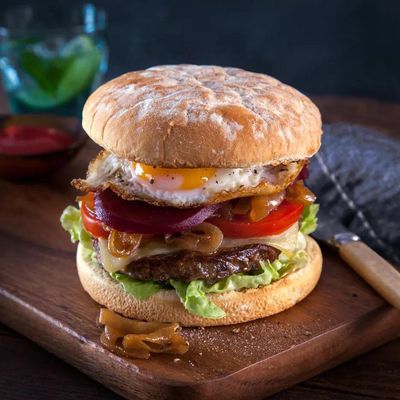
Aussie Burger with Beetroot

Aussie Burger with Beetroot

The Aussie burger, sometimes called "the lot", is a milk-bar institution that emerged in Australia in the mid-twentieth century when European immigrants and returning soldiers reshaped the corner takeaway. What distinguishes it from any American or British burger is the insistence on tinned pickled beetroot, a slice of canned pineapple, a fried egg and rashers of streaky bacon, all stacked under a thick beef patty on a toasted bun. The beetroot is non-negotiable: it stains the bread, it stains your fingers, it leaks down your wrist, and it is the entire point. The combination sounds chaotic but works because each layer plays a clear role: sweet pineapple against salty bacon, earthy beetroot against rich egg yolk, sharp tomato chutney cutting through melted cheese. The patty itself is generously sized, hand-shaped, and seasoned simply so the toppings can do the talking. Difficulty is low; the only real skill is timing several pans at once so the egg, bacon and patty all arrive hot together. This is not delicate food. It is built to be eaten leaning forward over a paper wrapper with napkins and a cold drink. Serve it at a backyard barbecue and watch grown adults negotiate the architecture of the bite.
Australian 40 minutes Serves4
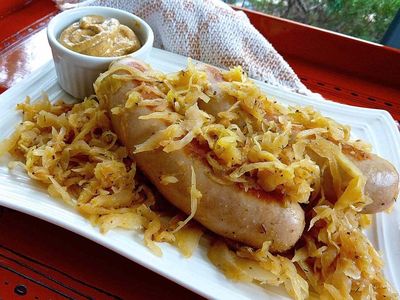
Bratwurst with Sauerkraut

Bratwurst with Sauerkraut

Bratwurst is less a single sausage than a whole family of them, with each German region defending its own version: long thin Nürnberger, plump Thüringer, the white veal Weisswurst of Bavaria, the smoked Frankfurter that became the American hot dog. What unites them is a fine grind of pork (often with veal), gentle seasoning of marjoram, white pepper, mace and a little caraway, and traditional natural casings. Authentic preparation matters: a raw bratwurst should never be slapped onto a screaming grill, because the high fat content scorches the outside before the inside cooks and the casing splits losing all the juice. The German method is a gentle two-stage cook: poach the sausages in barely simmering water or weak beer for 8-10 minutes until the inside is just set, then finish on a medium-hot grill for 3-4 minutes per side to colour the casing and add a touch of smoke. The accompanying sauerkraut is not the cold pickle from the jar but a warm braise: jarred kraut squeezed, then simmered with onion, bacon fat or butter, caraway seed, a bay leaf and a splash of white wine or apple juice for 25 minutes until soft and mellow. Difficulty is low; the only thing to get right is not boiling the sausages (a hard boil makes them swell and burst) and not impaling them on a fork (every puncture is a juice leak). Mustard is non-negotiable: sweet Bavarian süßer Senf for Weisswurst, sharp medium Düsseldorf or Löwensenf for everything else.

German 50 minutes Serves4
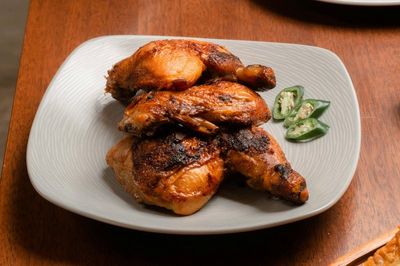
Chicken Inasal

Chicken Inasal

Chicken inasal is the pride of Bacolod City on Negros Occidental, where streetside grill houses serve nothing else: trays of chicken parts skewered on bamboo, smoking over long coal pits, with the cook brushing on bright orange annatto oil every few turns. The marinade is what marks it as Filipino: calamansi (a small, sour citrus halfway between lime and tangerine), cane vinegar, ginger, lemongrass, garlic and a generous slug of black pepper. The annatto oil (atsuete) is just neutral oil warmed gently with annatto seeds until it stains a vivid orange-red; this is the dish's signature look and a mild peppery flavour. Basting starts halfway through cooking so the colour goes onto skin that's already partly cooked, and continues right up to the moment the chicken leaves the grill. Difficulty for a home cook is low; the only special ingredients are calamansi (lime juice plus a touch of orange juice substitutes well) and annatto seeds (sometimes sold as achiote, found in any Filipino or Latin American shop). The flavour profile is sharp, herbal, slightly smoky, with a peppery edge from black pepper rather than chilli, and ribbon-thin lemongrass perfume running through everything. Service is non-negotiable: a heap of garlic rice (sinangag), a saucer of toyomansi (soy-calamansi-vinegar dipping sauce with sliced chillies), and the cook's pot of warm annatto oil for the table.

Filipino 4 hours 50 minutes Serves4
Grilled Kielbasa

Grilled Kielbasa

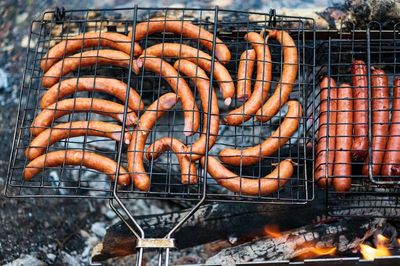
Kielbasa simply means "sausage" in Polish, and there are dozens of named varieties: kielbasa biała (white, fresh, the Easter sausage), kielbasa myśliwska (smoked hunter's sausage), kielbasa krakowska (a large dry sausage similar to bologna). The kielbasa most people picture, and the one for the grill, is kielbasa wiejska or kielbasa zwyczajna: a fully cooked pork sausage smoked over fruit or beech wood, seasoned with generous garlic, marjoram, salt and pepper, and sold in long curved horseshoes. Because it's pre-cooked and pre-smoked, grilling kielbasa is really about reheating and putting the finishing char on the casing. That makes it one of the easiest things on the summer table and a hard one to ruin. The proper technique is medium heat (not screaming high), turning often so all sides crisp evenly, and a light score or angled cuts in the thicker pieces to help the heat penetrate. The flavour profile is rich and garlicky, with the warm herbal note of marjoram that distinguishes Polish from Czech, Hungarian or German sausages, and a clear smoky undertone from the wood used in production. Traditional accompaniments are kapusta kiszona (sharp lacto-fermented cabbage), often warmed with onion and bacon, dark rye bread, sharp mustard (musztarda sarepska) or grated horseradish (chrzan), and pickled cucumbers. A bottle of cold Polish beer or a small glass of żubrówka is the drink.

Polish 35 minutes Serves6
Lahori Beef Boti Kebab

Lahori Beef Boti Kebab

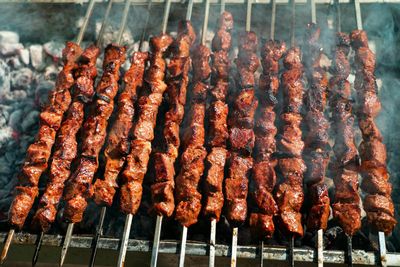
Beef tenderloin or fillet is cut into 3 cm cubes and marinated in two stages. A first short rub with raw papaya, ginger-garlic, salt and a splash of vinegar tenderises the meat (papaya enzymes break down the muscle fibre). After 30 minutes the second marinade goes in: yogurt, Kashmiri chilli, garam masala, kasuri methi, mustard oil and a touch of besan. The beef sits for at least 3 hours, ideally overnight. Threaded onto skewers and grilled hot until charred at the edges; the inside should stay pink and juicy.

Lahori 4 hours 32 minutes Serves4-6
Samgyeopsal

Samgyeopsal

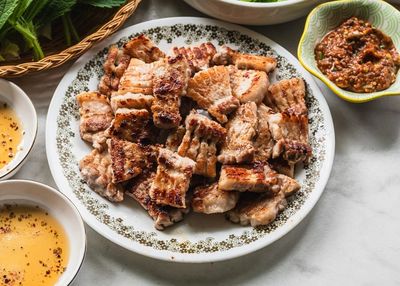
Samgyeopsal, literally "three-layered flesh" after the visible stripes of meat and fat, is the most beloved grill-at-the-table meal in South Korea. It is not a marinade-heavy preparation: the entire point is the quality of the pork belly itself, sliced thick and grilled fresh over charcoal or a hot griddle while everyone sits around the table with side dishes, garlic, and a pile of lettuce leaves. The eating ritual is as important as the cooking. You take a leaf of lettuce or sesame perilla, lay on a piece of grilled belly fresh off the heat, add a smear of ssamjang (a thick, savoury paste of doenjang fermented soybean paste and gochujang chilli paste), a sliver of raw garlic grilled briefly in the pork fat, maybe a strand of spring onion salad, then wrap the whole thing tight, pop it into your mouth in one bite, and chase it with a shot of soju. Korean restaurants do not slice the belly for you at the table on purpose: the host or eldest cuts it with kitchen scissors as it cooks, in messy diagonals, which is part of the relaxed, social character of the meal. Difficulty is low; the cook is essentially supervision and a pair of tongs. The skill is in the side dishes (banchan) and the pacing. Sourcing matters: ask for skin-off pork belly cut between 1 ½ and 2 cm thick. Thin belly burns; thicker belly stays juicy.

Korean 35 minutes Serves4
Smashburger

Smashburger

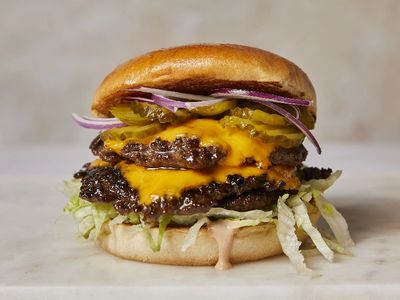
The smashburger is the American griddle cook's answer to a thick pub patty: take a loose ball of fatty ground beef, slap it onto a ripping hot flat-top, and press it paper thin so every square millimetre of meat hits the steel. What you get back is a patty with a brittle, almost potato-chip-like crust on the underside and a juicy, just-cooked interior, all in the space of ninety seconds. The technique came out of small Midwestern diners in the mid-twentieth century, but the modern revival is often credited to George Motz and the wave of regional burger documentation that followed. The Maillard reaction is the entire point here. A thick patty cooked rare on the inside has a thin band of seared flavour; a smashed patty is almost all crust. Pair that with cheap, salty American cheese that melts into the crags, a pillowy potato bun toasted in beef fat, and a sharp pickle, and you have one of the most satisfying things you can cook at home in under twenty minutes. Difficulty is low, but two details matter: the pan must be properly hot before the beef touches it, and you must only press once, in the first ten seconds. Anything more and you squeeze out the juices you worked to keep.

American 25 minutes Serves4