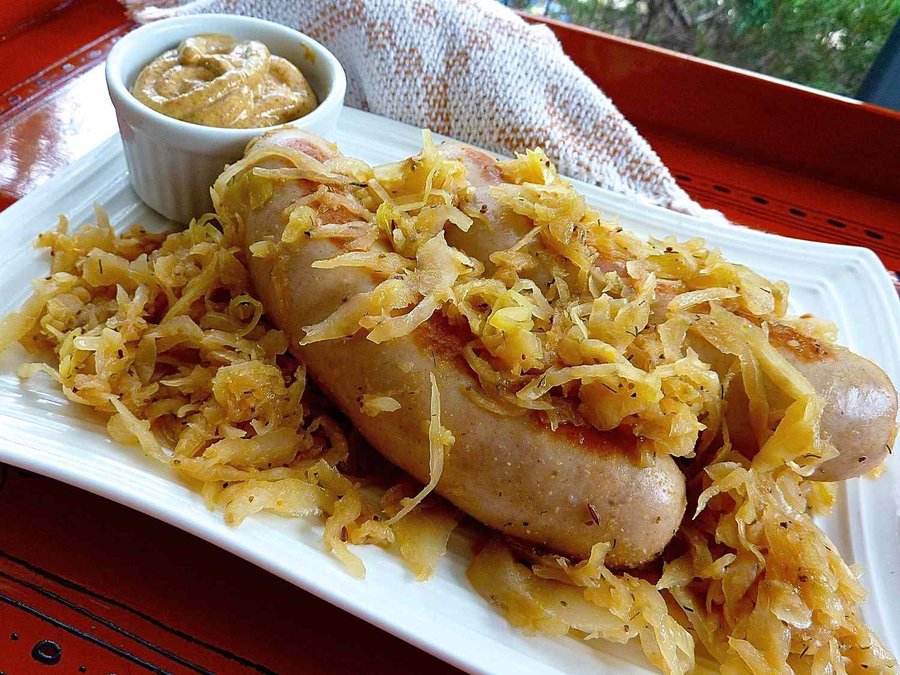
Bratwurst with Sauerkraut
Germany's grill staple: fine pork-and-veal sausages poached gentle, then grilled till the casing crackles. Served on caraway sauerkraut.
Overview
Bratwurst is less a single sausage than a whole family of them, with each German region defending its own version: long thin Nürnberger, plump Thüringer, the white veal Weisswurst of Bavaria, the smoked Frankfurter that became the American hot dog. What unites them is a fine grind of pork (often with veal), gentle seasoning of marjoram, white pepper, mace and a little caraway, and traditional natural casings. Authentic preparation matters: a raw bratwurst should never be slapped onto a screaming grill, because the high fat content scorches the outside before the inside cooks and the casing splits losing all the juice. The German method is a gentle two-stage cook: poach the sausages in barely simmering water or weak beer for 8-10 minutes until the inside is just set, then finish on a medium-hot grill for 3-4 minutes per side to colour the casing and add a touch of smoke. The accompanying sauerkraut is not the cold pickle from the jar but a warm braise: jarred kraut squeezed, then simmered with onion, bacon fat or butter, caraway seed, a bay leaf and a splash of white wine or apple juice for 25 minutes until soft and mellow. Difficulty is low; the only thing to get right is not boiling the sausages (a hard boil makes them swell and burst) and not impaling them on a fork (every puncture is a juice leak). Mustard is non-negotiable: sweet Bavarian süßer Senf for Weisswurst, sharp medium Düsseldorf or Löwensenf for everything else.
Ingredients
Bratwurst
- 8 fresh bratwurst (about 120 g each)
- 500 ml weak lager (or water)
- 1 bay leaf
- 5 g caraway seeds
- ½ onion (sliced)
Braised sauerkraut
- 600 g jarred sauerkraut (drained and lightly squeezed)
- 1 onion (finely chopped)
- 50 g smoked bacon lardons (or 30 g butter for meatless)
- 5 g caraway seeds
- 2 juniper berries (crushed)
- 1 bay leaf
- 150 ml dry white wine (or apple juice)
- 100 ml chicken (or vegetable stock)
- 5 g sugar
- salt
- pepper
To serve
- Sharp German mustard (Löwensenf medium-hot or Düsseldorf)
- Crusty rye bread (or pretzel rolls)
Method
Stage 1 - Sauerkraut
- Render the bacon lardons in a wide pan over medium heat until the fat runs and the lardons are crisp at the edges.
- Add the onion; cook 5-6 minutes until soft and translucent.
- Add caraway, crushed juniper and bay; stir 30 seconds.
- Tip in the squeezed sauerkraut; stir to coat in the fat.
- Pour in the wine and stock; add the sugar.
- Bring to a simmer; reduce heat to low; cover loosely and braise 25-30 minutes, stirring occasionally.
- Season with salt and pepper; the kraut should be soft and tangy, with most liquid absorbed.
Stage 2 - Poach the bratwurst
- Combine the lager (or water), bay, caraway and sliced onion in a wide pan; bring to a bare simmer (about 75-80°C, never boiling).
- Slip in the bratwurst; keep the liquid at the gentlest possible quiver.
- Poach 8-10 minutes until the sausages are firm to the touch and grey-pink throughout.
- Lift out carefully with tongs (not a fork) and drain on a tray.
Stage 3 - Grill
- Heat a charcoal or gas grill to medium. Oil the grates lightly.
- Lay the bratwurst across the grates at a slight angle.
- Grill 3-4 minutes per side, turning gently with tongs, until the casings are crisp, golden-brown and beginning to mark.
- Resist pressing them with a spatula; you'll lose the juices you just preserved.
Stage 4 - Serve
- Spoon a generous bed of warm sauerkraut onto each plate.
- Lay two bratwurst across the sauerkraut.
- Add a generous dollop of mustard alongside and a wedge of rye bread or a pretzel roll.
Notes
- Never pierce the casing: use tongs, not a fork. Every hole is a juice leak.
- Beer in the poach: any cheap pilsner works; the flavour barely transfers but the malt aroma is pleasant.
- Don't boil: a rolling boil bursts the casings. Aim for a quiet poach, surface barely moving.
- Sauerkraut tip: rinse if it's very sharp; squeeze out the brine before braising so the kraut can absorb new flavours.
Storage
- Bratwurst keeps 3 days refrigerated; reheat in a covered pan with a little stock.
- Sauerkraut keeps a week and improves on day two as the flavours meld.
- Both freeze well separately for up to 2 months.
More like this
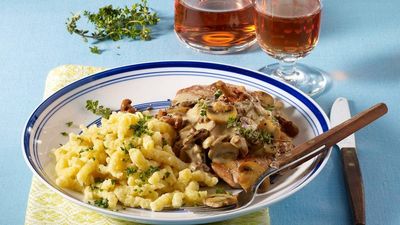
Jägerschnitzel
Pork loin escalopes pound thin, bread, and shallow-fry. While they crisp, a sauce of bacon, onion, mushrooms, white wine, stock and cream reduces in another pan. The schnitzel plates with the sauce on top (or alongside, if you want the crumb to stay crisp), with spätzle or boiled potatoes underneath.
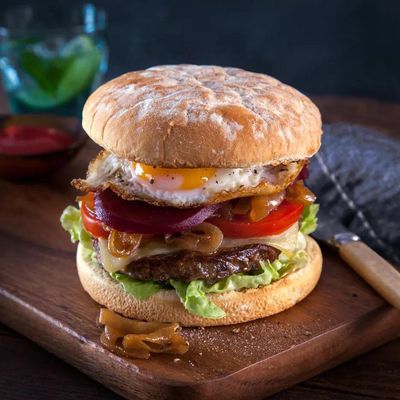
Aussie Burger with Beetroot
The Aussie burger, sometimes called "the lot", is a milk-bar institution that emerged in Australia in the mid-twentieth century when European immigrants and returning soldiers reshaped the corner takeaway. What distinguishes it from any American or British burger is the insistence on tinned pickled beetroot, a slice of canned pineapple, a fried egg and rashers of streaky bacon, all stacked under a thick beef patty on a toasted bun. The beetroot is non-negotiable: it stains the bread, it stains your fingers, it leaks down your wrist, and it is the entire point. The combination sounds chaotic but works because each layer plays a clear role: sweet pineapple against salty bacon, earthy beetroot against rich egg yolk, sharp tomato chutney cutting through melted cheese. The patty itself is generously sized, hand-shaped, and seasoned simply so the toppings can do the talking. Difficulty is low; the only real skill is timing several pans at once so the egg, bacon and patty all arrive hot together. This is not delicate food. It is built to be eaten leaning forward over a paper wrapper with napkins and a cold drink. Serve it at a backyard barbecue and watch grown adults negotiate the architecture of the bite.
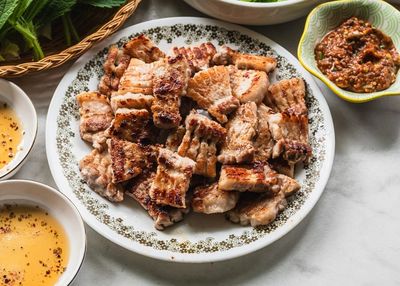
Samgyeopsal
Samgyeopsal, literally "three-layered flesh" after the visible stripes of meat and fat, is the most beloved grill-at-the-table meal in South Korea. It is not a marinade-heavy preparation: the entire point is the quality of the pork belly itself, sliced thick and grilled fresh over charcoal or a hot griddle while everyone sits around the table with side dishes, garlic, and a pile of lettuce leaves. The eating ritual is as important as the cooking. You take a leaf of lettuce or sesame perilla, lay on a piece of grilled belly fresh off the heat, add a smear of ssamjang (a thick, savoury paste of doenjang fermented soybean paste and gochujang chilli paste), a sliver of raw garlic grilled briefly in the pork fat, maybe a strand of spring onion salad, then wrap the whole thing tight, pop it into your mouth in one bite, and chase it with a shot of soju. Korean restaurants do not slice the belly for you at the table on purpose: the host or eldest cuts it with kitchen scissors as it cooks, in messy diagonals, which is part of the relaxed, social character of the meal. Difficulty is low; the cook is essentially supervision and a pair of tongs. The skill is in the side dishes (banchan) and the pacing. Sourcing matters: ask for skin-off pork belly cut between 1 ½ and 2 cm thick. Thin belly burns; thicker belly stays juicy.
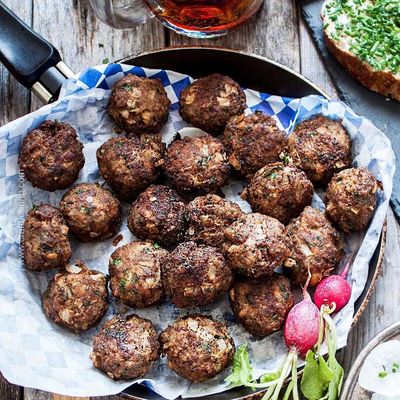
Frikadellen
A bread roll soaks in milk, squeezes out and mixes with minced pork and beef, finely chopped onion sweated soft, an egg, mustard, marjoram and plenty of pepper. Shaped into flat patties (frikadellen are flat, not round like meatballs) and pan-fried in butter. The bread keeps them tender; the flat shape gives more crust.