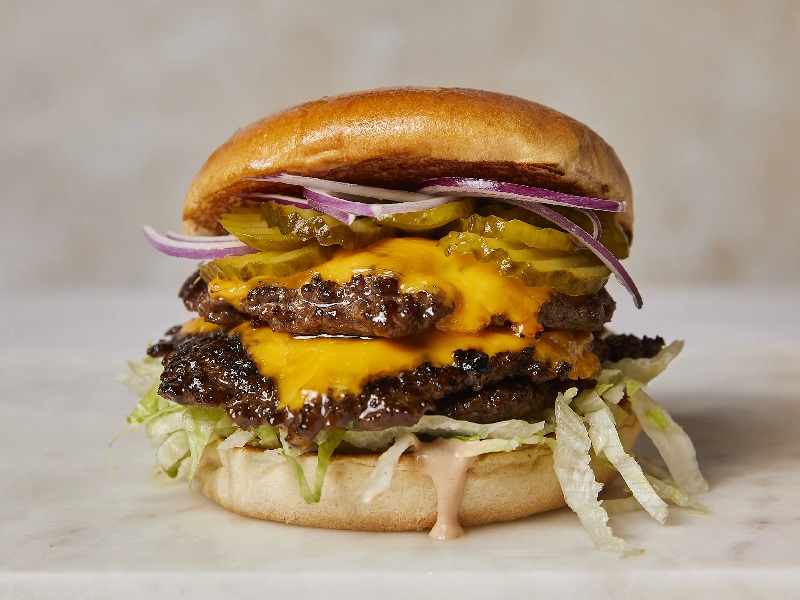
Smashburger
Crackling beef pressed onto a screaming-hot griddle, lacy brown edges curling around molten American cheese. The smell is pure diner: seared fat, toasted bun, and onions caramelising in the rendered tallow.
Overview
The smashburger is the American griddle cook's answer to a thick pub patty: take a loose ball of fatty ground beef, slap it onto a ripping hot flat-top, and press it paper thin so every square millimetre of meat hits the steel. What you get back is a patty with a brittle, almost potato-chip-like crust on the underside and a juicy, just-cooked interior, all in the space of ninety seconds. The technique came out of small Midwestern diners in the mid-twentieth century, but the modern revival is often credited to George Motz and the wave of regional burger documentation that followed. The Maillard reaction is the entire point here. A thick patty cooked rare on the inside has a thin band of seared flavour; a smashed patty is almost all crust. Pair that with cheap, salty American cheese that melts into the crags, a pillowy potato bun toasted in beef fat, and a sharp pickle, and you have one of the most satisfying things you can cook at home in under twenty minutes. Difficulty is low, but two details matter: the pan must be properly hot before the beef touches it, and you must only press once, in the first ten seconds. Anything more and you squeeze out the juices you worked to keep.
Ingredients
Patties
- 600 g ground beef chuck, ideally 20% fat
- Flaky sea salt
- Freshly ground black pepper
- 4 slices American cheese
To assemble
- 4 soft potato buns, split
- 30 g unsalted butter, softened
- 1 white onion (small), very thinly sliced
- 4 dill pickle chips per burger
- 2 tbsp yellow mustard
- 4 tbsp tomato ketchup
Method
Stage 1 - Prep
- Divide the beef into 8 loose balls of about 75 g each. Do not pack them tightly; just cup them in your palm.
- Slice the onion as thin as you can manage and keep it loose on a plate.
- Butter the cut faces of the buns.
Stage 2 - Toast the buns
- Heat a heavy cast-iron pan or flat-top over medium heat.
- Press the buttered buns cut-side down until deep golden, about 1 minute. Set aside.
Stage 3 - Smash
- Turn the heat to high and let the pan get properly hot, about 3 minutes. A drop of water should evaporate instantly.
- Place 2 beef balls into the dry pan, spaced apart. Immediately top each with a small pinch of sliced onion.
- Using a sturdy spatula and a second spatula or heavy can on top for leverage, press each ball flat to roughly 12 cm wide and 5 mm thick. Press hard, once, for about 10 seconds.
- Season the top of each patty with salt and pepper.
- Cook undisturbed for 90 seconds, until the edges are lacy and dark brown and juices bead on top.
- Slide the spatula firmly under each patty, scraping up the crust, and flip. Lay a slice of cheese on one patty, then stack the second patty on top to make a double.
- Cook a further 30 seconds for the cheese to melt.
Stage 4 - Build
- Spread mustard on the bottom bun, ketchup on the top.
- Lay pickle chips on the bottom bun, then the double-stack patty.
- Cap with the top bun and press gently. Serve immediately.
Notes
- Fat matters: 80/20 chuck is the minimum. Lean beef will not crisp and will taste dry.
- Do not move the patty: once smashed, leave it alone. Lifting too early tears off the crust you are trying to build.
- Pan temperature: if the beef does not hiss aggressively the second it hits the pan, the pan is not hot enough.
- Parchment trick: lay a square of baking parchment between the spatula and the beef when you smash to stop sticking.
Storage
- Cooked patties keep 2 days in the fridge but lose their crust. Reheat briefly in a hot pan, do not microwave. Build burgers fresh, never assembled and stored.
More like this
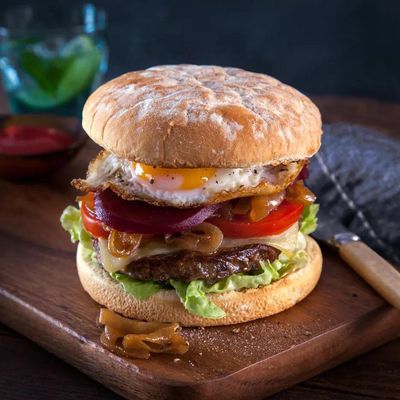
Aussie Burger with Beetroot
The Aussie burger, sometimes called "the lot", is a milk-bar institution that emerged in Australia in the mid-twentieth century when European immigrants and returning soldiers reshaped the corner takeaway. What distinguishes it from any American or British burger is the insistence on tinned pickled beetroot, a slice of canned pineapple, a fried egg and rashers of streaky bacon, all stacked under a thick beef patty on a toasted bun. The beetroot is non-negotiable: it stains the bread, it stains your fingers, it leaks down your wrist, and it is the entire point. The combination sounds chaotic but works because each layer plays a clear role: sweet pineapple against salty bacon, earthy beetroot against rich egg yolk, sharp tomato chutney cutting through melted cheese. The patty itself is generously sized, hand-shaped, and seasoned simply so the toppings can do the talking. Difficulty is low; the only real skill is timing several pans at once so the egg, bacon and patty all arrive hot together. This is not delicate food. It is built to be eaten leaning forward over a paper wrapper with napkins and a cold drink. Serve it at a backyard barbecue and watch grown adults negotiate the architecture of the bite.
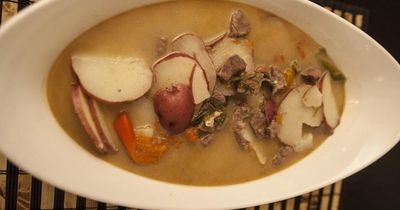
Ema Datshi
Bhutan's national dish, built on an honest two-ingredient premise: chillies and cheese, in roughly equal volume. The flavour is two things held in tension. The fierce burn of green chillies (jalapeños standing in for the hotter, more floral local Bhutanese varieties) on one side, the funky salty richness of blue cheese (Stilton or Gorgonzola standing in for the traditional yak cheese) on the other. The dairy fat tempers the burn just enough that you can actually eat it, but only just. The burn is the point. You build the dish out with beef, potato and tomato into a proper stew, and everything goes into the pot together to simmer until the cheese melts down into a fierce, creamy, chilli-flecked sauce. Eaten with red Bhutanese rice at most meals in Bhutan. Halve the chilli count the first time you cook it; the locals will laugh, but you'll be able to taste your next meal.
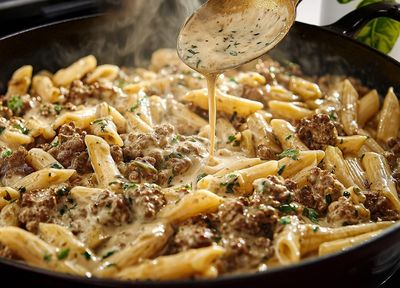
One-Pot Creamy Beef Pasta
An American weeknight pasta that compresses a Hamburger Helper-style box meal into a single pot, an open package of fresh ingredients, and 35 minutes of low-effort cooking. The trick is that the pasta is cooked directly in the broth (no separate boil, no drain), which means the starch released from the rigatoni stays in the pot and helps thicken the sauce when the cream and cheese are folded in at the end. Flavour is sharp-savoury rather than red-sauce-comforting, sharp white cheddar gives a tangy bite, parmesan adds salty umami, heavy cream binds the lot into something almost like a stovetop mac-and-cheese with ground beef stirred through. Rigatoni's wide ribbed surface clings to the sauce in a way that smoother shapes can't. Smell is browned beef and melted cheese. Genuinely easy and a single pan to wash; the only technical points are using freshly shredded cheese (pre-shredded supermarket bags have anti-caking starches that prevent smooth melting) and letting the off-heat rest do its job. A modern American weeknight staple that emerged from one-pot pasta TikTok and food-blog culture in the 2010s-2020s.
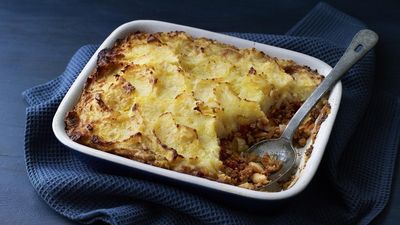
Cottage Pie
The textbook British family dinner, the dish that turns up on every primary-school menu and most weeknight tables. You brown beef mince with onion, carrot and celery, then simmer it down with stock, a spoon of tomato purée, a slosh of red wine and a generous splash of Worcestershire into a thick savoury gravy. Top with cheddar mash piled rough so the peaks catch and crisp in the oven, and bake until the surface is deep gold and the gravy bubbles around the edges. Forgiving, freezer-friendly, exactly as good on Wednesday from leftovers as on Sunday from the oven. A green vegetable and a spoon of brown sauce on the plate, a bowl of trifle waiting in the fridge for after.