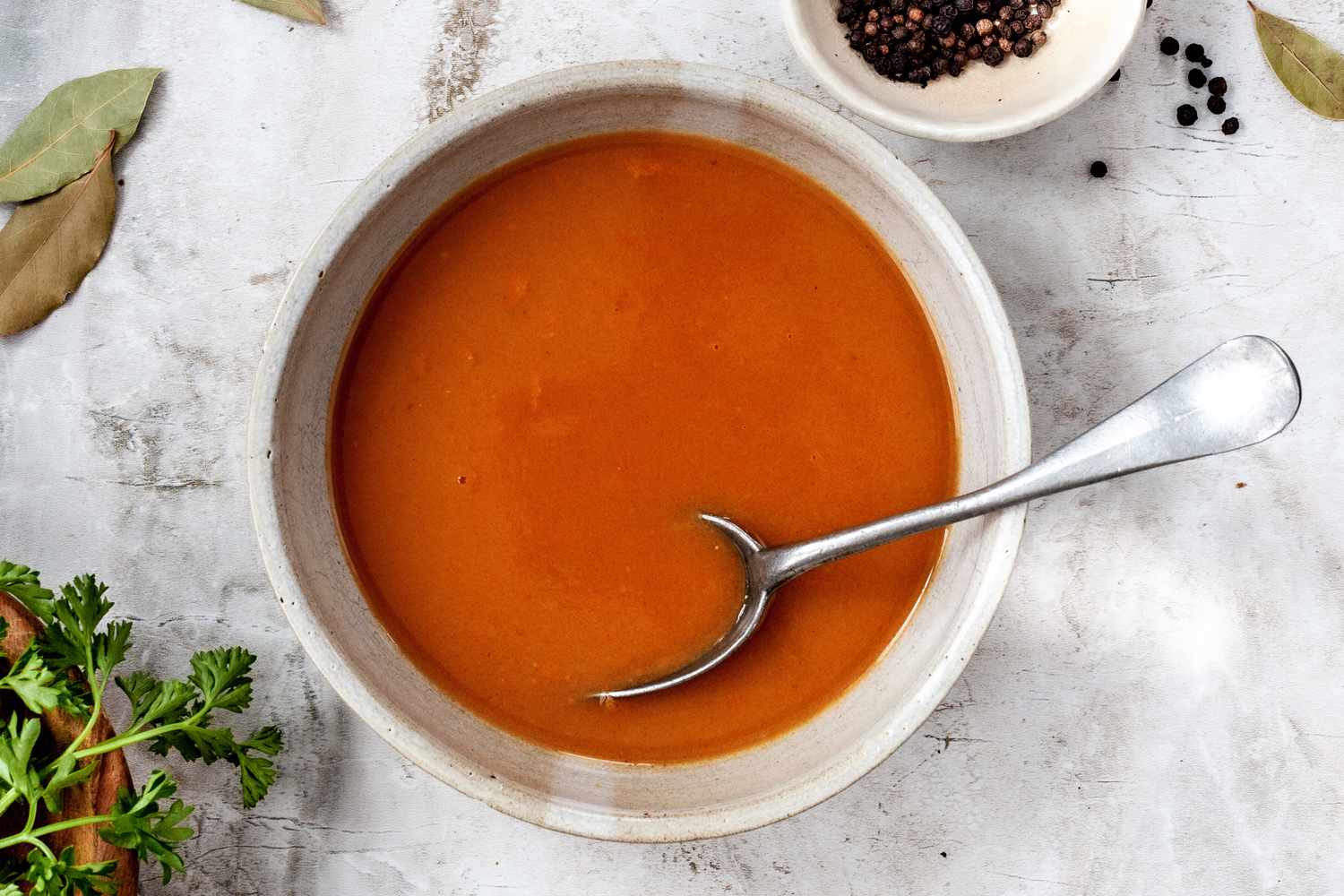
Espagnole
Espagnole is the most demanding of the mother sauces, and the one with the biggest pay-off. A dark roux, browned vegetables, slow-cooked stock, reduced down to demi-glace: a sticky meat sauce that tastes like a good restaurant. Most of an afternoon's work, but a small tub of it lifts pan sauces and steak finishings for weeks afterwards.
Overview
Espagnole is the most demanding of the five mother sauces. It is built on a brown roux (cooked further than the blond roux of veloute), made with brown stock (roasted bones), thickened with vegetables, and seasoned with tomato puree. The base is then simmered for hours to deepen, strained, and often reduced further into demi-glace, a syrupy concentrated meat reduction.
The whole process can take 6-8 hours. Most of that is waiting; active work is maybe an hour. But the result is so much richer than any shortcut that it is the gold standard for French saucing.
In a restaurant, demi-glace is made once a week, frozen in 50 ml portions, and used by the teaspoon: a teaspoon glazes a pan-sauce; a tablespoon finishes a bordelaise. Home cooks who make it discover their cooking lifts immediately.
The Hierarchy
- Brown stock (fond brun): the roasted-bones starting stock. See Stocks.
- Espagnole sauce: the base mother. Stock thickened with brown roux and mirepoix.
- Demi-glace: half espagnole + half brown stock, reduced by half. The "half-glaze".
- Glace de viande (meat glaze): further reduction to syrupy concentrate. Mostly gelatin and concentrated savoury essence.
Each layer concentrates the previous. Demi-glace is the most useful for home cooking.
Espagnole Method
For 1 litre of finished espagnole. Plan 4 hours from start to finish.
Ingredients
- 1.5 litres brown stock (chicken or veal)
- 60 g unsalted butter
- 60 g plain flour
- 1 large onion (finely chopped)
- 2 carrots (finely chopped)
- 2 celery stalks (finely chopped)
- 3 tablespoons tomato puree
- 1 bay leaf
- 4 parsley stalks
- 1 sprig thyme
- 10 black peppercorns (lightly crushed)
- 100 ml red wine (optional but recommended)
Method
- Brown the mirepoix. In a heavy-based pan, melt half the butter (30 g) over medium-high heat. Add the chopped onion, carrot and celery. Cook 15 minutes, stirring often, until deep brown but not burnt. This caramelisation is essential to the sauce's colour and depth.
- Add tomato puree. Stir in the 3 tablespoons tomato puree. Cook 2 minutes, stirring; the puree should darken from bright red to brick.
- Deglaze (optional). Pour in the 100 ml red wine. Reduce by half over high heat, 3-4 minutes.
- Reserve the mirepoix. Tip the contents of the pan into a bowl. Set aside.
- Make the brown roux. Wipe the pan. Melt the remaining 30 g butter. Add 60 g flour. Whisk constantly over medium heat for 8-10 minutes. The roux must go through stages: pale, biscuit, light brown, deep brown. Stop when the colour is the brown of milk chocolate, with a slightly nutty smell. Do not burn (acrid smell = start over).
- Whisk in the stock. Pour in a quarter of the warm brown stock while whisking. The mixture will sputter. Continue whisking until smooth. Add the rest of the stock in three additions, smoothing each before the next.
- Combine. Add the reserved mirepoix back into the pan, plus the bay, parsley, thyme, peppercorns.
- Simmer. Bring to a slow simmer. Cook uncovered (or with the lid cracked) for 2-3 hours. Skim any foam that rises. The volume should reduce by about a third.
- Strain. Pass through a fine sieve into a clean container. Discard the solids (they have given up everything by now).
- Continue reducing (optional). If you want demi-glace, return the strained sauce to the pan with an equal volume of fresh brown stock. Reduce by half. This is now demi-glace.
- Cool, store.
Volume yield: about 1 litre espagnole; about 750 ml demi-glace (if you took the second reduction); about 250 ml glace de viande (if you reduced further).
The Derivatives
Sauce Bordelaise
The classical French steak sauce. Reduce 100 ml red wine with 1 chopped shallot to a glaze. Add 250 ml demi-glace. Simmer 5 minutes. Off heat, whisk in 30 g cold butter and 30 g sliced cooked beef marrow. Pour over a grilled ribeye.
Sauce Robert
A pork sauce. Sweat onions in butter, add 100 ml white wine, reduce. Add 250 ml demi-glace, 1 tablespoon Dijon mustard. Finish with 1 teaspoon lemon juice. Pour over pork chop.
Sauce Charcutiere
Sauce Robert + gherkins. Add 2 tablespoons chopped cornichons at the end. Goes with pork, sausages.
Sauce Lyonnaise
Sweat finely sliced onions in butter until dark gold. Deglaze with 100 ml white wine vinegar, reduce. Add 250 ml demi-glace. Simmer 5 minutes. Classic with liver or steak frites.
Sauce Madere
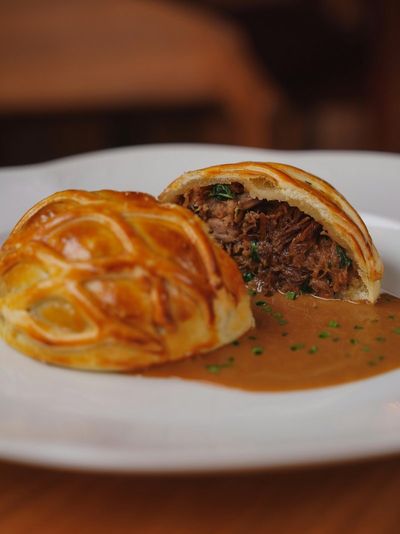
Add 100 ml Madeira wine to 250 ml demi-glace, reduce 5 minutes. Pour over beef wellington, kidney, mushroom-stuffed beef.
Sauce Perigueux
Madere + truffle. Add 1 tablespoon black truffle juice and 2 teaspoons chopped truffle. Restaurant-level.
Sauce Diane
Madere + cream. Add 50 ml double cream to a Madere sauce. Steak Diane.
Why Brown Roux is the Hard Bit
The brown roux is the make-or-break step of espagnole. Three failure modes:
- Under-cooked. A roux pulled too early gives a pale sauce that tastes of flour. The sauce never quite tastes right.
- Over-cooked / burnt. A roux taken too dark, or worse, burnt, gives an acrid bitter sauce. Throw it away and start over. Burnt roux cannot be recovered.
- Unevenly cooked. Without constant whisking, the roux scorches in patches. Some bits are fine, others taste burnt. The sauce is muddy in colour and inconsistent in flavour.
Use a heavy-based pan that distributes heat well. Whisk constantly, all the way to the corners. Adjust the heat down if the roux is darkening too fast; medium-low for the last 3 minutes is safer than medium.
Common Mistakes
The sauce is thin. Roux under-developed, or the simmer was too short. Continue reducing on a low heat.
The sauce tastes bitter. Burnt roux, burnt mirepoix, or burnt tomato puree. Once any of these tip into bitterness, the batch is lost. Start over.
The sauce is greyish-brown, not glossy mahogany. Mirepoix not browned enough, or roux not dark enough. Both contribute the colour.
The sauce tastes muddy. Skim more aggressively during the simmer. A film of fat or scum on top fouls the flavour over hours.
The demi-glace is gluey, not silky. Over-reduced. Espagnole reduced to less than half its volume gets sticky-tacky. Either thin with fresh stock, or accept it as a glaze rather than a sauce.
Storage
Espagnole and demi-glace freeze beautifully. Pour into ice-cube trays (each cube is roughly 20 ml = enough to finish one portion of sauce). Once frozen, transfer to a freezer bag. Drop a cube into a hot pan sauce; melts in 30 seconds.
Fridge: 5 days. Freezer: 6 months.
Where Next
- Stocks: the foundation under espagnole.
- Bechamel: the white mother sauce.
- Veloute: the blond mother sauce.
- Hollandaise: the emulsion mother sauce.
- Espagnole recipe: canonical recipe.
- Stocks-Sauces Course landing: back to the main course.
More like this
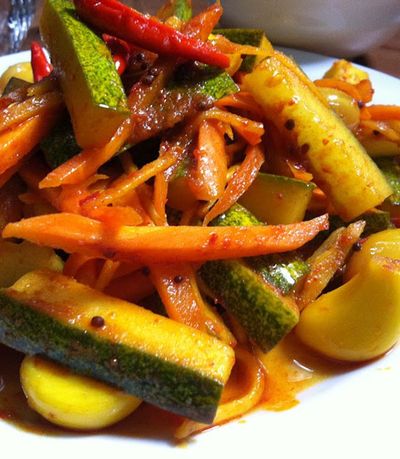
Acar Timun
Cucumber, carrot, shallot, chilli prep into thin slices or matchsticks. Salt rests for 10 minutes to draw moisture, drains. A simple dressing of vinegar, sugar, water and ginger whisks together. Vegetables toss with the dressing; rest for 1 hour at room temperature. Eats cool, never refrigerated cold; the texture suffers.
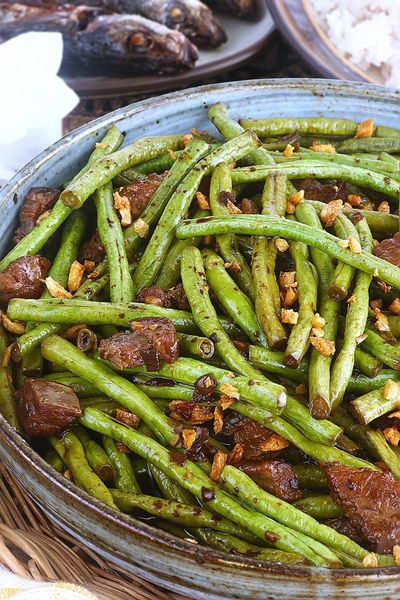
Adobong Sitaw
Garlic browns in oil; long beans toss in to colour briefly. Soy and vinegar pour in with bay and peppercorns; the beans braise covered until tender. Lid off; the liquid reduces to a glaze. Salt at the end, not the start, since soy is salty enough.
Ajad
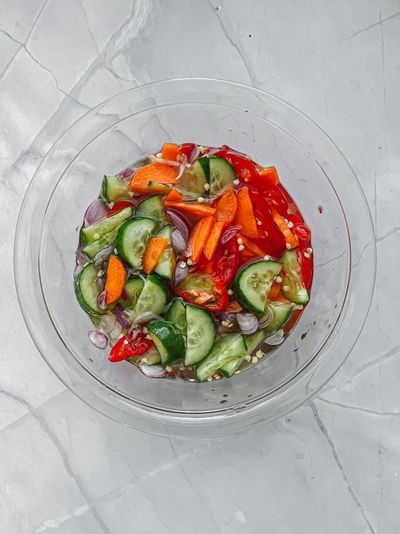
A simple syrup of rice vinegar, palm sugar, water and salt is brought to a gentle simmer to dissolve the sugar, then cooled. Cucumber, shallot and chilli are sliced thin and combined in a small bowl. The cooled syrup is poured over. Rested for 10-15 minutes for the vegetables to wilt slightly into the dressing. Served in small individual ramekins as a dip, OR in a larger bowl as a side, with peanuts sprinkled on top.
Akara
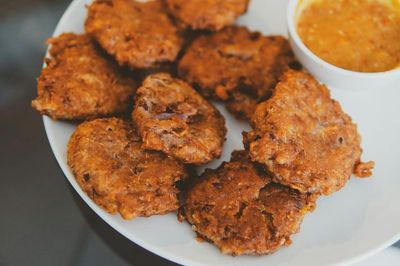
Dried black-eyed beans soak briefly to loosen the skins; the skins rub off (this is the key step, skin-on akara is bitter and grey). The peeled beans go into a blender with onion, Scotch bonnet and just enough water to make a thick batter (not a paste). The batter is whipped by hand or with a wooden spoon for 5 minutes until light and aerated, this is what makes akara fluffy rather than dense. Spoonfuls drop into 175°C oil and fry for 3-4 minutes per side until golden. Drained on paper. Eaten hot.