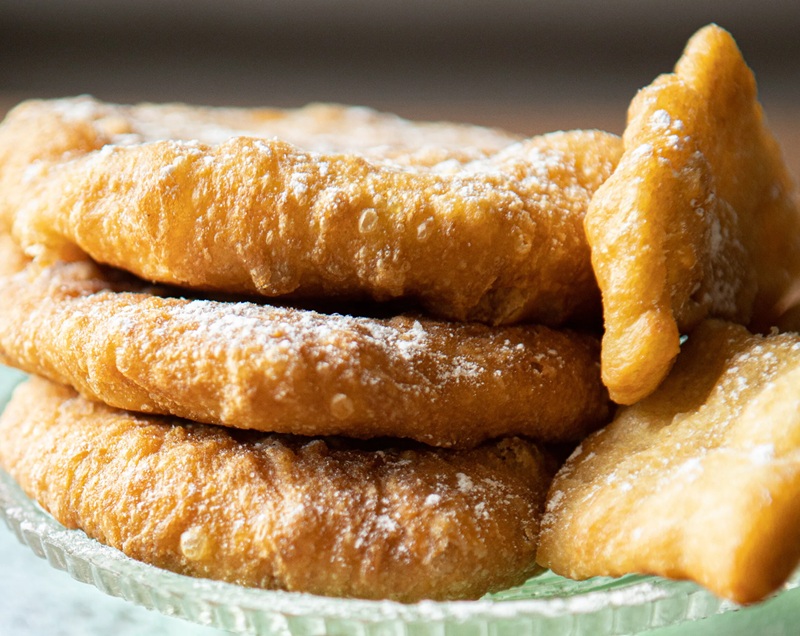
Peushkel
The simplest Uyghur donut: flour, water and yeast deep-fried till golden and dusted with icing sugar. Eaten warm for breakfast or with afternoon tea.
Overview
The most stripped-down Uyghur fried bread: flour, water, yeast, salt absent, sugar absent. The honesty of the ingredient list is the point, what you taste is fermented wheat, fresh oil, and the dusting of icing sugar on top. The hot-oil pass before shaping (the same technique that defines [[twisted-donuts]]) gives the surface a faint crackle and a darker fry colour than a plain yeasted dough would manage; the two short slits down the middle let steam escape and create the puffed shape that gives peushkel its silhouette. Smell is warm bread and frying oil, and very little else. Easy enough that this is the snack Uyghur children learn to make first, no measuring fussy quantities, no decorative shaping. Eaten across Xinjiang for breakfast with milk tea, or as a mid-afternoon pick-me-up, and a household staple in homes where every cookable scrap of flour matters; peushkel exists, in part, because it's what you can make when the cupboard is mostly bare.
Ingredients
Dough
- 150 g plain flour
- 70 ml water
- 2 g instant yeast
Hot-oil pass
- 40 ml olive oil (heated)
- ½ teaspoon baking soda
- 1 handful flour (for the pass)
To fry
- 1 ½ litres olive (or sunflower oil, for deep-frying)
- Icing sugar, to finish
Method
Stage 1 - Dough
- Combine flour, yeast and water; knead 10 minutes until smooth and uniform.
- Cover with a damp cloth; rise 2-6 hours at room temperature until doubled.
Stage 2 - Hot-oil pass
- Tip the dough into a bowl; flatten between your palms.
- Sprinkle the baking soda and the handful of flour over.
- Heat the 40 ml of oil until lightly smoking; pour straight onto the dough.
- Mix with a spoon until it cools enough to handle, then knead by hand into a smooth ball.
- Rest 5 minutes.
Stage 3 - Shape and fry
- Heat the frying oil to ~170°C / 340°F.
- Take walnut-sized pieces of dough; roll each into a ball.
- Flatten with a rolling pin to ~1 cm thick rounds.
- Make two short slits down the middle of each round.
- Gently lower 3-4 rounds at a time into the oil; fry 2-3 minutes until light gold, turning once.
- Lift onto kitchen paper.
- Dust generously with icing sugar while warm. Serve.
Notes
- Less is more: no milk, no sugar, no eggs is the point. The dough relies on the yeast and the hot-oil pass for flavour. Anything more makes a different donut.
- The two slits: the cuts give the dough room to puff and create the signature peushkel shape. Skip them and you get domed rounds.
- Eat warm: the dough firms as it cools. Best within the hour.
Storage
- Best the day of frying.
- Keep 1 day at room temperature in a paper bag; revive briefly in a hot oven.
More like this
Uyghur Twisted Donuts
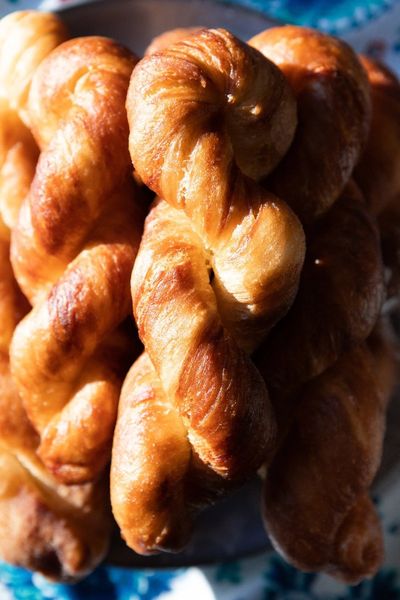
A fried dough with a glassy, slightly biscuit-crisp shell and a soft, chewy, slightly elastic interior, the texture you only get from a yeasted dough that's had a "hot-oil pass" before frying. Pouring smoking oil onto risen dough with a sprinkle of baking soda is the trick: the heat partially cooks the surface gluten, the baking soda neutralises some acidity, and the result fries up with a deeper colour and a crackle that plain donut dough can't manage. The flavour is simple and yeasty, sweetened only by the icing-sugar dusting at the end. Smell is warm wheat and fresh oil. The signature is the shape, a hand-twisted rope that doubles back on itself and counter-twists into a tight spiral, genuinely satisfying to make once you've got the rhythm. A bazaar street snack across Xinjiang, sold from glass-fronted carts next to milk-tea stalls; you eat one warm in the morning with milk tea and it's enough until lunch.
Sheker Manta
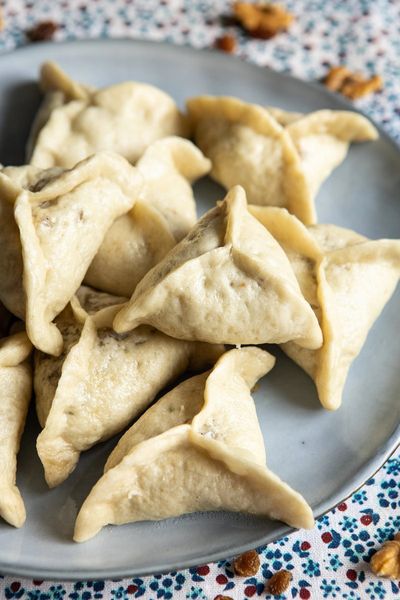
A sweet steamed dumpling with the surprising savoury-rich note of rendered lamb fat carrying the filling. Walnuts and raisins give crunch and chew respectively; sugar sweetens; and the lamb fat, slowly rendered to clear oil and stirred through warm, coats every piece of fruit and nut so the whole filling holds together as a glossy paste rather than a dry crumble. Vegetable oil is the standard vegetarian swap and works, but tastes lighter and lacks the meaty undertone that defines the original. The dough wrapper is yeasted and pillowy, slightly thicker in the centre than at the edges, and pinches into a clean triangle with a small visible swirl at the centre seam. Smell when the steamer lid lifts is warm wheat, walnut, and the faintest whisper of lamb. Not difficult but not quick, the dough wants 2 hours minimum to rise, and the wrap takes practice. A Uyghur snack with deep roots; the manta family of steamed dumplings runs across Central Asia from Turkey to Mongolia, and the Uyghur sweet variant is one of the few in that family that breaks the savoury convention.
Alur Chop
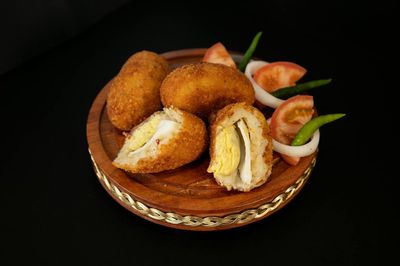
Alur chop (alu meaning potato, chop being a Bengali loan-word for a fried cutlet, inherited from the British "chop") is the workhorse of Bengali street snacks: every tea stall, every train platform, every late-afternoon adda has a stack of these warming under a glass cover. The construction is two layers. The inner mash is heavily seasoned: boiled potato folded through fried onion, ginger, green chilli, roasted cumin and a measured punch of Bengali bhaja moshla (a dry-roasted spice blend of cumin, coriander and dried chilli). Some versions add a few peanuts or roasted chana dal for crunch; in Kolkata the mash often includes a slick of mustard oil for fragrance. The outer shell is a thin chickpea-flour batter, the same family as beguni and piyaju, fried hot so it sets into a thin crisp casing rather than a heavy crust. The trick is contrast: a shell crisp enough to crackle, a centre soft and yielding and a touch wet from the onion. They are sold individually wrapped in newspaper for a few rupees and eaten standing up, often with muri puffed rice and a small dollop of kasundi (Bengali fermented mustard sauce) on the side. A monsoon and winter snack above all, when the cold air makes the hot oil and the inside-warm chop feel particularly right.
Beguni
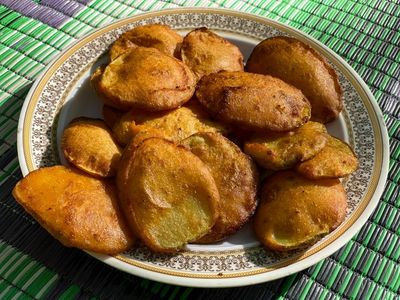
Beguni (from begun, the Bengali word for brinjal/eggplant) is the simplest of the great Bengali pakoras: long thin slices of aubergine, dipped in seasoned chickpea-flour batter and deep-fried. Done well, the contrast is everything, a shatteringly crisp shell with the lightly bitter, custard-soft eggplant inside. It is the defining iftar fritter across Bangladesh, where it appears every evening during Ramadan alongside piyaju (onion fritters) and chickpea ghugni; in West Bengal it is the tea-stall companion of muri and a monsoon-day comfort food. The technique is short on ingredients but particular: the eggplant must be salted first to draw out bitter water and prevent the slice from absorbing oil; the batter must be just thick enough to coat the back of a spoon, with the texture of double cream; and the oil must be hot enough (around 180 C) that the batter sets instantly into a crisp shell. The traditional fat is mustard oil heated until just smoking, then cooled briefly to take the raw edge off; this gives beguni its characteristic mustardy back-note. Nigella seeds (kalonji) in the batter are non-negotiable in Bangladesh, they pop slightly in the hot oil and give the fritter its distinctive aroma. Eat immediately, with a few slivers of raw onion, a green chilli and a wedge of lime.