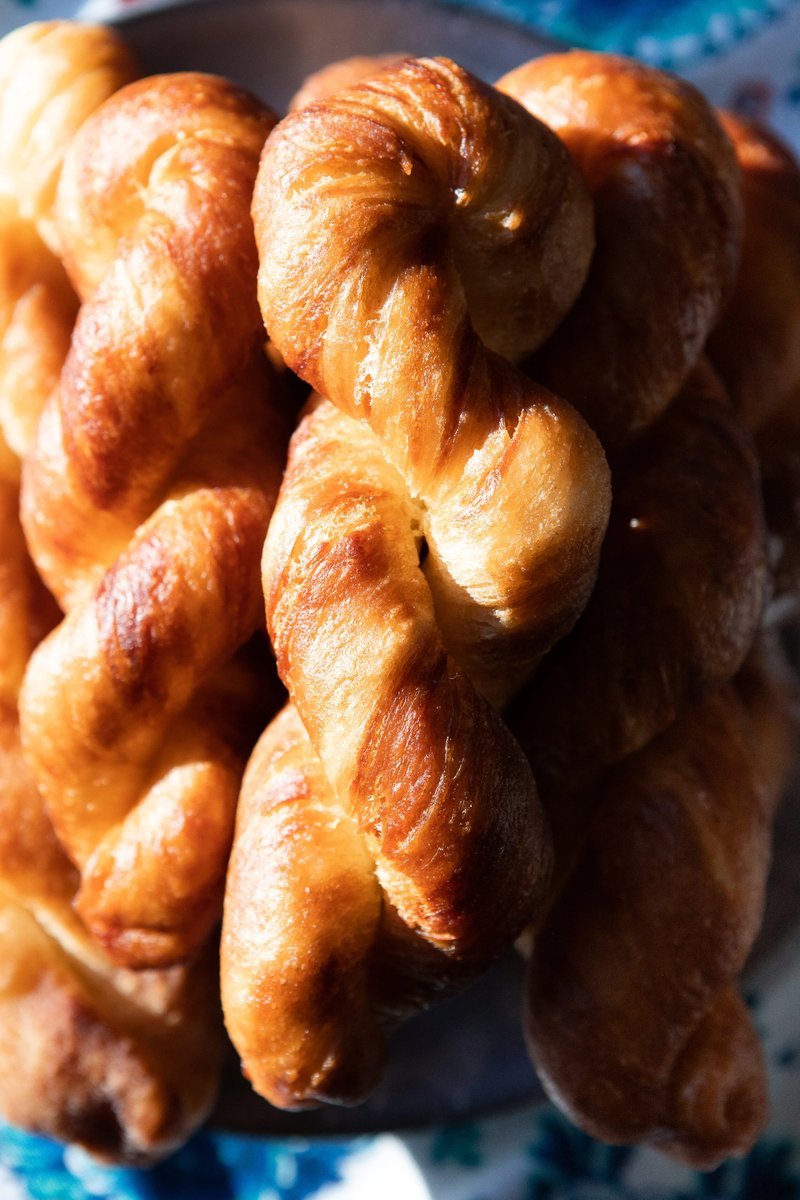
Uyghur Twisted Donuts
Uyghur fried-dough ropes: hand-twisted into spirals and deep-fried till golden, then dusted with icing sugar. A milk-tea companion across Xinjiang.
Overview
A fried dough with a glassy, slightly biscuit-crisp shell and a soft, chewy, slightly elastic interior, the texture you only get from a yeasted dough that's had a "hot-oil pass" before frying. Pouring smoking oil onto risen dough with a sprinkle of baking soda is the trick: the heat partially cooks the surface gluten, the baking soda neutralises some acidity, and the result fries up with a deeper colour and a crackle that plain donut dough can't manage. The flavour is simple and yeasty, sweetened only by the icing-sugar dusting at the end. Smell is warm wheat and fresh oil. The signature is the shape, a hand-twisted rope that doubles back on itself and counter-twists into a tight spiral, genuinely satisfying to make once you've got the rhythm. A bazaar street snack across Xinjiang, sold from glass-fronted carts next to milk-tea stalls; you eat one warm in the morning with milk tea and it's enough until lunch.
Ingredients
Dough
- 300 g plain flour
- 3 g instant yeast
- 30 g caster sugar
- 1 egg
- 120 ml water
- 1 teaspoon baking soda
- 30 ml sunflower oil (heated, for the dough)
To fry and finish
- Sunflower oil (or vegetable oil, 1 litre, for deep-frying)
- Icing sugar, to dust
Method
Stage 1 - Dough rise
- Combine flour, yeast, sugar, egg and water in a bowl. Knead 5 minutes until smooth.
- Cover with a damp cloth or cling film; rise 2-4 hours at room temperature until doubled.
Stage 2 - Hot-oil pass
- Sprinkle the baking soda and a small handful of flour over the risen dough.
- Heat the 30 ml of sunflower oil until lightly smoking; pour it directly onto the dough.
- Stir vigorously with a spoon (it'll be hot). When cool enough to handle, knead until smooth again.
- Cover and rest 10 minutes.
Stage 3 - Shape and twist
- Divide the dough into 7 equal pieces.
- Roll each into a rope ~28 cm long and 2 cm thick.
- Hold one end of the rope steady; with the other hand, twist tight (multiple rotations).
- Lift the rope off the surface; bring the two ends together. The rope will counter-twist on itself into a tight spiral.
- Repeat 1-2 more rotations until the spiral has 3-4 visible twists; pinch the ends to seal.
- Lay on a tray; rest 15-30 minutes, flipping once for even rise.
Stage 4 - Fry
- Heat the frying oil over medium-high heat to ~170°C / 340°F. Test with a wooden chopstick: small even bubbles around it means ready.
- Lower the heat to its lowest setting.
- Gently add 3-4 twists at a time; fry 2 minutes per side, 4-5 minutes total, until deep gold.
- Lift onto kitchen paper to drain.
- Dust with icing sugar while still warm. Serve immediately, or once cool.
Notes
- Hot oil into the dough: the second-stage hot oil + baking soda + flour pass is the Uyghur trick. The hot oil flavours the dough and the baking soda crisps the fried surface.
- Lowest heat for frying: the dough fries through to the centre at moderate heat. Hot oil burns the surface before the inside cooks.
- Twist count: more twists = tighter spiral = sturdier finished shape. Aim for 3-4 visible turns minimum.
Storage
- Eat the same day for best texture.
- Freezes well up to 1 month; thaw at room temperature.
More like this
Peushkel
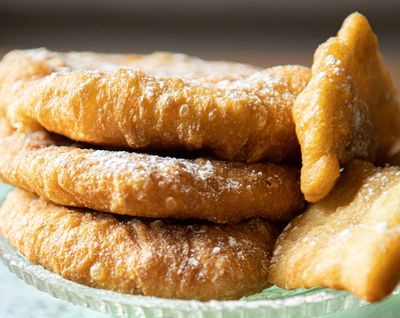
The most stripped-down Uyghur fried bread: flour, water, yeast, salt absent, sugar absent. The honesty of the ingredient list is the point, what you taste is fermented wheat, fresh oil, and the dusting of icing sugar on top. The hot-oil pass before shaping (the same technique that defines [[twisted-donuts]]) gives the surface a faint crackle and a darker fry colour than a plain yeasted dough would manage; the two short slits down the middle let steam escape and create the puffed shape that gives peushkel its silhouette. Smell is warm bread and frying oil, and very little else. Easy enough that this is the snack Uyghur children learn to make first, no measuring fussy quantities, no decorative shaping. Eaten across Xinjiang for breakfast with milk tea, or as a mid-afternoon pick-me-up, and a household staple in homes where every cookable scrap of flour matters; peushkel exists, in part, because it's what you can make when the cupboard is mostly bare.
Jian Bing
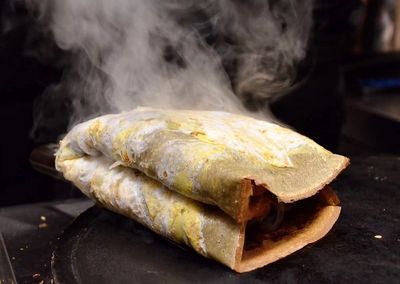
A thin batter of mung-bean flour, millet flour, plain flour, water, salt and five-spice is whisked to a single-cream consistency; rested for 1 hour. A wide flat griddle or large non-stick pan is heated; a ladle of batter is spread thinly with a wooden disc-rake (jian bing rake, or just rotate the pan to spread). An egg is cracked onto the crepe; smashed and spread with a spatula. The crepe is flipped; the cooked side is painted with sweet bean sauce and chilli paste; scattered with herbs; topped with a crisp wonton sheet; folded into quarters. Eaten warm, by hand.
Kimchijeon (Kimchi Pancake)
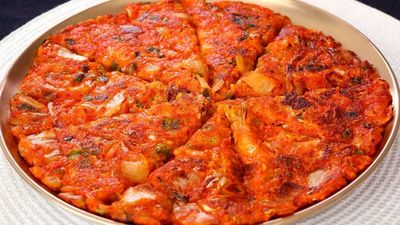
Well-fermented sour kimchi is chopped fine; the juice is reserved. A batter of plain flour, an egg, water and kimchi juice is mixed thin (consistency of pancake batter). Kimchi and chopped spring onion are stirred in. Half the batter is poured into a hot oiled pan, spread thin, fried for 4 minutes; flipped with a confident wrist or a wide spatula; fried another 3 minutes. Cut into wedges; eaten with soy-vinegar dip.
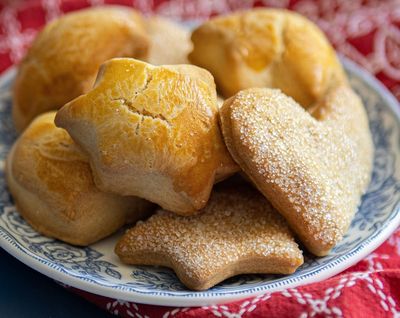
Pichene
Soft butter-yellow biscuits with a layer of crystalline white sugar pressed into the top before baking. The flavour is plain and clean: egg, milk, sunflower oil, baking soda, the kind of childhood cookie that's exactly as sweet as a child's tea wants. The sugar crust on top is the signature; pressing each cookie face-down into a plate of sugar before the tray is what bonds the topping, and it gives the finished biscuit a faint crunch over a soft, cake-like crumb underneath. Smell is buttery-vanilla even though there's no vanilla in the recipe. Genuinely easy to make: no chilling, no rolling-to-millimetres, no nuanced technique. Roll, cut, press into sugar, bake. A staple of Uyghur tea tables, packed into tin boxes for car journeys and bus trips across Xinjiang, and the snack that every Uyghur grandmother makes for visiting children. The shapes, stars, circles, hearts, are improvisational, so home versions look as varied as the cutters in the kitchen drawer.