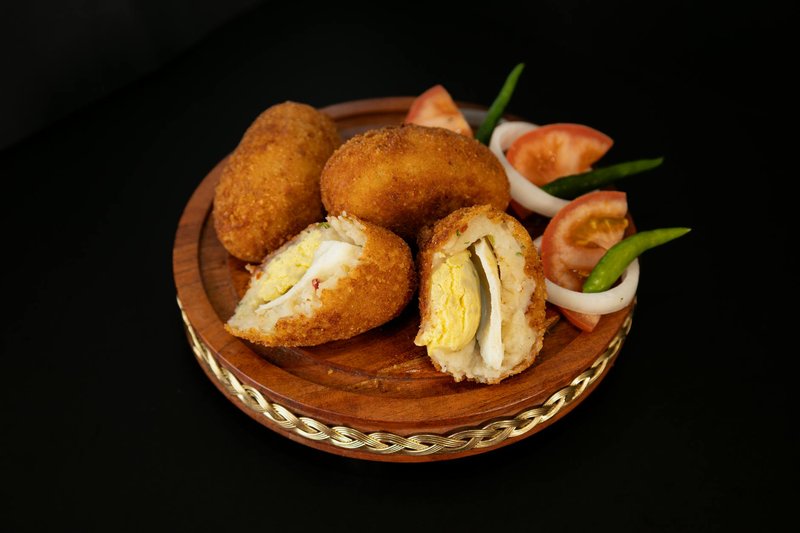
Alur Chop
Bengal's tea-stall croquette: a fist-sized ball of spiced mashed potato wrapped in chickpea-flour batter, deep-fried mahogany. Eaten with kasundi mustard.
Overview
Alur chop (alu meaning potato, chop being a Bengali loan-word for a fried cutlet, inherited from the British "chop") is the workhorse of Bengali street snacks: every tea stall, every train platform, every late-afternoon adda has a stack of these warming under a glass cover. The construction is two layers. The inner mash is heavily seasoned: boiled potato folded through fried onion, ginger, green chilli, roasted cumin and a measured punch of Bengali bhaja moshla (a dry-roasted spice blend of cumin, coriander and dried chilli). Some versions add a few peanuts or roasted chana dal for crunch; in Kolkata the mash often includes a slick of mustard oil for fragrance. The outer shell is a thin chickpea-flour batter, the same family as beguni and piyaju, fried hot so it sets into a thin crisp casing rather than a heavy crust. The trick is contrast: a shell crisp enough to crackle, a centre soft and yielding and a touch wet from the onion. They are sold individually wrapped in newspaper for a few rupees and eaten standing up, often with muri puffed rice and a small dollop of kasundi (Bengali fermented mustard sauce) on the side. A monsoon and winter snack above all, when the cold air makes the hot oil and the inside-warm chop feel particularly right.
Ingredients
Mash
- 500 g floury potatoes (peeled, cut into 3 cm chunks)
- 2 tbsp mustard oil
- 1 red onion (small, finely chopped)
- 15 g ginger (finely grated)
- 2 green chillies (finely chopped)
- ½ tsp ground turmeric
- 1 tsp roasted cumin powder
- ½ tsp ground coriander
- ½ tsp Kashmiri chilli powder
- ¾ tsp salt
- ½ tsp sugar (rounds out the spices, very Bengali)
- 1 tsp bhaja moshla (see notes), or extra roasted cumin
- 15 g fresh coriander (finely chopped)
- 1 tbsp lime juice
Batter
- 120 g chickpea flour (besan)
- 25 g rice flour
- ½ tsp nigella seeds (kalonji)
- ½ tsp ground turmeric
- ½ tsp Kashmiri chilli powder
- ¼ tsp baking soda
- ¾ tsp salt
- 150-170 ml cold water
To fry and serve
- 500 ml mustard oil (or neutral oil)
- 1 red onion (small, sliced into rings, to serve)
- 2 green chillies (to serve)
- Kasundi mustard (or tomato ketchup, to serve)
Method
Stage 1 - Boil the potatoes
- Boil the potato chunks in salted water for 12-15 minutes until completely tender.
- Drain very thoroughly; return to the dry pan over low heat for a minute to steam off remaining water.
- Mash smoothly with a fork or masher. The mash should be dry, not wet.
Stage 2 - Season the mash
- Heat the mustard oil in a small frying pan until just smoking; reduce the heat to medium.
- Add the onion; fry 4-5 minutes until soft and lightly golden.
- Add the ginger and green chilli; fry 1 minute more.
- Stir in the turmeric, roasted cumin, coriander and chilli powder; fry 30 seconds.
- Tip the spiced onion mixture into the mashed potato.
- Add the salt, sugar, bhaja moshla, fresh coriander and lime juice.
- Mix thoroughly until uniformly coloured. Taste and adjust salt and chilli.
- Cool until cool enough to handle.
Stage 3 - Shape
- Divide the mash into 8 equal portions (about 70 g each).
- Roll each portion firmly into a smooth oval croquette around 7 cm long. Pack them tightly so they don't fall apart in the oil.
- Set on a plate; chill 15 minutes if the mash feels too soft.
Stage 4 - Batter
- Whisk the chickpea flour, rice flour, nigella seeds, turmeric, chilli powder, baking soda and salt in a bowl.
- Whisk in the cold water gradually until the batter is smooth and the consistency of thick double cream - it should fully coat a chop without dripping in sheets.
Stage 5 - Fry
- Heat the frying oil in a karahi or deep pan to 180 C. If using mustard oil, bring it to smoking first then reduce the heat to take off the raw edge.
- Roll a chop in the batter, turning to coat evenly.
- Lift it out with a slotted spoon and lower carefully into the oil.
- Fry 2-3 chops at a time, turning gently with the spoon, for 4-5 minutes until deep golden brown all over.
- Lift onto kitchen paper; let the oil come back to temperature between batches.
Stage 6 - Serve
- Pile hot onto a plate.
- Serve with raw onion rings, whole green chillies and a spoonful of kasundi mustard on the side. A glass of hot milky tea is the proper accompaniment.
Notes
- Bhaja moshla: a roasted Bengali spice blend. Dry-toast 1 tbsp cumin seeds, 1 tbsp coriander seeds and 2 dried red chillies in a pan until very fragrant; cool and grind. Keeps in a jar for a month. A tiny pinch lifts almost any Bengali dish.
- Dry the mash: wet mash makes the chops fall apart in the oil and lets the batter slide off. After boiling, return the potatoes to the pan over low heat for a minute before mashing.
- Mustard oil for the mash: even a teaspoon of raw mustard oil stirred through the finished mash gives the authentic Bengali fragrance.
- Shaping: press firmly. A loose chop disintegrates the moment it hits hot oil.
- Variations: some Kolkata versions include a hard-boiled egg quartered inside the chop, or a few raisins and peanuts in the mash. Both are good.
Storage
- Best eaten within an hour of frying.
- The shaped, unfried chops can be refrigerated covered for up to a day, batter-coated and fried to order.
- Cooked chops re-crisp acceptably in a hot oven (200 C, 5 minutes); soggy reheats are not worth it.
More like this
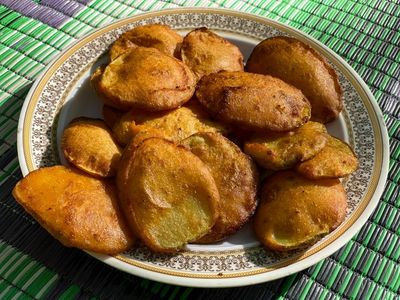
Beguni
Beguni (from begun, the Bengali word for brinjal/eggplant) is the simplest of the great Bengali pakoras: long thin slices of aubergine, dipped in seasoned chickpea-flour batter and deep-fried. Done well, the contrast is everything, a shatteringly crisp shell with the lightly bitter, custard-soft eggplant inside. It is the defining iftar fritter across Bangladesh, where it appears every evening during Ramadan alongside piyaju (onion fritters) and chickpea ghugni; in West Bengal it is the tea-stall companion of muri and a monsoon-day comfort food. The technique is short on ingredients but particular: the eggplant must be salted first to draw out bitter water and prevent the slice from absorbing oil; the batter must be just thick enough to coat the back of a spoon, with the texture of double cream; and the oil must be hot enough (around 180 C) that the batter sets instantly into a crisp shell. The traditional fat is mustard oil heated until just smoking, then cooled briefly to take the raw edge off; this gives beguni its characteristic mustardy back-note. Nigella seeds (kalonji) in the batter are non-negotiable in Bangladesh, they pop slightly in the hot oil and give the fritter its distinctive aroma. Eat immediately, with a few slivers of raw onion, a green chilli and a wedge of lime.
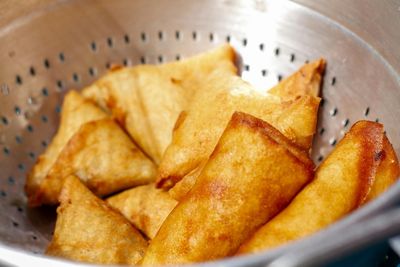
Burmese Samosa
The Burmese take on the South Asian samosa, with a thinner, crisper pastry and a milder filling than its Indian cousin. You make a hot-water dough that rolls out very thin so the fried shell ends up glassy and crisp rather than bready. The filling is mild by Indian standards: turmeric, ginger, fried onion and a whisper of cumin folded into mashed potato and peas, finished with crushed peanuts for the nuttiness that marks the Burmese version. The triangles fry at moderate heat until amber and crackling, the pastry blistering as it goes. Eaten hot dipped in tamarind sauce, or torn into chunks for a samusa-thoke salad later.
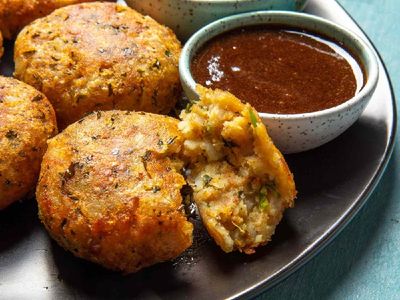
Aloo Tikki
Floury potatoes boil in their skins, then mash dry. A spice paste of green chilli, ginger and roasted cumin folds in with chopped coriander, mint and amchur for sourness. Cornflour and gram flour bind without making the tikki gummy. Patties form, chill to firm up, then shallow-fry in shallow oil on a flat pan for 4-5 minutes per side until deep gold and crisp with a soft interior. The chilled rest is what stops them falling apart.
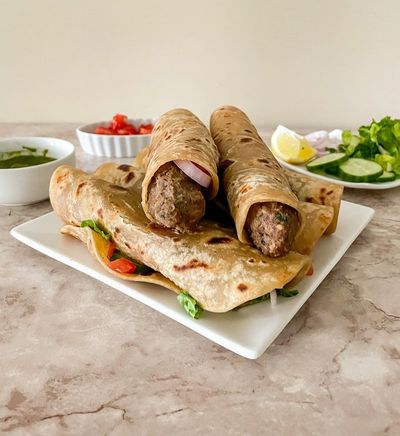
Seekh Kebab Roll
Lamb mince (with enough fat for tenderness; 20%) combines with grated onion (squeezed dry), ginger, garlic, green chilli, fresh coriander, mint, garam masala, ground cumin, ground coriander, salt and a small spoon of besan (chickpea flour, helps the mince cling to the skewer). Mixed vigorously for 3 minutes to develop the proteins. Rested for 1 hour. Shaped into long sausages on metal skewers (or wooden skewers soaked for 30 min). Grilled hard over charcoal (or under a screaming-hot grill) 8-10 minutes turning often, until charred and just-cooked. Pulled off the skewers onto warm parathas; rolled with sliced onion, fresh coriander, mint chutney; eaten by hand.