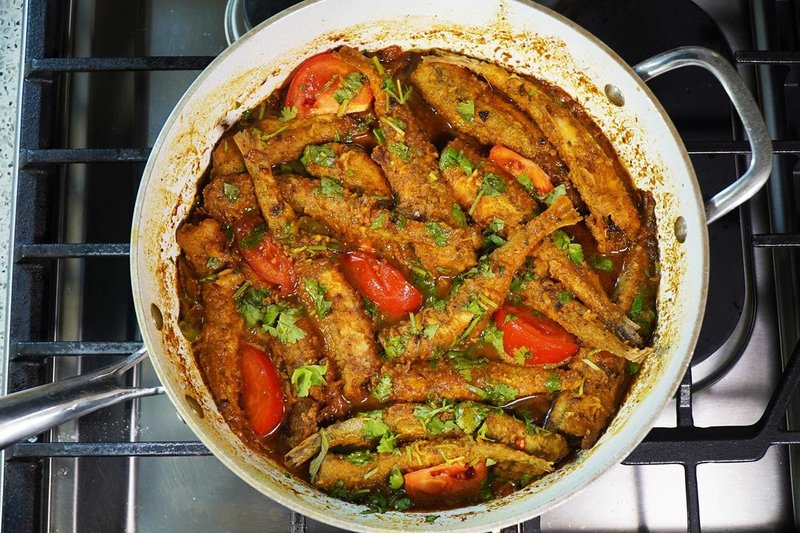
Curry Smelts
Trinidad's comfort dish: small whole fish seasoned with green seasoning, lightly floured, fried crisp, then dropped into a Caribbean curry of roasted geera and chilli.
Overview
Trinidadian comfort food that brings together the East Indian and Afro-Caribbean strands of Trini cookery in one pan: small whole fried fish (a West African and Caribbean coastal habit) drowned in a Trinidadian East Indian curry sauce. The fish are smelts, sardines or whitebait, whole, head-on, eaten with a small bite to remove the spine. Once fried they sit crisp; when the curry sauce hits, the outer crust softens slightly and absorbs the gravy while the centre stays meaty. The sauce is the dish's signature: roasted geera (dry-toasted cumin) gives a smoky, nutty depth that pre-ground supermarket cumin can't touch, anchar masala adds a fermented-tangy edge (it's the Trinidadian pickled-mango spice mix), and Caribbean curry powder rounds the warmth. Whole pierced Scotch bonnet scents without flooring. Smell when the spices bloom in hot oil is heavy and pungent in the best possible way. Not difficult but it's a two-pan dance, so timing matters. A daily-cookery dish across Trinidad and Tobago and the Indo-Trinidadian diaspora, eaten with steamed rice or with sada roti torn and used as a scoop.
Ingredients
- 700 g (1 ½ lbs) smelts (or sardines, anchovies, whitebait)
- 1 lime (or lemon, juiced)
- 1 teaspoon salt
- 1 teaspoon black pepper (divided)
- 1 ½ tablespoons Caribbean green seasoning
- ¾ cup plain flour
- 500 ml vegetable oil (for frying)
- 1 ½ tablespoons vegetable oil (for sauce)
- 1 onion (small, diced)
- 6 garlic cloves (smashed)
- 1 Scotch bonnet (whole, pierced)
- ¾ tablespoon anchar masala
- ¾ tablespoon ground roasted geera (cumin)
- 2 tablespoons Curry Powder
- 480 ml water
- 2 tablespoons chopped cilantro
Method
Stage 1 - Prep the fish
- Wash the smelts with lime/lemon juice and cool water; pat dry.
- Season in a wide bowl with salt, half the black pepper and the green seasoning. Toss to coat.
Stage 2 - Fry the fish
- Dust the seasoned smelts lightly with flour.
- Heat the frying oil in a heavy pan to 175°C / 350°F.
- Fry in batches 5-7 minutes until golden and crisp.
- Drain on paper towels.
Stage 3 - Curry sauce
- Pour the water into the bowl that held the seasoned fish - the residual marinade flavours the sauce.
- Heat the 1 ½ tablespoons of oil in a wide saucepan over medium heat.
- Add the onion, garlic and whole pierced Scotch bonnet. Cook 1 minute until fragrant.
- Reduce heat to low.
- Add the roasted geera, anchar masala, remaining black pepper and curry powder. Stir 4 minutes - the spices should darken and release their oils.
- Pour in the seasoned water; increase to medium-high.
- Reduce by ~25% until the sauce deepens in colour.
Stage 4 - Combine
- Return the fried smelts to the pan.
- Spoon the sauce over to coat.
- Simmer 3-4 minutes until the sauce thickens and the fish absorbs the curry.
- Loosen with a splash of water if too thick.
Stage 5 - Serve
- Taste; adjust salt.
- Scatter chopped cilantro over.
- Serve with coconut rice or sada roti.
Notes
- Roasted geera is the heart: the dry-toasted cumin gives the dish its deep nutty character. Pre-ground supermarket cumin is a poor substitute - roast whole seeds dry and grind.
- Anchar masala specifically: a Trinidadian spice mix for pickled mangoes; gives a tangy, fermented edge to the curry. Garam masala is the closest substitute.
- Fry first, then curry: the pre-frying lets the fish hold shape through the curry simmer. Skip it and the fish disintegrates.
Storage
- Best eaten fresh.
- Keeps 2 days refrigerated; the fish softens but flavour deepens.
- Don't freeze - the fish texture suffers.
More like this
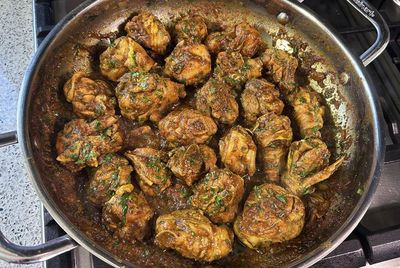
Bunjay-Style Curry Chicken
A dry curry rather than a saucy one, "bunjay" is Trinidadian patois for "fry-down", the technique of cooking meat in its own juices until the gravy completely disappears and the spices coat the surface of the meat in a sticky, glaze-like crust. The flavour is concentrated rather than diluted; nothing's been thinned with water or coconut milk, so what you taste is bone-in chicken, rendered chicken fat, and toasted spice. The spice mix is the East Indian Trinidadian signature: turmeric for colour and earth, roasted geera (toasted cumin, ground) for nuttiness, anchar masala for tang, regular curry powder for breadth. The pan oil splits and separates around the chicken at the end, which is the visual cue you're looking for. Smell when the curry powder hits hot oil is deeply aromatic, almost incense-like. Not difficult but it requires attention during the cook-down phase; if you walk away the curry burns onto the bottom of the pan. A Trinidadian household staple, eaten across the country with white rice and dhal, and a clean example of how Indian indentured labourers' descendants in the Caribbean evolved a distinct curry tradition over 150 years.
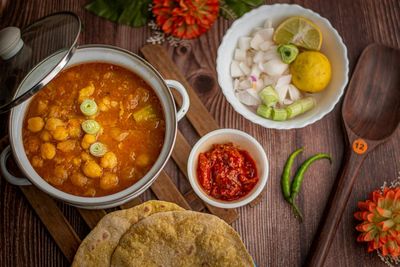
Buss-Up-Shut Roti with Curry
Buss-up-shut, also called paratha roti, is the flaky-layered Trinidadian roti that takes its English name from "burst-up shirt", a buss-up-shut roti is one that has been beaten the moment it comes off the tawa until it explodes into soft, irregular shreds. It is descended from the South Asian paratha, brought by indentured Indian labourers in the 19th century and rebuilt in Trinidad with a softer, more elastic dough and a finishing technique that is uniquely local. The recipe here covers the roti itself, which is the demanding part, with a short Trini channa-aloo curry on the side so you have a proper plate to scoop with. The layering technique (rolling, brushing with oil, coiling, resting, rolling out) is what creates the laminated, flaky structure. The beating step uses two wooden spatulas (called "klappers" in some roti shops) and looks dramatic but is straightforward. Difficulty is moderate; the dough is forgiving but the rolling-and-coiling step needs a little practice. Once you have a feel for it, you will make this every fortnight.
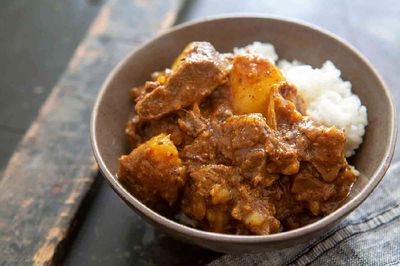
Trinidadian Curry Goat
Trinidadian curry goat sits in a quiet rivalry with Jamaican curry goat, but the two are different dishes. Jamaican curry goat is built on Madras-style curry powder, scotch bonnet and allspice with little coconut and a wetter finish. Trinidadian curry goat is built on a fresh blend of green seasoning (a herb-and-aromatic puree of culantro, thyme, garlic, chives and onion), Caribbean curry powder (which leans heavily on amchar masala and roasted geera), and the bunjay technique of frying the curry paste in oil until it splits before the meat goes in. The result is a darker, herbier, drier curry that hugs the bone rather than pooling around it. Kid goat is the preferred meat; older mutton-goat works but takes longer. UK home cooks can usually find kid goat at Caribbean butchers, Halal butchers and many Asian supermarkets in the chilled or frozen section. Bone-in pieces are essential for flavour and gelatin. Lamb shoulder on the bone makes an honest substitute. Difficulty is low to moderate; the cook is mostly long and passive once the curry is bunjayed. Serve with paratha-style "buss-up-shut" roti, dhalpuri roti, white rice, or coconut rice.
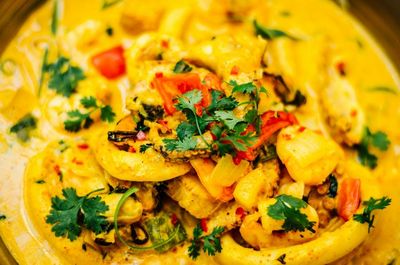
Octopus Curry (Cari Ourite)
Cari ourite is the dish that turns up at every Mauritian fisherman's Sunday lunch, and at every Creole restaurant on the south coast. The technique is to braise octopus low and slow in a tomato-and-onion masala that leans on fresh thyme and a finishing pinch of garam masala instead of the heavier dried-spice masalas you find in cari boeuf or cari poulet. Octopus has a sweet, slightly mineral flavour that needs space, so the seasoning is restrained: thyme for aroma, tomato for body, ginger and garlic for the base, mild curry powder for depth, garam masala right at the end for top-note warmth. The tentacles cook for around 45 minutes (small octopus) to an hour (larger). The biggest variable is the octopus itself; small frozen octopus, sold cleaned at most fishmongers and many supermarkets, is reliable and the freezing actually helps tenderise the flesh. Difficulty is moderate; the cook is mostly passive once the masala is built. Serve with plain steamed rice and a satini cotomili (coriander chutney) or a spoon of pickled chilli. A simple green salad with vinaigrette on the side keeps it honest.