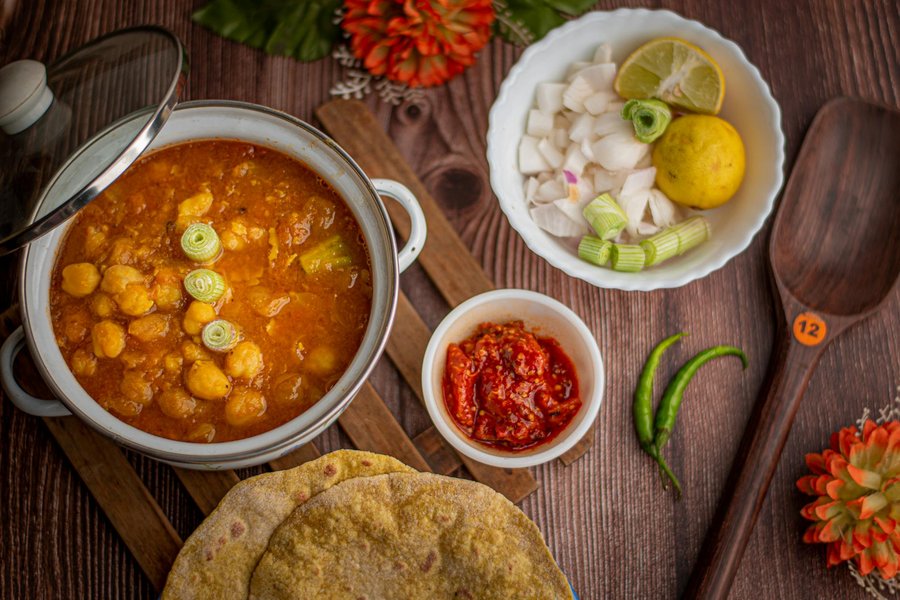
Buss-Up-Shut Roti with Curry
Trinidad's torn paratha: a soft flaky flatbread beaten straight off the heat till it bursts into rough fluffy pieces. Served with a quick channa-and-aloo.
Overview
Buss-up-shut, also called paratha roti, is the flaky-layered Trinidadian roti that takes its English name from "burst-up shirt", a buss-up-shut roti is one that has been beaten the moment it comes off the tawa until it explodes into soft, irregular shreds. It is descended from the South Asian paratha, brought by indentured Indian labourers in the 19th century and rebuilt in Trinidad with a softer, more elastic dough and a finishing technique that is uniquely local. The recipe here covers the roti itself, which is the demanding part, with a short Trini channa-aloo curry on the side so you have a proper plate to scoop with. The layering technique (rolling, brushing with oil, coiling, resting, rolling out) is what creates the laminated, flaky structure. The beating step uses two wooden spatulas (called "klappers" in some roti shops) and looks dramatic but is straightforward. Difficulty is moderate; the dough is forgiving but the rolling-and-coiling step needs a little practice. Once you have a feel for it, you will make this every fortnight.
Ingredients
Dough
- 500 g plain flour, plus extra for dusting
- 1 ½ tsp baking powder
- 1 tsp salt
- 2 tbsp neutral oil, plus 4-5 tbsp for brushing
- 280-300 ml warm water
Channa and aloo curry (filling)
- 1 can (400 g) chickpeas, drained and rinsed
- 2 potatoes (medium, about 400 g, peeled and cut into 2 cm cubes)
- 3 tbsp neutral oil
- 1 onion (medium, finely chopped)
- 5 garlic cloves (minced)
- 1 tbsp Caribbean green seasoning
- 2 tbsp Caribbean curry powder
- ½ tsp ground turmeric
- ¾ tsp ground roasted geera (cumin)
- 1 Scotch bonnet (whole, pricked, optional)
- 1 sprig fresh thyme
- 500 ml water (or stock)
- 1 tsp salt, or to taste
- Small handful chopped chadon beni (or coriander)
- 1 lime, cut in wedges
Method
Stage 1 - Mix and rest the dough
- Combine the flour, baking powder and salt in a wide bowl. Stir in the 2 tbsp oil.
- Add the warm water gradually, mixing as you go, until you have a soft, slightly sticky dough. Adjust with extra flour or water as needed; the dough should feel slightly tackier than a pizza dough.
- Knead 6-8 minutes until smooth and very elastic.
- Cover with a damp cloth and rest 1 hour at room temperature. This long rest is essential for the layering to work.
Stage 2 - Start the curry
- Heat the oil in a heavy saucepan over medium heat.
- Add the onion and cook 4-5 minutes until soft.
- Stir in the garlic, green seasoning and thyme. Cook 1 minute.
- Mix the curry powder, turmeric and roasted geera with 4 tbsp water to make a paste. Tip into the pan and bunjay (fry, stirring) 2-3 minutes until the paste darkens and the oil starts to separate.
- Add the potatoes and stir to coat in the curry. Cook 2 minutes.
- Add the chickpeas, Scotch bonnet, water and salt. Bring to a simmer.
- Cover and cook 20-25 minutes until the potatoes are tender and beginning to break down at the edges, thickening the gravy. Crush a few of the chickpeas with the back of a spoon for body. Taste for salt and discard the Scotch bonnet and thyme stem. Keep warm.
Stage 3 - Divide and roll
- Turn the rested dough onto a lightly floured surface. Divide into 4 equal pieces (loyahs); each should weigh around 200 g. Roll each into a smooth ball.
- Working with one ball at a time, dust with flour and roll out to a thin round about 25 cm across.
- Brush the surface generously with oil (about 1 tsp per roti).
- Make a single straight cut from the centre of the round to the edge.
- Starting from one side of the cut, roll the dough tightly into a cone shape, finishing at the other side of the cut. Press the tip of the cone down into the wide end to form a compact spiral. This is the lamination.
- Cover the spirals with a damp cloth and rest 20 minutes.
Stage 4 - Final roll-out
- Flatten one spiral with the palm of your hand, dust with flour, and roll out very gently to a thin round about 28-30 cm across. Use light pressure; pressing too hard squeezes out the layers.
- Set aside on a dusted surface. Repeat with the remaining spirals. Do not stack them.
Stage 5 - Cook on the tawa
- Heat a wide tawa, crepe pan or large flat frying pan over medium-high heat for 2 minutes.
- Lay a rolled roti onto the dry pan. Cook 30-40 seconds until it lifts easily and the underside has light brown spots.
- Flip with a wide spatula. Brush the top with oil and the edges. Cook 30-40 seconds.
- Flip again, brush the other side with oil, and cook 20-30 seconds. The roti should be soft and pliable with brown spots, never crisp.
Stage 6 - Buss it up
- Slide the cooked roti straight off the pan onto a clean cloth or sheet of greaseproof paper.
- Using two wooden spatulas, immediately beat and clap the roti from the edges towards the centre while it is still hot. Within 15-20 seconds the layers will burst apart into soft, fluffy shreds.
- Pile the buss-up-shut into a covered bowl or wrap in a clean cloth to keep warm and soft. Repeat with the rest.
Notes
- Long rest, soft dough: the hour-long rest after kneading and the 20 minutes after coiling are what let the gluten relax. Skipping either gives you a tough roti.
- The cut-and-coil is the lamination: the cut and spiral is what creates the layered structure. Roll the cone tightly but not so tight you tear it.
- Light hand on the final roll: press too hard and you squeeze the layers shut, which means no buss-up-shut. Long, light passes with a rolling pin from centre out.
- Beat it hot: the roti has to be beaten the moment it comes off the tawa, while it is still hot enough for the steam between the layers to do the work. A cool roti will not buss.
- Two spatulas, not hands: the roti is too hot for hands. Two wooden spatulas, or one spatula and a clean cloth, work best.
Variations
Dhalpuri filling: Stuff each dough ball with a tablespoon of seasoned ground split-pea powder (see the Mauritian dholl puri for the technique) before the cone-and-coil step. Sada roti: Skip the oil-brushing and coiling for plain, thicker sada roti; cook longer per side. Curry duck or curry chicken alongside: Channa-aloo is the everyday roti shop pairing, but Trinidadian curry chicken or curry duck both work brilliantly.
Serving
Lay a buss-up-shut on each plate. Spoon the channa-aloo curry alongside (not on top; the roti is for scooping). A wedge of lime, a scatter of chadon beni or coriander, and a small dish of pepper sauce. Tear the roti by hand to scoop up the curry.
Storage
- Roti is best eaten fresh from the cloth. Will keep soft 3-4 hours wrapped.
- Refrigerated roti goes stiff; reheat 15-20 seconds per side on a dry tawa to soften.
- Channa-aloo keeps 3 days refrigerated and reheats well with a splash of water.
- Freeze cooked (but un-bussed) roti between sheets of greaseproof for up to 1 month. Defrost, reheat and beat to buss.
More like this
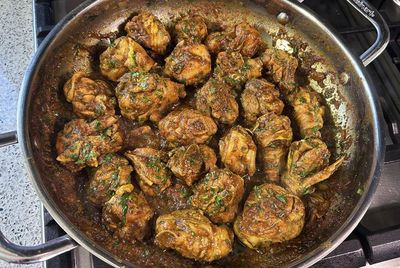
Bunjay-Style Curry Chicken
A dry curry rather than a saucy one, "bunjay" is Trinidadian patois for "fry-down", the technique of cooking meat in its own juices until the gravy completely disappears and the spices coat the surface of the meat in a sticky, glaze-like crust. The flavour is concentrated rather than diluted; nothing's been thinned with water or coconut milk, so what you taste is bone-in chicken, rendered chicken fat, and toasted spice. The spice mix is the East Indian Trinidadian signature: turmeric for colour and earth, roasted geera (toasted cumin, ground) for nuttiness, anchar masala for tang, regular curry powder for breadth. The pan oil splits and separates around the chicken at the end, which is the visual cue you're looking for. Smell when the curry powder hits hot oil is deeply aromatic, almost incense-like. Not difficult but it requires attention during the cook-down phase; if you walk away the curry burns onto the bottom of the pan. A Trinidadian household staple, eaten across the country with white rice and dhal, and a clean example of how Indian indentured labourers' descendants in the Caribbean evolved a distinct curry tradition over 150 years.
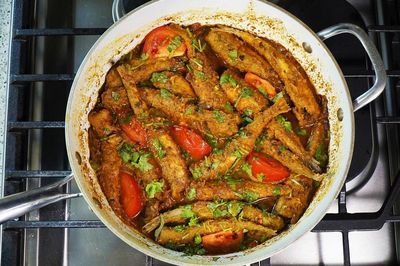
Curry Smelts
Trinidadian comfort food that brings together the East Indian and Afro-Caribbean strands of Trini cookery in one pan: small whole fried fish (a West African and Caribbean coastal habit) drowned in a Trinidadian East Indian curry sauce. The fish are smelts, sardines or whitebait, whole, head-on, eaten with a small bite to remove the spine. Once fried they sit crisp; when the curry sauce hits, the outer crust softens slightly and absorbs the gravy while the centre stays meaty. The sauce is the dish's signature: roasted geera (dry-toasted cumin) gives a smoky, nutty depth that pre-ground supermarket cumin can't touch, anchar masala adds a fermented-tangy edge (it's the Trinidadian pickled-mango spice mix), and Caribbean curry powder rounds the warmth. Whole pierced Scotch bonnet scents without flooring. Smell when the spices bloom in hot oil is heavy and pungent in the best possible way. Not difficult but it's a two-pan dance, so timing matters. A daily-cookery dish across Trinidad and Tobago and the Indo-Trinidadian diaspora, eaten with steamed rice or with sada roti torn and used as a scoop.
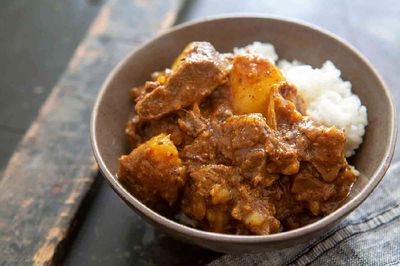
Trinidadian Curry Goat
Trinidadian curry goat sits in a quiet rivalry with Jamaican curry goat, but the two are different dishes. Jamaican curry goat is built on Madras-style curry powder, scotch bonnet and allspice with little coconut and a wetter finish. Trinidadian curry goat is built on a fresh blend of green seasoning (a herb-and-aromatic puree of culantro, thyme, garlic, chives and onion), Caribbean curry powder (which leans heavily on amchar masala and roasted geera), and the bunjay technique of frying the curry paste in oil until it splits before the meat goes in. The result is a darker, herbier, drier curry that hugs the bone rather than pooling around it. Kid goat is the preferred meat; older mutton-goat works but takes longer. UK home cooks can usually find kid goat at Caribbean butchers, Halal butchers and many Asian supermarkets in the chilled or frozen section. Bone-in pieces are essential for flavour and gelatin. Lamb shoulder on the bone makes an honest substitute. Difficulty is low to moderate; the cook is mostly long and passive once the curry is bunjayed. Serve with paratha-style "buss-up-shut" roti, dhalpuri roti, white rice, or coconut rice.
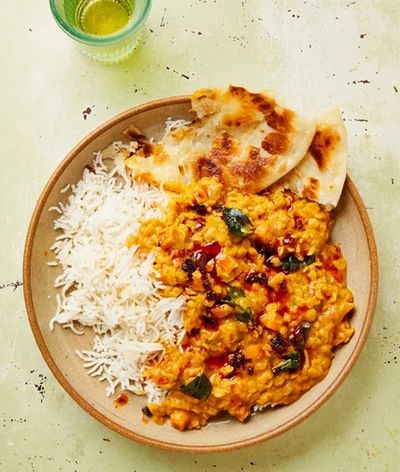
Malaysian Dhal Curry
Yellow split peas (chana dal) simmer with onion, turmeric and tomato until very soft. The lentils break down into a thick soup. Right at the end, a tempering of mustard seeds, curry leaves, dried red chillies, garlic and shallots is poured sizzling-hot over the surface. The aromatic oil seeps through; the dish transforms.