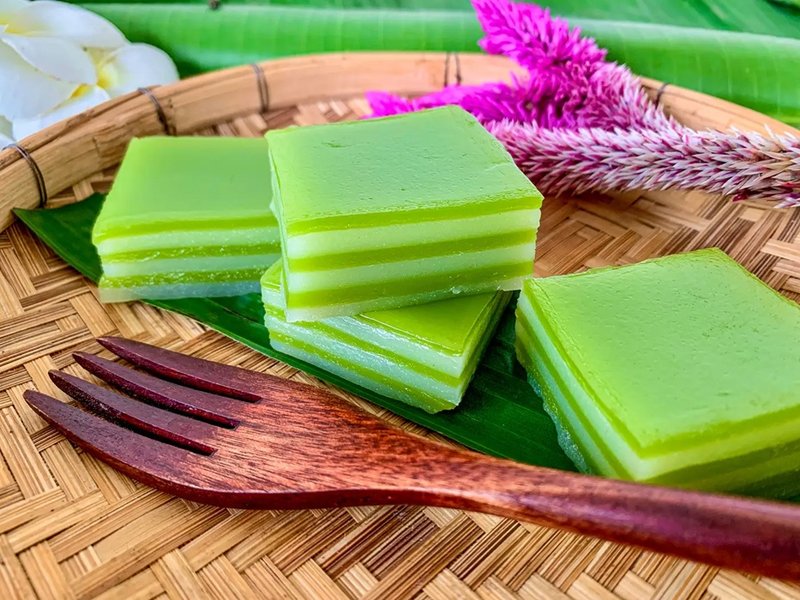
Kanom Chan
Thailand's auspicious layer cake: nine pandan-and-coconut-milk jelly layers, each set before the next is poured. Eaten at weddings.
Overview
A single batter is made: rice flour, tapioca starch, mung-bean starch (for the right texture), coconut milk, sugar, salt and pandan extract for fragrance and green colour. The batter divides into two bowls: one stays plain (white-cream), the other gets a strong dose of pandan extract for vivid green. A square tin lines a bamboo steamer. Layer one (green) pours in 4-5 mm thick; steam for 5-6 minutes until just set. Layer two (white) pours over; steam again. Alternate until 9 thin layers are built (or 8, or 7, odd numbers preferred). Cool fully, cut into squares with an oiled knife.
Ingredients
Batter
- 200 g rice flour
- 200 g tapioca starch (sometimes labelled tapioca flour)
- 50 g mung-bean starch (or substitute cornflour if unavailable)
- 350 g caster sugar
- 1 teaspoon salt
- 900 ml coconut milk
- 200 ml water
- 1 teaspoon natural pandan extract (or 2 tablespoons fresh pandan juice - see Notes)
- A few drops of green food colour (only if the pandan is weak; pandan extract is usually enough)
To prepare the tin
- 1 teaspoon vegetable oil (for greasing)
Method
Stage 1 - Set up steamer
- Choose a 20 cm square tin (or a round dish 22 cm across) that fits inside your steamer.
- Lightly grease the inside with vegetable oil.
- Bring water to a boil in a wide pot underneath the steamer base.
Stage 2 - Mix the batter
- In a large bowl, whisk rice flour, tapioca starch, mung-bean starch, sugar and salt.
- Slowly pour in the coconut milk, whisking continuously to avoid lumps.
- Add the water.
- Whisk to a smooth, lump-free batter - strain through a sieve into a measuring jug for total smoothness.
Stage 3 - Divide
- Divide the batter into two equal portions.
- Leave one plain (this will be the white-cream layer).
- Stir the pandan extract into the other (this will be the green layer).
- If the green isn't vivid enough, add a few drops of green food colour.
Stage 4 - First layer
- Place the empty tin inside the steamer over boiling water.
- Cover; pre-heat the empty tin 2 minutes.
- Pour about 4-5 mm of green batter into the tin (roughly a 9th of the green batter - measure with a ladle and check with a ruler if needed).
- Cover; steam 5-6 minutes until firmly set (poke with a clean finger; the surface should be matte and resilient, not wet).
Stage 5 - Subsequent layers
- Without lifting the tin out, pour 4-5 mm of white batter directly onto the set green layer.
- Cover; steam another 5-6 minutes.
- Continue alternating: green, white, green, white… until 9 layers total (or your batter is used up).
- Don't pour wet batter onto a damp surface - each layer must be fully set before the next is added or they'll bleed together.
Stage 6 - Final cook
- After the final layer is poured, cover and steam an additional 10 minutes to ensure everything is fully set through.
Stage 7 - Cool
- Lift the tin out of the steamer.
- Cool to room temperature, 1 hour minimum.
- Cover and refrigerate at least 2 hours to firm fully.
Stage 8 - Cut and serve
- Run a clean oiled knife around the edges; invert onto a board or lift out using cling-film handles if you lined the tin.
- Cut into 2 cm squares or 2 x 4 cm rectangles with an oiled knife (oil prevents sticking).
- Optional traditional eating: pull the layers apart with the fingers, layer by layer.
Notes
- Pandan options: Real pandan juice (from blending fresh or frozen pandan leaves with water and straining) gives the truest flavour and a softer green. Concentrated pandan extract (sold in bottles labeled "Pandan Essence" at Asian shops) is much more potent and gives a vivid colour - use sparingly. A few drops of green food colour can help if the pandan colour is weak.
- Three starches, not one: Rice flour gives the body, tapioca starch gives the chew, mung-bean starch gives the snap. Substituting all rice flour gives a softer, more porridge-like texture. Substituting cornflour for mung-bean works in a pinch.
- Each layer fully set: Pouring wet batter onto an unset layer mixes the colours into a marbled mess. Test with a finger before pouring the next layer.
Storage
- Refrigerate 5 days in an airtight container. Each piece can be wrapped individually in cling film.
- Bring to room temperature 15 minutes before eating; chilled kanom chan is too firm.
- Doesn't freeze - the starch structure breaks down on thaw.
More like this
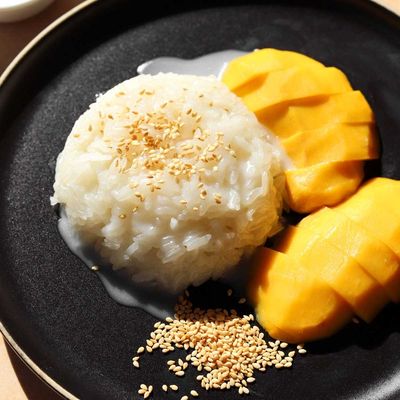
Mango Sticky Rice
Glutinous (sticky) rice is soaked at least 6 hours, then steamed for 20-25 minutes over boiling water until pearly and chewy. While the rice steams, a coconut sauce is warmed gently, coconut milk, palm sugar, salt, and (optionally) a pandan leaf for fragrance, until just dissolved, never boiled. Most of this sauce is poured over the freshly steamed rice while still hot; the rice absorbs over 15 minutes covered. The remaining sauce, plus a separate pour of plain coconut cream, dresses the plated dish. Ripe mango is sliced; toasted sesame and (optionally) toasted mung beans top.
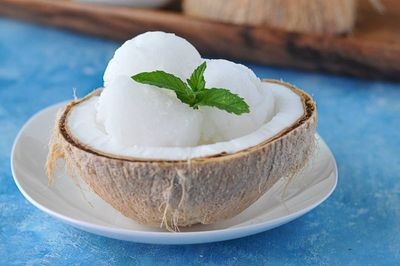
Thai Coconut Ice Cream
A custard-free, fully coconut ice cream. Coconut milk (full-fat) and coconut cream combine with palm sugar, glucose syrup (or honey, keeps the texture smooth) and salt; warm together gently to dissolve the sugar. Cool fully (4 hours fridge or an ice bath). Churn in an ice-cream machine for 25-30 minutes until thick and creamy. Transfer to a container; freeze 2+ hours to firm. Serve in small bowls or, for the Bangkok cart presentation, in halved fresh coconut shells, topped with any combination of: small banana slices, sticky rice, roasted peanuts, sweet red beans, palm-sugar syrup, toasted coconut.
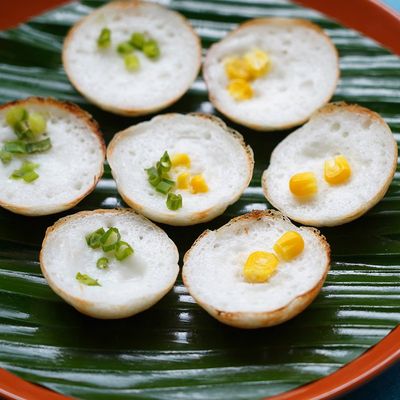
Khanom Krok
Two batters. The first (the base) is rice flour, palm sugar, salt, coconut milk and a small amount of mung-bean flour; rests for 2 hours so the rice flour hydrates. The second (the top) is just coconut cream, salt and a pinch of rice flour. A khanom krok pan (or an aebleskiver pan, or a takoyaki pan) is heated; each dimple is brushed with oil; the base batter goes in three-quarters; covered briefly to set; the top coconut-cream batter spoons over to fill; covered again; the half-spheres release when the bottom is golden and the tops are barely jiggling. Two are paired together and served on a small banana-leaf square.
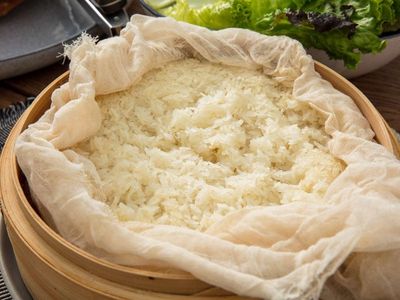
Khao Niao
Sticky rice must be the right variety: Thai glutinous rice (also called sweet rice, sticky rice, or kao niao, looks the same as ordinary white rice but opaque white when raw, not translucent). Soak the rice 4-12 hours in cold water until grains can be crushed easily between fingers. Drain. Steam over (not in) boiling water for 20-25 minutes in a traditional bamboo cone, banana leaves, or a steamer lined with muslin. Test by tasting a grain, fully cooked, chewy, slightly translucent. Transfer to a covered bamboo basket or wooden bowl for serving.