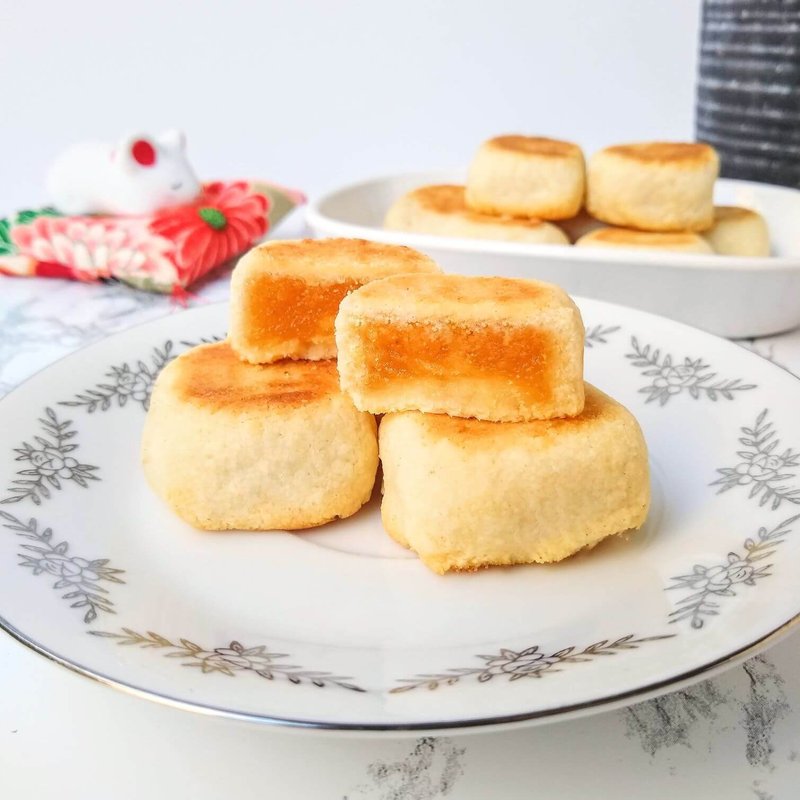
Pineapple Cake
Taiwan's signature gift cake: small shortbread rectangles filled with thick chewy pineapple jam, baked golden in metal moulds and individually wrapped.
Overview
The filling cooks first: fresh or tinned pineapple (drained well), maltose syrup, sugar, and butter cook down for 30+ minutes into a thick, golden, chewy jam. The dough is a classic shortbread of butter, icing sugar, egg yolk and flour with milk powder for tenderness. Each cake wraps a ball of cooled pineapple paste in dough, presses into a square or rectangular metal mould, bakes pale gold.
Ingredients
Pineapple paste
- 600 g fresh pineapple (peeled, cored; or drained tinned pineapple chunks)
- 100 g caster sugar
- 50 g maltose syrup (or honey + 1 tablespoon glucose syrup)
- 30 g unsalted butter
- A pinch of salt
Dough
- 200 g unsalted butter (softened)
- 60 g icing sugar (sifted)
- 2 egg yolks (large)
- 30 g full-fat milk powder
- 280 g plain flour
- A pinch of salt
Equipment
- 16 small rectangular pineapple cake moulds (about 5 x 4 cm) - or use mini-loaf tins, or shape free-form
Method
Stage 1 - Pineapple paste
- Pulse the pineapple in a food processor to a coarse rubble (or grate by hand). Squeeze out and discard about half the juice - too much liquid means the paste won't thicken.
- Tip the squeezed pulp into a wide heavy pan.
- Add the sugar, maltose syrup, butter and salt.
- Cook over medium-low heat, stirring often, 30-40 minutes until the mixture is thick, golden, and pulls away from the pan when the spoon is drawn through. The colour should deepen to caramel-gold.
- Cool fully; refrigerate at least 30 minutes (warm filling is too soft to wrap).
Stage 2 - Divide the filling
- Once cool and firm, divide the paste into 16 equal balls (about 18 g each); roll each into a small oval. Refrigerate while you make the dough.
Stage 3 - Dough
- Cream the butter and icing sugar in a wide bowl until pale.
- Beat in the egg yolks one at a time.
- Mix in the milk powder, flour and salt with a spatula until just combined.
- Wrap and rest 15 minutes (don't refrigerate fully - too cold and it cracks during shaping).
Stage 4 - Shape
- Heat the oven to 170°C (150°C fan).
- Divide the dough into 16 equal pieces (about 35 g each).
- Flatten one piece in your palm into a disc.
- Place a pineapple ball in the centre; bring the edges of the dough up around the filling; pinch closed and roll smooth.
- Place the wrapped ball into a metal mould; press flat to fill the mould evenly.
- Set the mould on a parchment-lined baking sheet.
- Repeat for all 16.
Stage 5 - Bake
- Bake 18-22 minutes until pale gold (don't take them brown).
- After 12 minutes, flip each mould (with the cake inside) so the other side colours evenly.
- Cool 5 minutes; carefully unmould while still warm.
- Cool fully on a wire rack.
Stage 6 - Serve
- Eat at room temperature with hot tea.
- Wrap individually in plastic if giving as gifts; the cakes keep their shape and stay tender.
Notes
- Maltose vs honey: Maltose syrup gives the chewy texture that's authentic pineapple cake. Honey works as a substitute but the filling is slightly stickier.
- Drain the pineapple hard: Excess liquid means the paste won't reach the right consistency in cooking time. Squeeze through a sieve or muslin.
- Pale, not golden: Pineapple cakes are baked light. Deep gold means overdone - the texture goes from tender shortbread to dry biscuit.
Storage
- Keeps 2 weeks at room temperature in an airtight tin; flavour deepens.
- Don't refrigerate (firms the shortbread); freezes 2 months.
More like this
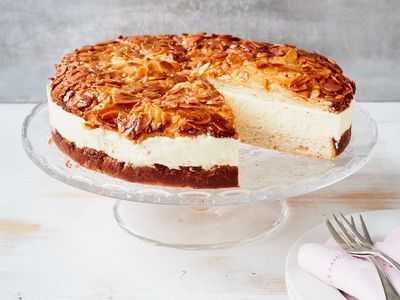
Bienenstich
A milk-and-butter enriched yeast dough proves to soft and pillowy. A honey-almond topping (butter, honey, sugar, cream, flaked almonds) cooks on the stovetop until thickly bubbling, then spreads on the proved dough and bakes together: the dough rises, the topping caramelises golden and chewy. Once cooled, the cake splits horizontally and fills with thick vanilla pastry cream (Konditorcreme) lightened with whipped cream.
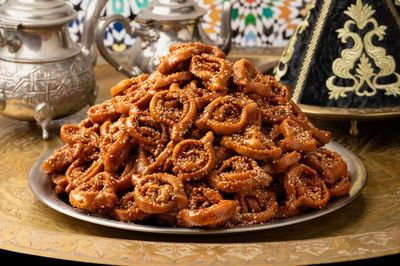
Chebakia (Sesame Honey Rosettes)
A dough rich in toasted sesame seeds, almond, aniseed, cinnamon, orange-flower water, melted butter and a touch of saffron rests for 1 hour. Rolled thin (3 mm); cut into rectangles; each rectangle slits 4 times lengthways but not through. Each piece folds and twists into a rosette by threading one corner through the centre slits. Fries in moderately hot oil. Hot rosettes plunge into warmed honey + orange-flower water; soaked for 2 minutes; lifted; sprinkled with sesame.
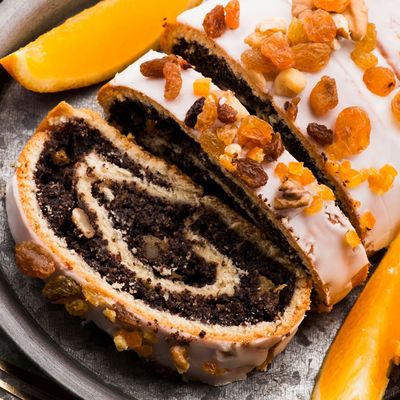
Makowiec
The filling starts the night before: poppy seeds soak then simmer in milk and cook to a thick paste with honey, butter, vanilla, raisins, walnuts and candied peel. The next day, an enriched yeast dough rolls into a thin rectangle, spreads thickly with the cold poppy filling, and rolls into a tight log. After a final prove, it bakes in a long tin until the dough is bronze. Once cool, a thin lemon glaze drizzles across the top and a scatter of candied peel finishes it.
Pakhlava (Azerbaijani)
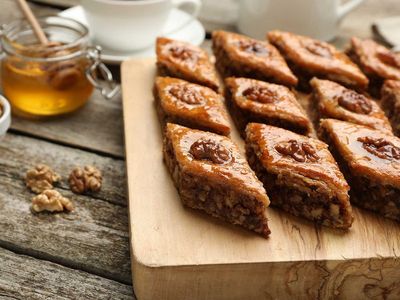
The Azerbaijani take on the pan-Caucasus pastry that goes by half a dozen names across the region. You make an enriched dough from flour, butter, milk, egg yolks and yeast, then roll it into eight layers stacked with a heavy filling of crushed walnuts spiced with cardamom and saffron between each one. The top gets scored in the traditional diamond pattern, brushed with saffron-tinted egg yolk so it bakes to a deep amber, and a single walnut pressed into the centre of each diamond as a marker. Forty-five minutes at 180°C, then a saffron-honey syrup poured generously over while it's still hot from the oven. The trick the recipe insists on is the overnight rest before slicing; that's when the syrup absorbs fully and the layers set so the diamonds cut cleanly. Eaten at Novruz, weddings and feast days, with strong black tea on the side.