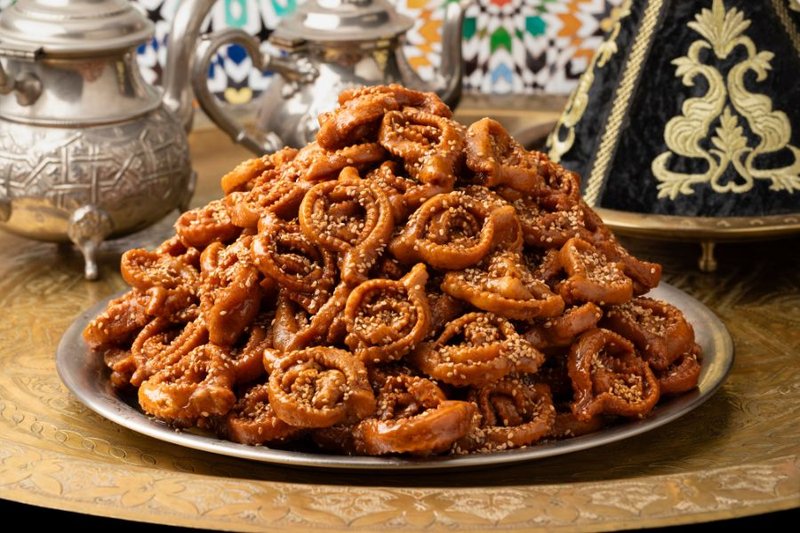
Chebakia (Sesame Honey Rosettes)
Morocco's Ramadan rosette: a sesame-and-almond dough cut and twisted into ornate flowers, deep-fried, plunged into warm honey, dusted with more sesame.
Overview
A dough rich in toasted sesame seeds, almond, aniseed, cinnamon, orange-flower water, melted butter and a touch of saffron rests for 1 hour. Rolled thin (3 mm); cut into rectangles; each rectangle slits 4 times lengthways but not through. Each piece folds and twists into a rosette by threading one corner through the centre slits. Fries in moderately hot oil. Hot rosettes plunge into warmed honey + orange-flower water; soaked for 2 minutes; lifted; sprinkled with sesame.
Ingredients
Dough
- 500 g plain flour
- 200 g toasted sesame seeds (lightly ground)
- 100 g almonds (toasted, finely ground)
- 1 tablespoon ground aniseed
- 1 tablespoon ground cinnamon
- 1 teaspoon salt
- 1 pinch saffron threads (ground, steeped in 2 tablespoons hot water)
- 1 sachet (7 g) instant yeast
- 100 g unsalted butter (melted, cooled slightly)
- 2 eggs (large)
- 3 tablespoons white vinegar
- 4 tablespoons orange-flower water
- 100 ml warm water (or as needed)
Frying
- 1 litre neutral oil
Honey glaze
- 700 g clear honey
- 3 tablespoons orange-flower water
Finishing
- 100 g toasted sesame seeds (for sprinkling)
Method
Stage 1 - Dough
- In a wide bowl, combine flour, ground sesame, ground almond, aniseed, cinnamon, salt and yeast.
- Add the melted butter, eggs, vinegar, orange-flower water and saffron infusion.
- Mix to a shaggy dough; add warm water as needed to bring together.
- Knead 8 minutes to a smooth, slightly sticky dough.
- Rest 1 hour covered.
Stage 2 - Roll and cut
- Roll the rested dough on a lightly floured surface to 3 mm thick.
- Cut into rectangles 8 × 5 cm.
- With a sharp knife, slit each rectangle lengthways 4 times - slits should not reach the ends (the dough must stay in one piece).
Stage 3 - Shape rosettes
- Take one rectangle; hold by the two short ends.
- Thread one corner through the centre slit, pulling out the other side.
- Pinch the corners to set the shape.
- Practice on a few - the goal is an open flower / rosette form.
- Set on a tray.
Stage 4 - Warm the honey
- In a wide pan, warm the honey with the orange-flower water until just liquid (not boiling).
- Keep warm.
Stage 5 - Fry
- Heat the oil to 170°C.
- Lower 4-5 chebakia at a time; fry 3-4 minutes, turning, until deep amber.
- Lift directly into the warm honey.
Stage 6 - Soak
- Submerge in honey 2 minutes (use a slotted spoon to push them under).
- Lift onto a wire rack; let excess drip.
- Sprinkle with toasted sesame seeds while still sticky.
- Cool fully.
Notes
- Rosette shaping takes practice: your first chebakia will look terrible. By the 10th they're recognisable; by the 20th they're beautiful. Watch a YouTube video of a Moroccan grandmother folding chebakia - it's mesmerising.
- Toasted sesame in the dough, not raw: raw sesame tastes bland. Toast 200 g in a dry pan 4 minutes till fragrant, then grind lightly.
- Honey HOT enough to penetrate, NOT boiling: boiling honey turns bitter. Body-temperature warm is perfect.
- Soak fully: chebakia depends on the deep honey absorption. Skimping on soaking gives dry chebakia.
Storage
- Keeps 3 weeks at room temperature in a sealed tin.
- Don't refrigerate.
- Best on day 2 when the honey has distributed fully.
More like this
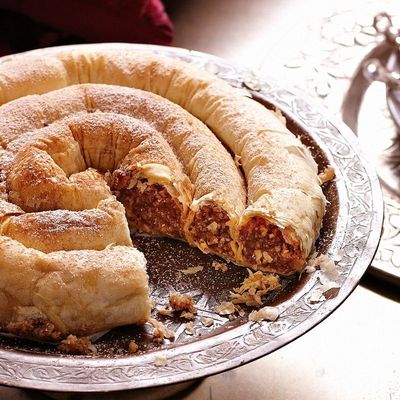
m'Hencha (Almond Snake Coil)
Almond paste: ground almonds, icing sugar, melted butter, cinnamon, orange-flower water, mixes to a soft pliable paste. Rolls into long ropes 1 cm thick. Warka sheets lay flat, almond ropes line one long edge, sheet rolls into a long thin cylinder. Several cylinders form (typically 4-6). Brushes with egg-yolk wash. Starting at the centre of a buttered round tin, the first cylinder coils tightly; subsequent cylinders join end-to-end with a brush of water, continuing the coil outward until the tin is filled. Top brushes with butter; bakes at 180°C 35 minutes till deep gold. Dusts with icing sugar in a crisscross pattern, with lines of cinnamon between.
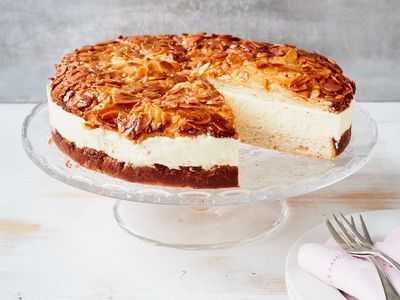
Bienenstich
A milk-and-butter enriched yeast dough proves to soft and pillowy. A honey-almond topping (butter, honey, sugar, cream, flaked almonds) cooks on the stovetop until thickly bubbling, then spreads on the proved dough and bakes together: the dough rises, the topping caramelises golden and chewy. Once cooled, the cake splits horizontally and fills with thick vanilla pastry cream (Konditorcreme) lightened with whipped cream.
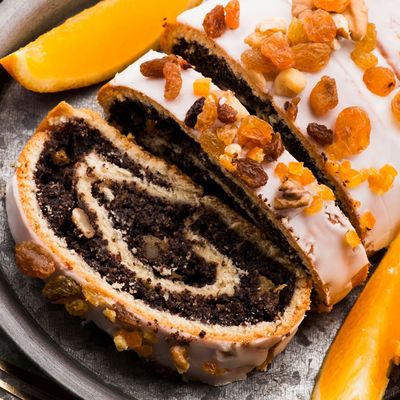
Makowiec
The filling starts the night before: poppy seeds soak then simmer in milk and cook to a thick paste with honey, butter, vanilla, raisins, walnuts and candied peel. The next day, an enriched yeast dough rolls into a thin rectangle, spreads thickly with the cold poppy filling, and rolls into a tight log. After a final prove, it bakes in a long tin until the dough is bronze. Once cool, a thin lemon glaze drizzles across the top and a scatter of candied peel finishes it.
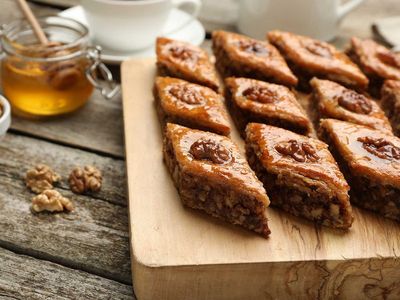
Pakhlava (Azerbaijani)
The Azerbaijani take on the pan-Caucasus pastry that goes by half a dozen names across the region. You make an enriched dough from flour, butter, milk, egg yolks and yeast, then roll it into eight layers stacked with a heavy filling of crushed walnuts spiced with cardamom and saffron between each one. The top gets scored in the traditional diamond pattern, brushed with saffron-tinted egg yolk so it bakes to a deep amber, and a single walnut pressed into the centre of each diamond as a marker. Forty-five minutes at 180°C, then a saffron-honey syrup poured generously over while it's still hot from the oven. The trick the recipe insists on is the overnight rest before slicing; that's when the syrup absorbs fully and the layers set so the diamonds cut cleanly. Eaten at Novruz, weddings and feast days, with strong black tea on the side.