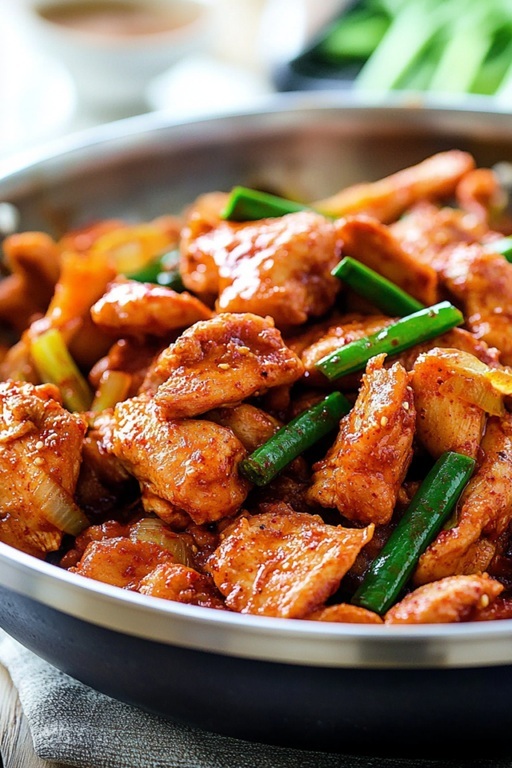
Dak Galbi
Korean spicy chicken stir-fry: chicken thighs marinated in gochujang sauce, cooked on a flat hot pan with cabbage, sweet potato and rice cakes. A communal dish in Korea, eaten straight from the central pan with rice and lettuce wraps.
Overview
Boneless chicken thighs cube up and marinate in a gochujang-soy-garlic-ginger paste with mirin and sugar. They stir-fry hard with onion, sweet potato chunks, cabbage and Korean rice cakes (tteok). Often finished with cheese melted over for the modern variant; classic version skips it.
Ingredients
Marinade
- 800 g boneless chicken thighs (cut into 3 cm chunks)
- 4 tablespoons gochujang
- 2 tablespoons gochugaru
- 3 tablespoons soy sauce
- 2 tablespoons mirin
- 2 tablespoons brown sugar
- 4 garlic cloves (crushed)
- 1 tablespoon grated ginger
- 1 tablespoon toasted sesame oil
Stir-fry
- 2 tablespoons vegetable oil
- 1 onion (sliced)
- 1 sweet potato (small, peeled, cubed; about 200 g)
- ¼ small cabbage (chopped into 3 cm pieces)
- 200 g Korean rice cakes (tteokbokki / tteok), soaked in warm water for 10 minutes if using dried
- 4 spring onions (cut into 4 cm pieces)
- 1 tablespoon toasted sesame seeds
- 100 g mozzarella (optional, for the cheesy variant)
To serve
- Cooked short-grain rice
- Lettuce leaves (for wraps)
Method
Stage 1 - Marinate
- Combine all marinade ingredients in a bowl.
- Toss the chicken through; refrigerate at least 1 hour, ideally 4.
Stage 2 - Pre-cook the sweet potato
- Boil the cubed sweet potato for 3-4 minutes until just tender. Drain.
Stage 3 - Stir-fry
- Heat the vegetable oil in a large heavy pan or wok over high heat.
- Add the marinated chicken; stir-fry for 4-5 minutes until starting to caramelise.
- Add the onion and sweet potato; cook another 3 minutes.
- Add the cabbage and rice cakes; cook 4-5 minutes, tossing, until the cabbage is tender and the rice cakes are soft.
- Add the spring onions and a splash of water if it looks dry.
Stage 4 - Optional cheese
- Push the stir-fry to one side of the pan.
- Scatter mozzarella in the cleared space; cover briefly until melted.
Stage 5 - Serve
- Bring the pan straight to the table.
- Set out lettuce leaves and rice; diners build wraps with chicken, cheesy melt and rice.
- Scatter sesame seeds over.
Notes
- Hot pan, no overcrowding: Dak galbi is a high-heat stir-fry. A crowded pan steams; the result is greasy and dull.
- Rice cakes (tteok): Cylindrical or sliced; both work. Find at any Korean shop; soak briefly if dried.
- Cheese is divisive: Classic Korean diners skip it; the modern Seoul version melts cheese over. Either way works.
Storage
- Keeps 2 days refrigerated. Reheat in a pan with a splash of water.
More like this
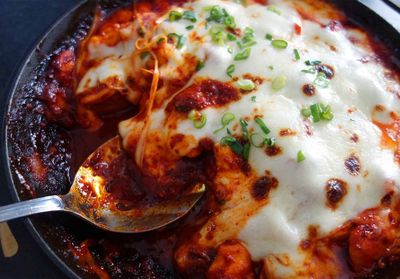
Buldak
Boneless chicken thighs cube small; marinate for 1 hour in gochujang, gochugaru, soy, garlic, ginger, sugar and sesame oil. Pan-grill in a wide cast-iron skillet over medium-high until the sauce caramelises and the chicken is just cooked. Off heat, generous mozzarella scatters across the top; cover briefly or finish under a grill to melt. Top with sesame seeds and spring onions.
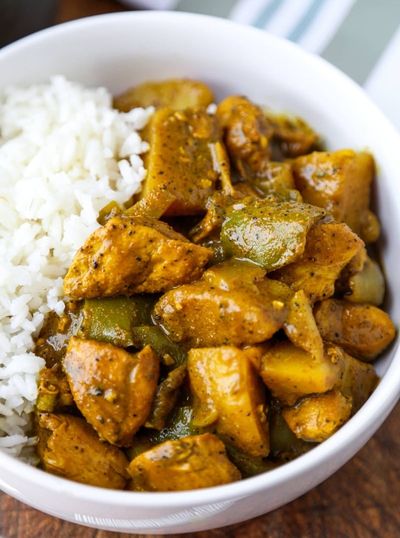
Authentic Jamaican Curry Chicken
Jamaican curry sits in its own corner of the global curry map: heavier on turmeric and allspice than Indian Madras, lighter on cumin, and built on a technique called "burning the curry" that gives the dish its character. The technique is exactly what it sounds like, dry curry powder hits hot oil and is stirred for 30 seconds until it darkens from yellow to deep gold and smells like toasted spice. That move concentrates the flavours and removes any raw edge. The finished stew is bright yellow stained slightly orange, savoury and aromatic rather than searingly hot, with thyme and a whole pierced Scotch bonnet scenting the gravy without flooring it. Smell: bloomed curry powder, allspice, browned chicken fat. Not difficult, but requires confidence in the 30-second bloom (under-do it and the dish is flat; over-do it and you have to start over). A Sunday-dinner staple across Jamaica and the diaspora, served over white rice with the gravy spooned generously over.
Cantonese BBQ Chicken
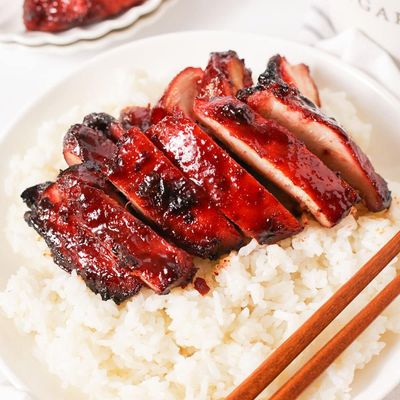
This is summer-BBQ adaptation of the lacquered red roast meats that hang in the windows of Cantonese siu mei shops. The marinade borrows from char siu (hoisin, soy, Shaoxing wine, five-spice, fermented bean curd, garlic, ginger) but pulls back on the sugar slightly because chicken does not need as much sweetness as pork shoulder. Bone-in skin-on thighs are the right cut: they stay juicy on the grill, the skin renders down and crisps, and the bones give the meat shape. A two-stage glaze does the rest. The thighs cook over indirect heat first to render the fat and set the meat, then move directly over the coals for the last few minutes while a honey-maltose mixture is brushed on repeatedly. Every brush of glaze caramelises, blackens slightly at the edges, then gets brushed again. The result is sticky-shiny with a smell that is half five-spice, half woodsmoke. Difficulty is low if you control your heat. A two-zone fire (one side coals piled high, the other side empty) is the only real requirement; on a gas grill, two burners on full and one off does the same job. Serve sliced over plain rice with sliced cucumber and a spoon of chilli oil, or stuffed into bao with hoisin and spring onion.
Cheesy Jerk Chicken Nachos
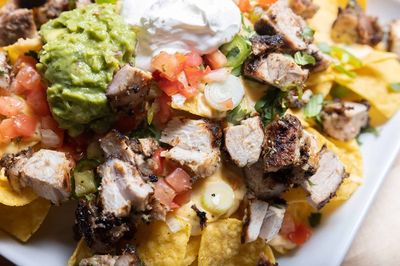
A Caribbean-American fusion that works because both food cultures speak the language of "everything on one tray". The base is American nachos: tortilla chips, melted cheese, black beans. On top sits jerk-marinated chicken thigh, which carries the dish's flavour, allspice, Scotch bonnet, nutmeg, cinnamon, thyme, soy and brown sugar blended into a wet jerk paste, marinated into the meat overnight, then oven-baked and sliced. The fresh element on top is a Trinidadian-style fruit chow: diced mango, pineapple, red bell pepper and red onion dressed with lime juice and cilantro. The chow is what makes this work; without it the nachos are just spicy meat-and-cheese, with it the dish has acid, crunch and sweetness to cut through the richness. Smell is melted cheese hitting jerk seasoning, with a citrus-tropical lift from the chow on top. Not difficult but it's three components running on different timelines, so plan ahead. A modern party-and-Super-Bowl-tray dish rather than something a Kingston grandmother makes, popularised by Caribbean-American food bloggers in the 2010s.