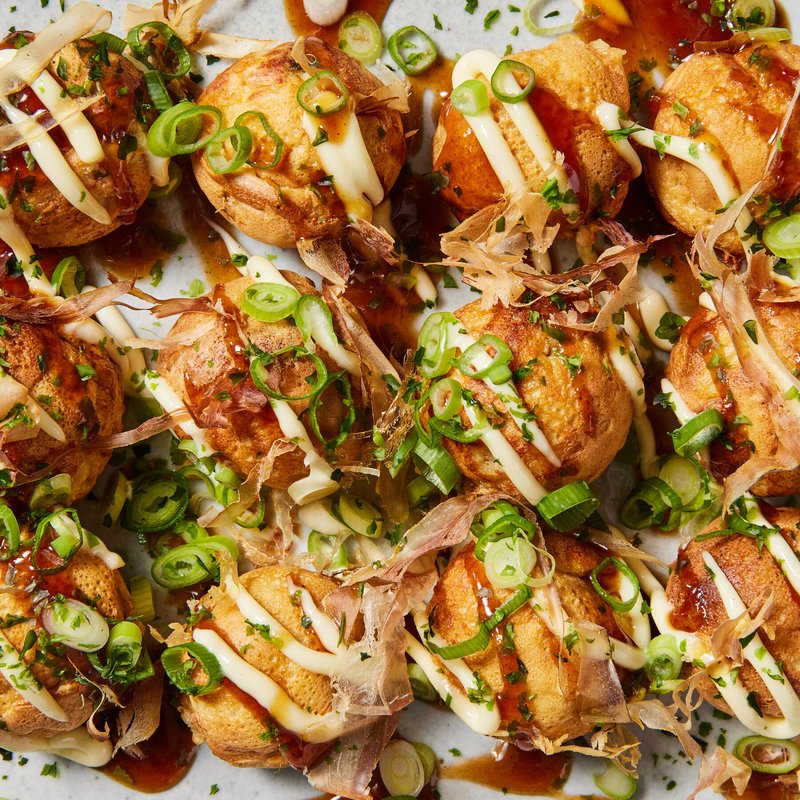
Takoyaki
Osaka's octopus balls: a dashi-spiked batter cooked in a dimpled pan around chunks of octopus, finished with sauce and dancing bonito.
Overview
A thin batter is whisked from plain flour, dashi (Japanese stock), eggs, a touch of soy and mirin, salt, like a thin pancake batter. The takoyaki pan (cast-iron or non-stick with half-spherical dimples) heats; each dimple oils with vegetable oil. Batter fills each dimple plus the connecting flat surface (overflow is intentional). A small piece of pre-cooked octopus, a pinch of pickled red ginger, a few cubes of tempura crumbs (tenkasu) and a sprinkle of spring onion drop into each dimple. As the bottom sets, a sharp wooden skewer rotates each ball: scrape the overflow from around each, fold it into the bottom, twist 90° to expose the wet top, allow it to set, twist another 90°, eventually achieving a complete sphere. Cooked until golden all around. The balls are plated and drizzled with takoyaki sauce and mayo, then scattered with bonito flakes and aonori.
Ingredients
Batter
- 200 g plain flour
- 600 ml dashi (from instant dashi powder - 1 tablespoon dissolved in 600 ml hot water - OR homemade)
- 2 eggs (large)
- 1 tablespoon light soy sauce
- 1 tablespoon mirin
- ½ teaspoon salt
- 1 teaspoon baking powder
Fillings
- 200 g cooked octopus tentacle (sold pre-cooked at Japanese / Mediterranean shops - cut into 1 ½ cm chunks; about 30 pieces total)
- 4 tablespoons pickled red ginger (beni shoga - sold in jars at Japanese shops; finely chopped)
- 4 spring onions (finely chopped, white and green)
- 4 tablespoons tempura crumbs (or tenkasu, sold in packets; or substitute crushed plain rice crackers)
For cooking
- 4 tablespoons vegetable oil (for greasing the pan)
Toppings
- 4 tablespoons takoyaki sauce (sold in bottles; or substitute: 3 tablespoons Worcestershire + 1 tablespoon ketchup + 1 tablespoon mirin + 1 teaspoon soy)
- 4 tablespoons Japanese mayonnaise (Kewpie - the squeezy bottle)
- 4 tablespoons bonito flakes (or katsuobushi, shaved dried tuna)
- 2 tablespoons aonori (powdered green seaweed)
Equipment
- A takoyaki pan (cast iron half-sphere dimpled pan)
- A wooden / bamboo skewer or chopstick for rotating
- A small ladle
Method
Stage 1 - Batter
- In a wide bowl, whisk plain flour, salt and baking powder.
- In a separate jug, whisk eggs with dashi, soy and mirin.
- Slowly pour the wet into the dry, whisking smoothly, until you have a thin lump-free batter - the consistency of single cream.
- Rest 10 minutes.
Stage 2 - Prep the fillings
- Cut the cooked octopus into 1 ½ cm chunks (one piece per takoyaki).
- Finely chop the pickled red ginger.
- Finely chop the spring onions.
- Have the tempura crumbs ready.
Stage 3 - Heat the pan
- Heat the takoyaki pan over medium heat 2-3 minutes.
- Generously brush each dimple AND the flat connecting surface with vegetable oil - be generous, not stingy. The pan should glisten.
Stage 4 - First pour
- Pour batter from a ladle to overfill EACH dimple AND coat the flat surface in between - this overflow is intentional and gets folded into each ball later.
- Don't worry about neatness; takoyaki is meant to be a mess that resolves itself.
Stage 5 - Add fillings
- Working quickly: drop a chunk of octopus into each dimple.
- Sprinkle a pinch of pickled ginger, tempura crumbs and spring onion across each.
Stage 6 - Set the bottoms
- Cook 2-3 minutes - the bottom of each ball sets while the top is still wet.
Stage 7 - Begin rotating (the technical part)
- With a skewer (or chopstick), break the flat batter overflow around each ball at the dimple edges.
- Use the skewer to push the overflow batter from around each dimple INTO the dimple, then rotate each ball 90° so the un-set top swings down into the dimple. The previously-uncooked batter now sits in the dimple and starts to cook.
- Wait 1 minute; rotate another 90°. Continue rotating gradually until each ball is round and golden all around.
- Total cooking time: 8-12 minutes per batch.
Stage 8 - Final crisp
- Once spherical, give each ball a final minute in the pan to crisp the surface evenly.
Stage 9 - Plate
- Lift the takoyaki out of the pan with the skewer into a plate (10-12 per plate is a typical serving).
- Don't crowd - the steam softens the surface.
Stage 10 - Topping
- Drizzle takoyaki sauce in zigzag lines.
- Drizzle Japanese mayonnaise in zigzag lines.
- Scatter a generous handful of bonito flakes - they curl and "dance" in the heat (this is part of the visual spectacle).
- Sprinkle aonori across.
Stage 11 - Serve
- Eat immediately, with toothpicks.
- Caution: the centres are extremely hot. Bite gently first to test.
Notes
- A takoyaki pan is essential: The half-spherical dimples are the technique. Aebleskiver pans (Danish) are the closest substitute and work fine; plain frying pans cannot make this dish. Pans are widely sold online or at Japanese shops.
- The skewer rotation is the skill: It takes 2-3 practice runs to learn the rhythm. The key insight: the overflow batter around each dimple is intentional - it becomes the "new top" when you rotate.
- Octopus is traditional, but flexible: Pre-cooked octopus is the classic filling. Substitutes that work: cooked prawn, scallop, mushroom (vegetarian), cheese cubes (modern variations), small pieces of cooked sausage.
Storage
- Best within 5 minutes of cooking - they go soft fast.
- The batter keeps refrigerated 24 hours.
- Cooked takoyaki: refrigerate 1 day; reheat under a hot grill 2 minutes (microwave makes them soggy).
More like this
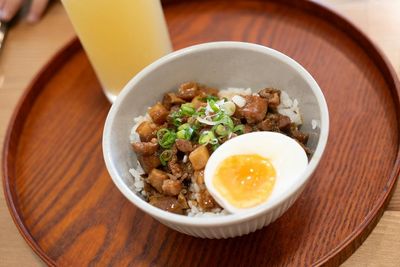
Lu Rou Fan
Pork belly is hand-diced into 1 cm cubes (skin on), parboiled, then braised slowly in a fragrant mixture of soy, Shaoxing, rock sugar, five-spice, garlic and fried shallots. The slow simmer renders the fat and softens the skin into a gelatinous, glossy braise that clings to rice. A jammy soy-braised egg and a few pickled greens on the side are traditional.
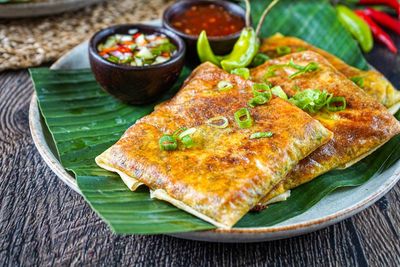
Martabak Telur
A simple flour-water-oil dough rests for 1 hour (gluten relaxes; will roll paper-thin). Filling: beef mince cooks with shallot, garlic, ginger, curry-leaf, ground spices till dry and aromatic; cools; mixes with beaten eggs, spring onion and chopped coriander just before frying. Dough divides; each portion stretches paper-thin like a strudel; filling spoons in the centre; the edges fold over to make a flat square parcel; pan-fries for 3 minutes per side. Cuts in quarters; eats with chilli-pickle sauce.
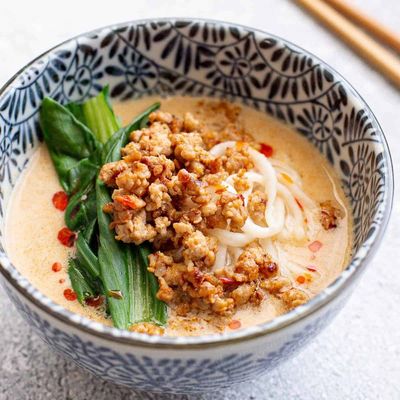
Tantanmen
Three components assemble at service. (1) Niku miso: ground pork stir-fries with garlic, ginger, doubanjiang and miso, then sweetened with sugar and finished with sesame oil. (2) Tare (concentrated seasoning paste): white sesame paste (tahini), soy sauce, rice vinegar, chilli oil, miso paste, garlic, whisked together. (3) Hot soup: chicken stock with a touch more sesame paste and chilli oil swirled in. Ramen noodles cook separately. Bowls layered: tare in the bottom, hot soup ladled over, cooked noodles, mound of niku miso, blanched bok choy, soft-boiled marinated egg, scallions, extra chilli oil.

Asun (Spicy Smoky Goat Meat)
Goat meat (bone-in pieces, ideally) simmers in water with onion, garlic, bay, salt and bouillon till tender (45 min). Lifts out; pats dry; grills over high heat (or under a hot grill / on a griddle pan) till charred (8-10 min). Pepper base: scotch bonnet, red pepper, onion, garlic blitz to paste; sautés in oil with curry powder, thyme, ginger till fragrant. Charred meat tosses in the pepper paste; cooks for 5 minutes more; tops with fresh chopped onion. Eats hot.