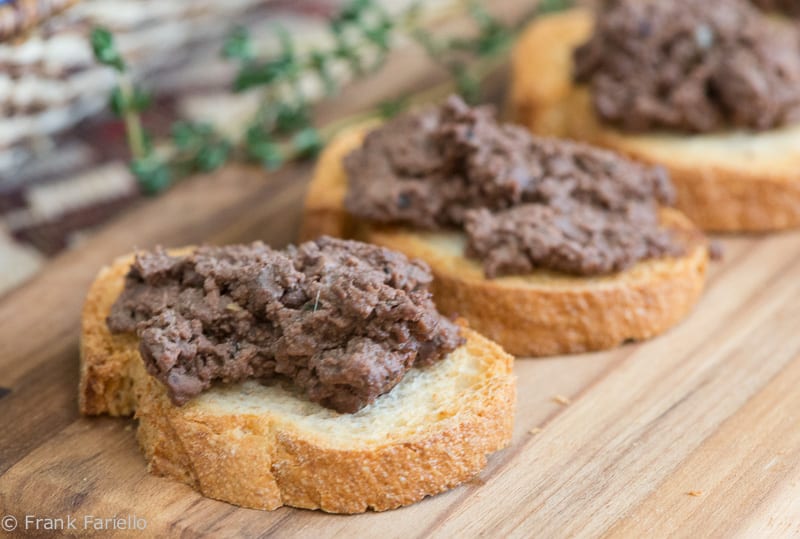
Crostini di Fegatini
Tuscany's defining antipasto: chicken livers cooked with onion, anchovies, capers and Vin Santo, spread warm onto small crusty toasts.
Overview
Onion is softened in olive oil with chopped anchovies. Trimmed chicken livers join and brown briefly. Vin Santo (sweet Tuscan dessert wine, or dry Marsala / brandy as substitute) deglazes; capers are stirred in; the mixture simmers for 8 minutes covered until the livers are tender. Pulsed (not pureed) in a food processor with a knob of cold butter and fresh sage to a coarse spreadable paste. Warm, the paté is spread onto small toasts; eaten as antipasto with prosecco or a glass of Chianti.
Ingredients
Livers
- 350 g chicken livers (the freshest you can get, ideally from a butcher rather than supermarket)
- 250 ml whole milk (for soaking)
Cooking
- 3 tablespoons olive oil
- 30 g unsalted butter (for cooking)
- 1 onion (large, finely diced)
- 4 anchovy fillets in oil (chopped)
- 2 tablespoons capers (drained, rinsed)
- 6 fresh sage leaves
- 80 ml Vin Santo (or dry Marsala, brandy, or dry white wine + 1 teaspoon sugar)
- 1 tablespoon red wine vinegar
- 1 bay leaf
- ½ teaspoon salt (to taste)
- ½ teaspoon black pepper
To finish
- 30 g cold unsalted butter (cubed, for the food processor)
- 1 small bunch fresh flat-leaf parsley (chopped)
- Extra-virgin olive oil to drizzle
Crostini
- 1 baguette (or ciabatta, sliced 1 cm thick - about 24 slices)
- 3 tablespoons olive oil (for brushing)
- 1 garlic clove (peeled, whole, for rubbing)
Method
Stage 1 - Prep the livers
- Trim livers: remove any green-tinged bile spots, white connective tissue, and obvious veins. Cut large livers in half so all are roughly equal size.
- Soak in milk for 20 minutes (mellows the strong iron flavour; optional but recommended).
- Drain; pat dry on kitchen paper.
Stage 2 - Soften the aromatics
- Heat olive oil and 30 g butter in a wide pan over medium heat.
- Add the diced onion; cook 10-12 minutes, stirring occasionally, until very soft and just gold (slow softening is what builds the pâté's body).
- Add the chopped anchovies; cook 2 minutes, mashing them into the onion (they should dissolve).
- Add the sage leaves; cook 1 minute.
Stage 3 - Cook the livers
- Increase heat to medium-high; add the livers in a single layer.
- Cook 4 minutes, turning occasionally, until they're sealed and just pink at the centre (don't overcook - they'll continue cooking in Stage 4).
Stage 4 - Deglaze and simmer
- Pour in the Vin Santo; let it bubble vigorously for 30 seconds, scraping the base.
- Add the capers, vinegar and bay leaf.
- Season with salt and pepper.
- Cover; reduce heat to low; simmer 6-8 minutes until the livers are cooked through but still rosy at the centre and the liquid is reduced to about 4 tablespoons.
Stage 5 - Process
- Discard the bay leaf.
- Tip the contents of the pan into a food processor - including any liquid.
- Add the 30 g cold cubed butter and a small handful of fresh parsley.
- Pulse 6-10 times to a coarse-textured spread (NOT smooth pâté - Tuscan style is rustic and chunky).
- Taste; adjust salt and pepper.
Stage 6 - Toast the bread
- Heat oven to 200°C (180°C fan).
- Arrange bread slices on a baking tray.
- Brush both sides with olive oil.
- Toast 8-10 minutes, turning halfway, until golden and crisp.
- While still warm, rub one side of each slice with the whole garlic clove (gently - just enough for aroma).
Stage 7 - Assemble
- Spread a generous spoon of warm liver pâté onto each crostino.
- Drizzle with extra-virgin olive oil.
- Scatter with fresh parsley or extra capers.
Stage 8 - Serve
- Eat warm or at room temperature.
- Excellent with a glass of Chianti, Vino Nobile or a chilled Vin Santo if served as dessert-time antipasto.
Notes
- Don't overcook the livers: Overcooked livers give a grainy, dry pâté. Rosy at the centre when you process is right; they finish from the residual heat. Tuscan crostini di fegatini should be silky-rich, not chalky.
- Anchovies and capers dissolve: Anchovies are not a fishy presence in the finished spread - they melt into umami background. Capers add brightness and tiny bursts of salt.
- Rustic, not smooth: A food processor pulsed 6-10 times gives the right texture. A blender or longer processing makes French-pâté-smooth - different dish.
Storage
- Refrigerate 4 days in a sealed jar with a thin film of olive oil over the top (which seals the surface).
- Freezes 2 months. Defrost in the fridge overnight.
- Serve at room temperature or gently warmed.
More like this
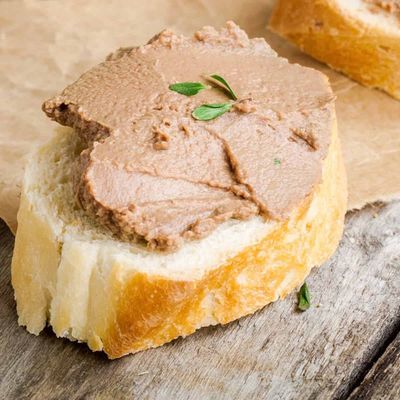
Chicken Liver Pâté
Chicken livers fry briefly with shallot and garlic, deglaze with brandy, finish with thyme and a splash of cream. The hot mixture blends with cubed cold butter into a silky paste, presses into a terrine, and sets cold under a layer of clarified butter. Eats best after a day in the fridge.

Arancini
Cold risotto (saffron Milanese-style is traditional in arancini "alla Milanese"; plain works too) is mixed with grated parmesan and beaten egg to bind. Filling, a stew of beef-and-pork ragù with peas, OR a cube of mozzarella, sits in the centre of each ball. Hands wet with water shape the rice around the filling into a tight orange-sized ball (or cone, for the Catania style). Each ball is rolled first in flour, then in beaten egg, then in fine breadcrumbs (or in the doubled-up "panata" mix of flour + water for the Sicilian original). Deep-fried at 180°C in 4-5 cm of oil for 4-6 minutes per ball until deep gold. Drained on kitchen paper; eaten warm.
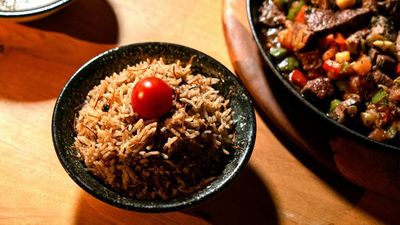
Diri Ak Djon Djon
Dried djon djon mushrooms are soaked in hot water for 30 minutes; the inky black soaking liquid is strained and reserved (the mushrooms themselves are mostly discarded or used minimally). Aromatics, shallot, garlic, thyme, parsley, Scotch bonnet, épis, are sweated in oil, then green peas and lima beans are added, then long-grain rice is stirred in to coat. The djon djon broth is poured over the rice; the pot is covered and steamed gently until the rice is tender and slate-black. Garnished with parsley and served as the centrepiece of any meal it appears in.
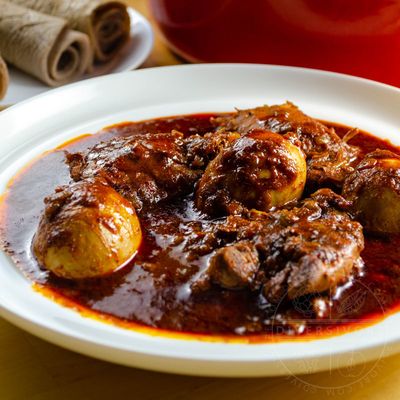
Doro Wat
Ethiopia's national dish, the spiced chicken stew that turns up at every wedding, Easter feast and Christmas table, and the one dish a cook is judged on. The foundation is the onion - you cook it down slowly for nearly an hour into a deep dark base, and this is the step that decides whether the wat is great or merely acceptable. Berbere (the Ethiopian spice blend of chilli, fenugreek, ginger and a dozen others) and niter kibbeh (spiced clarified butter, the dish's defining fat) fold in. Chicken thighs and legs simmer in the deep red sauce, and hard-boiled eggs join late, scored with a knife so they take on the colour and the flavour. Eaten communally from a single platter, with injera flatbread torn into pieces to scoop the stew. No cutlery, no individual plates, hands clean before the meal.