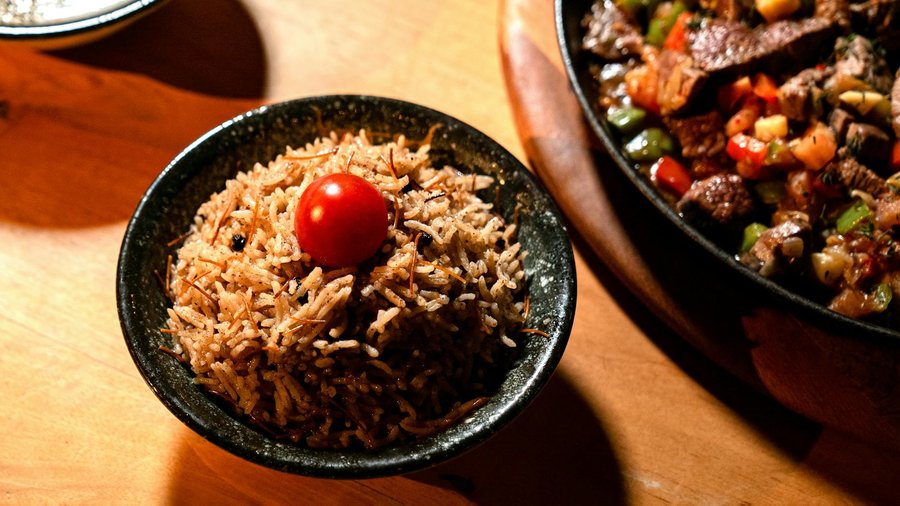
Diri Ak Djon Djon
Slate-black celebration rice from northern Haiti. Long-grain steeped in wild djon djon mushroom broth, with peas folded through.
Overview
Dried djon djon mushrooms are soaked in hot water for 30 minutes; the inky black soaking liquid is strained and reserved (the mushrooms themselves are mostly discarded or used minimally). Aromatics, shallot, garlic, thyme, parsley, Scotch bonnet, épis, are sweated in oil, then green peas and lima beans are added, then long-grain rice is stirred in to coat. The djon djon broth is poured over the rice; the pot is covered and steamed gently until the rice is tender and slate-black. Garnished with parsley and served as the centrepiece of any meal it appears in.
Ingredients
Djon djon broth
- 50 g dried djon djon mushrooms (about 1 cup loose)
- 1 litre hot water
Rice
- 4 tablespoons vegetable oil (or 2 tablespoons oil and 30 g butter)
- 1 shallot (large, finely chopped)
- 6 garlic cloves (finely chopped)
- 1 Scotch bonnet (whole, pierced; remove before serving)
- 2 sprigs fresh thyme
- 2 tablespoons épis (Haitian green seasoning - see Notes)
- 100 g frozen green peas
- 100 g cooked lima beans (or butter beans)
- 400 g long-grain rice (basmati or jasmine)
- 1 ½ teaspoons salt
- ½ teaspoon black pepper
- 2 cloves
- 1 small bunch parsley (chopped, to finish)
To serve
- Griot (or stewed chicken)
- Pikliz
- Sliced avocado
Method
Stage 1 - Steep the djon djon
- Rinse the dried djon djon mushrooms briefly under cold water to remove grit (they often come with stalks attached).
- Tip into a heatproof bowl. Pour over the litre of hot water.
- Steep 30 minutes, pressing the mushrooms down once or twice. The water will turn deep black.
- Strain through a fine sieve (or coffee filter / muslin) into a measuring jug. You should have around 750-800 ml of inky black broth. Top up with hot water if needed.
- Discard most of the spent mushrooms; you can keep a tablespoon of the softened ones to scatter through the finished rice if you like.
Stage 2 - Aromatics
- Heat the oil (and butter if using) in a heavy lidded pot over medium heat.
- Add the shallot; cook 3-4 minutes until softened.
- Add the garlic, thyme sprigs and cloves; stir 30 seconds.
- Add the épis; stir 1 minute until fragrant.
- Add the peas and lima beans; stir to coat.
Stage 3 - Toast the rice
- Add the rice to the pot. Stir thoroughly so every grain is coated in the oil and aromatics. Cook 1-2 minutes - this is the toasting step that keeps the grains separate.
- Add the salt and pepper.
Stage 4 - Steam
- Pour in the djon djon broth (use 750 ml for slightly drier rice, 800 ml for softer). Lay the pierced Scotch bonnet on top.
- Bring to a vigorous boil, uncovered, until the level of liquid drops below the surface of the rice - around 3-4 minutes.
- Reduce heat to the lowest setting. Cover tightly (a folded tea towel under the lid helps trap steam).
- Cook 18-20 minutes without lifting the lid.
- Turn off the heat. Leave covered another 10 minutes to finish steaming.
Stage 5 - Finish
- Remove and discard the Scotch bonnet and thyme stems.
- Fluff the rice gently with a fork. The grains should be slate-black, separate and tender.
- Scatter chopped parsley over the top.
Stage 6 - Serve
- Spoon onto warmed plates as the base for griot or stewed chicken, with pikliz and avocado on the side.
Notes
- Djon djon substitute: the real mushroom is hard to find outside Haitian groceries. A fair fallback: 25 g dried porcini steeped the same way, plus 1 teaspoon squid ink (or 1 sachet of cuttlefish ink) stirred into the strained broth for colour. The flavour is not identical but the deep earthy savouriness is close, and the colour is right. Some cooks add a pinch of activated charcoal for purely cosmetic black, but it adds no flavour.
- Strain the broth carefully: djon djon mushrooms grow on dead wood and shed grit when soaked. Strain through a fine sieve, then again through muslin or a coffee filter for the cleanest broth.
- The mushrooms themselves are not really eaten: they are flavouring agents, like tea leaves. Most are discarded after steeping. A tablespoon of softened mushrooms scattered through the finished rice is optional.
- Pierced Scotch bonnet: the whole pepper on top of the rice infuses gentle heat without breaking and overwhelming the dish. If it bursts during cooking, the rice becomes very hot. Pierce a couple of small holes only.
- Épis: see the griot recipe for the standard épis paste, or use any Caribbean green seasoning.
Variations
Diri djon djon ak kribich: with prawns or shrimp stirred through the rice for the last 5 minutes of cooking - a coastal Cap-Haïtien variant. With crab: small whole crabs (or large crab claws) are simmered briefly in the broth before the rice goes in - common at weddings.
Serving
Serve with: griot (the classic pairing), stewed chicken (poul nan sòs), pikliz, sliced avocado, fried plantains. Almost always part of a larger Haitian Sunday spread rather than a stand-alone meal.
Storage
- Keeps 3 days refrigerated; reheat in a covered pan with a sprinkle of water, or in the microwave covered.
- Freezes 2 months but rice texture is best fresh. Thaw overnight in the fridge; reheat with a little added water.
Recipes mentioned here
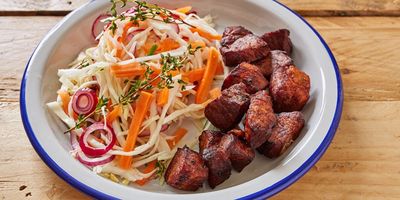
Griot
Pork shoulder is cubed and marinated overnight in a punchy mixture of épis, bitter orange juice, lime juice, garlic, Scotch bonnet, thyme and salt. The next day the pork simmers in its own marinade until tender (the meat goes in cold and comes up to a slow simmer; the marinade reduces almost entirely as it cooks). Once the pork is fork-tender and the liquid has cooked down to a sticky glaze, the cubes are drained dry and deep-fried in hot oil for 5-7 minutes until the outsides crackle and brown. Served piping hot with pikliz, rice, beans and plantains.
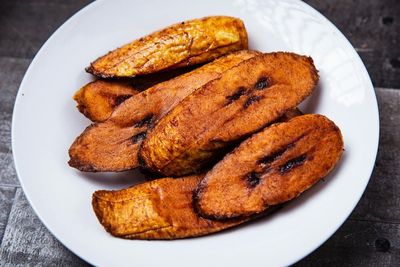
Fried Plantains
Ripe plantains (not the green ones used for tostones) are peeled, sliced thick on the bias, and fried gently in vegetable oil so the natural sugars caramelise without the outsides burning. The result is sweet, slightly chewy, with a soft interior. A light dusting of salt at the end lifts the sweetness. Don't rush the heat: medium-low is the rule.
More like this
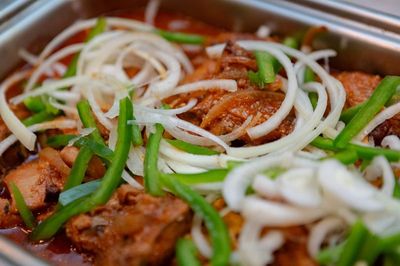
Poul Ak Nwa
A Sunday dish from Cap-Haïtien on Haiti's north coast where cashews have been a regional cash crop since colonial times. The dish translates as "chicken with cashews" and the nut is everywhere: ground into powder and whisked into the gravy as a thickener (the technique parallels almond-and-walnut gravies in West African and Levantine cookery), and added whole-toasted near the end for texture. The flavour is unexpectedly creamy, like a cashew-cream sauce that happens to be tomato-based; mellow, sweet, faintly nutty, sat over a base of Haitian épis (the green seasoning paste of parsley, scallion, garlic, bell pepper, thyme and lime that's the foundation of most Haitian cookery). A whole habanero in the bouquet garni adds quiet heat. Smell is roasted cashews and tomato paste with thyme drifting through. Not difficult but not quick, 3-4 hours of marinating, then 45 minutes of cooking, and the bouquet garni technique (wrapping herbs in cheesecloth) gives a clean, herb-free finished sauce. Served at Haitian Sunday tables on the north coast over white rice with sliced avocado on the side; the cashew sweetness and the buttery avocado are the pairing that makes it.
Jasha Maru
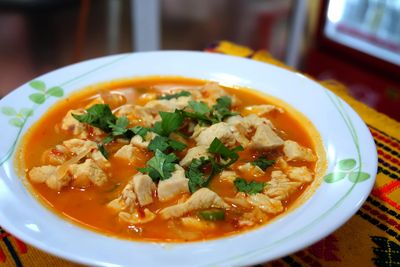
The Bhutanese weeknight chicken stew, the dish a Thimphu cook turns to after a long day. You joint a whole bone-in chicken and stew it with onion, tomato, plenty of fresh garlic and ginger, three or four green chillies, and butter or vegetable oil with a splash of water. The cook is fast: a brief sear to colour the meat, a simmer with the tomato until the chicken is cooked through and falling off the bone, and a finish with chopped coriander and spring onion just before serving. What you get back is a brothy, fresh, gently spicy chicken dish that sits somewhere between Indian and East Asian cookery, which is exactly where Bhutan sits geographically. Eaten with red rice, perhaps a small bowl of ema datshi on the side for whoever wants to push the heat further.
Griot
Pork shoulder is cubed and marinated overnight in a punchy mixture of épis, bitter orange juice, lime juice, garlic, Scotch bonnet, thyme and salt. The next day the pork simmers in its own marinade until tender (the meat goes in cold and comes up to a slow simmer; the marinade reduces almost entirely as it cooks). Once the pork is fork-tender and the liquid has cooked down to a sticky glaze, the cubes are drained dry and deep-fried in hot oil for 5-7 minutes until the outsides crackle and brown. Served piping hot with pikliz, rice, beans and plantains.
Authentic Jamaican Curry Chicken
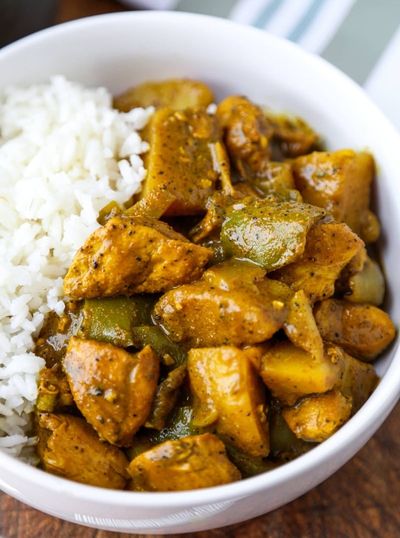
Jamaican curry sits in its own corner of the global curry map: heavier on turmeric and allspice than Indian Madras, lighter on cumin, and built on a technique called "burning the curry" that gives the dish its character. The technique is exactly what it sounds like, dry curry powder hits hot oil and is stirred for 30 seconds until it darkens from yellow to deep gold and smells like toasted spice. That move concentrates the flavours and removes any raw edge. The finished stew is bright yellow stained slightly orange, savoury and aromatic rather than searingly hot, with thyme and a whole pierced Scotch bonnet scenting the gravy without flooring it. Smell: bloomed curry powder, allspice, browned chicken fat. Not difficult, but requires confidence in the 30-second bloom (under-do it and the dish is flat; over-do it and you have to start over). A Sunday-dinner staple across Jamaica and the diaspora, served over white rice with the gravy spooned generously over.