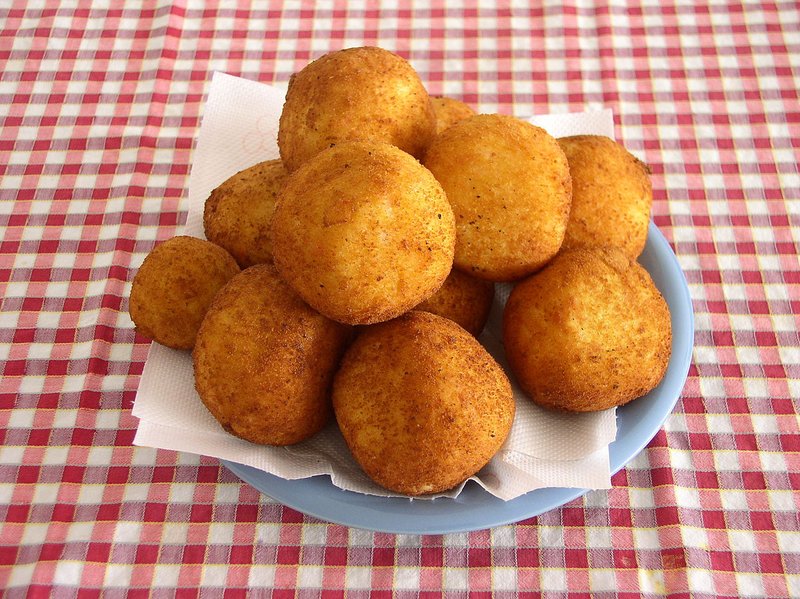
Arancini
Sicily's golden rice balls: cold risotto wrapped around meat ragù or mozzarella, breaded and deep-fried till crisp outside, soft within.
Overview
Cold risotto (saffron Milanese-style is traditional in arancini "alla Milanese"; plain works too) is mixed with grated parmesan and beaten egg to bind. Filling, a stew of beef-and-pork ragù with peas, OR a cube of mozzarella, sits in the centre of each ball. Hands wet with water shape the rice around the filling into a tight orange-sized ball (or cone, for the Catania style). Each ball is rolled first in flour, then in beaten egg, then in fine breadcrumbs (or in the doubled-up "panata" mix of flour + water for the Sicilian original). Deep-fried at 180°C in 4-5 cm of oil for 4-6 minutes per ball until deep gold. Drained on kitchen paper; eaten warm.
Ingredients
Rice base (or use 500 g cold leftover risotto)
- 300 g arborio rice
- 1 litre hot chicken stock (or vegetable stock)
- 1 large pinch saffron threads (soaked in 2 tablespoons hot water)
- 50 g unsalted butter
- 1 onion (small, finely diced)
- 100 ml dry white wine
- 60 g parmesan cheese (finely grated)
- 1 teaspoon salt
- ½ teaspoon black pepper
To shape (added to cold rice)
- 1 egg (large, beaten - to bind the cold rice)
- 30 g extra parmesan cheese (grated)
Filling (choose one or do half-and-half)
Meat Ragù option
- 200 g Ragù (Bolognese-style - see Ragu)
Mozzarella option
- 150 g low-moisture mozzarella (cut into 1 ½ cm cubes - one cube per arancino)
Coating
- 100 g plain flour
- 2 eggs (large, beaten with 1 tablespoon water)
- 200 g fine dried breadcrumbs (panko gives extra crunch; fine breadcrumbs are more traditional)
For frying
- 1 litre vegetable oil (or sunflower)
To serve
- Lemon wedges
- Marinara (or a herby tomato sauce, optional)
- Crispy radicchio salad
Method
Stage 1 - Make the saffron risotto (skip if using leftover)
- Heat the stock in a small pan; stir in the saffron and its water; keep at a low simmer.
- Melt half the butter (25 g) in a heavy lidded pot over medium heat; add diced onion; cook 6 minutes until soft.
- Add the rice; stir 2 minutes to toast.
- Pour in the white wine; stir until absorbed.
- Add saffron-stock 1 ladle at a time, stirring until each addition is absorbed before adding the next. Continue 18 minutes until the rice is just al dente.
- Off heat; beat in the remaining butter and the 60 g parmesan vigorously to mantecare.
- Season with salt and pepper.
- Spread the risotto thinly on a tray; cool to room temperature; refrigerate at least 4 hours, ideally overnight. Cold rice is essential - warm rice won't hold shape.
Stage 2 - Prep the filling
- Ragù version: warm the ragù gently; stir in the peas; cool fully to a thick spoonable consistency.
- Mozzarella version: cube the mozzarella; pat dry with kitchen paper (excess moisture causes blow-outs during frying).
Stage 3 - Shape
- Tip the cold rice into a wide bowl; mix in the beaten egg and 30 g extra parmesan thoroughly.
- Set up three shallow plates: flour, beaten egg, breadcrumbs.
- Wet your hands. Take a handful of rice (about 80 g per ball - egg-sized) and flatten into a disc on your palm.
- Place 1 tablespoon of cold ragù (or 1 cube of mozzarella) in the centre.
- Fold the rice up and over to enclose the filling completely; gently squeeze and roll into a tight ball, ensuring no filling shows at any seam.
- Set on a tray. Repeat for all 8 balls.
Stage 4 - Bread
- Roll each ball first in flour (shake off excess), then dip in egg (let drip), then roll in breadcrumbs, pressing gently so the crumbs stick all over.
- For a thicker, crispier crust: dip back into egg and breadcrumbs a second time.
Stage 5 - Rest the breaded balls
- Refrigerate the breaded balls 15 minutes (helps the crust adhere during frying).
Stage 6 - Fry
- Heat oil to 180°C in a deep heavy pan with at least 4 cm of oil depth.
- Fry 2-3 balls at a time, 4-6 minutes, turning, until deep golden brown all over.
- Lift onto a paper-lined plate.
- Don't crowd - too many drop the oil temperature and the rice steams instead of frying.
Stage 7 - Serve
- Rest 3 minutes before serving (the inside is volcanic).
- Eat warm, with a lemon wedge to squeeze over and (optional) a small bowl of tomato sauce for dipping.
Notes
- Rice MUST be cold: Warm or room-temperature rice will not hold its shape. Make the risotto a day ahead, OR spread thinly on a tray and chill at least 4 hours.
- No filling visible at the seam: Any exposed filling (especially mozzarella) leaks into the oil during frying and creates a deflated arancino. Inspect each ball before breading.
- Catania cones vs Palermo balls: Catania shapes arancini into cones (representing Mount Etna); Palermo makes them round (representing oranges). Both are correct. The recipe works for either shape.
- Risotto al salto trick: Yesterday's leftover risotto, with no filling, can be pressed flat and pan-fried into a crispy disc instead of formed into balls - a quicker option when you have less time.
Storage
- Fried arancini are best within 30 minutes.
- Cooled fried arancini refrigerate 2 days; reheat at 190°C 8 minutes (microwave makes them soggy).
- Unfried breaded balls freeze 2 months on a tray; fry from frozen at 170°C for 8 minutes.
More like this
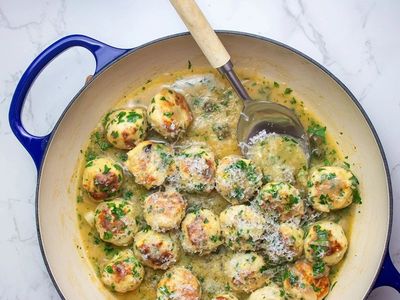
Chicken Piccata Meatballs
Chicken piccata, the Italian-American mid-century classic of pounded chicken cutlets in a lemon-butter-caper pan sauce, reshaped into meatball form, which trades the precise look of cutlets for a juicier, more forgiving texture. The flavour is unmistakably piccata: butter as the body of the sauce, lemon as the brightness, capers as the salty-vinegary punctuation. Underneath sits a chicken meatball lightened by ricotta (it keeps the lean ground chicken from going dry and dense) and parmesan, with parsley, garlic, smoked paprika and a pinch of red pepper flakes lifting the seasoning. The meatballs themselves stay tender because the mix isn't overworked and because they finish cooking in the sauce rather than the pan. Smell is melted butter, lemon and capers, the same smell every Italian-American restaurant kitchen has on a Tuesday lunch service. Easy enough for a weeknight, restrained enough not to feel like a stand-in dish; the technique is essentially "make meatballs, build pan sauce, return meatballs". Serves over pasta, rice or crusty bread to mop the sauce.
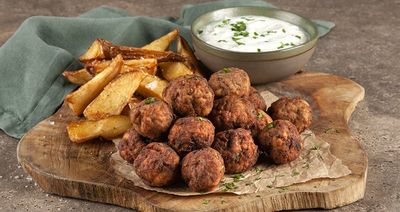
Keftedakia (Greek Mini Meatballs)
A grated onion (juice squeezed out) folds into beef-or-pork-and-beef mince with bread soaked in milk and squeezed dry, an egg, a generous amount of dried mint and oregano, parsley, garlic, salt and pepper. A tablespoon of ouzo or red wine adds depth. Mixture rests for 30 minutes (the flavours mingle, the bread fully absorbs). Rolls into walnut-sized balls, dusts in flour, pan-fries in olive oil 6-8 minutes turning often until deep brown and cooked through. Serves with tzatziki and lemon wedges.
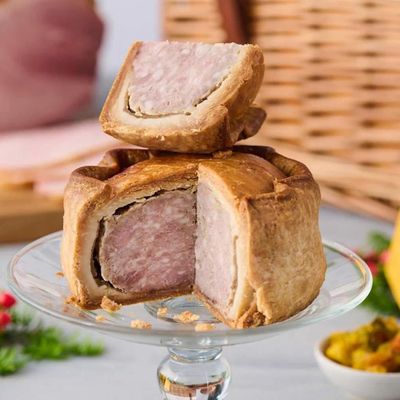
Pork Pie
Pork shoulder (uncured, fatty) and a small amount of bacon are chopped into 5 mm dice (not minced, the texture is key). Mixed with white pepper, mace, sage, salt and a touch of anchovy paste for umami. The hot-water-crust pastry: flour is mixed with hot water-and-lard mixture, kneaded warm into a pliable dough. Two-thirds of the dough lines a tall round tin (or is moulded freestanding around a glass jar); the filling is packed in tight; a lid of remaining dough is laid over the top with a 1 cm steam hole punched. Baked at 200°C for 30 min, then 160°C for another 60-75 min. Left to cool. A rich pork stock (made from trotters or with gelatin sheets) is poured through the steam hole while the pie is still warm. Refrigerated overnight to set the jelly. Sliced and eaten cold.
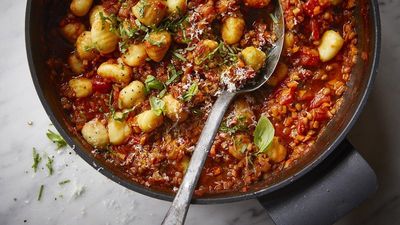
Ragù with Gnocchi
This ragù blends deep browning, layered aromatics, and a long, gentle oven braise to create a sauce with rich umami, silky texture, and balanced brightness. A two-milk finish adds softness, while a quick red wine gastrique lifts the sauce at the end.