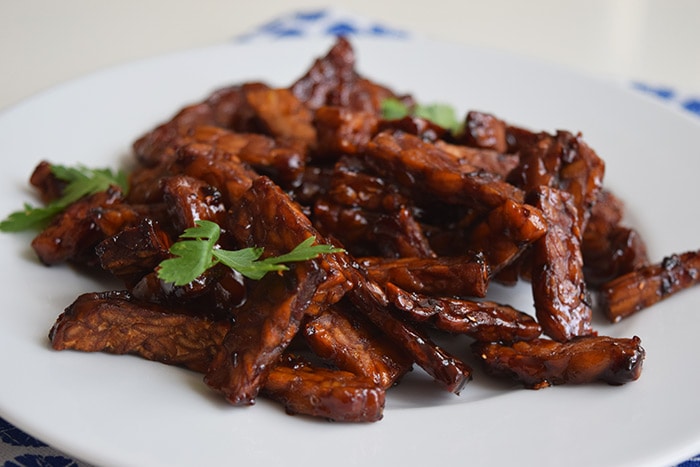
Tempeh Goreng
Indonesian fried tempeh: thick batons marinated in garlic, coriander and tamarind, then deep-fried until shatteringly crisp on the outside and dense and nutty within. Served as a snack, a side, or a main with rice and sambal.
Overview
Tempeh is sliced into thick fingers; marinated in a paste of garlic, coriander seed, tamarind, salt and water. The batons drain briefly, then deep-fry in batches until crisp and deep golden. Best eaten hot, with kecap manis or sambal for dipping.
Ingredients
- 400 g tempeh (cut into 1 ½ cm thick batons, about 6 cm long)
- 5 garlic cloves
- 1 teaspoon coriander seeds
- 1 tablespoon tamarind paste
- 1 teaspoon salt
- 1 teaspoon palm sugar (or brown sugar)
- 200 ml water
- Vegetable oil (for deep-frying)
To serve
- Kecap manis (Indonesian sweet soy)
- Sambal Oelek (or sliced bird's eye chillies)
- Steamed Rice
Method
Stage 1 - Marinade
- Crush the garlic and coriander seeds to a paste in a mortar (or finely mince).
- Mix with the tamarind, salt, sugar and water in a wide dish.
- Add the tempeh batons; turn to coat. Marinate 30 minutes - the tempeh soaks up the liquid.
Stage 2 - Drain
- Lift the batons out of the marinade; let them drain on a wire rack 5 minutes (excess water spits in hot oil).
Stage 3 - Fry
- Heat 4 cm of oil in a wok or deep pan to 180°C (a tempeh corner should bubble vigorously when dipped).
- Fry the batons in 2 batches for 4-5 minutes each until deep golden and crisp on all sides.
- Lift onto kitchen paper to drain.
Stage 4 - Serve
- Eat immediately, dipped in kecap manis with sambal alongside, or piled over rice.
Notes
- Tempeh quality matters: Look for the densely packed, slightly mottled (white-grey) Indonesian-style tempeh; supermarket "soy fermented blocks" sometimes have a much denser, less interesting texture.
- Don't skip the drain: Wet tempeh in hot oil splatters dangerously and gives a soggy crust.
- Fry temperature: Below 170°C and the tempeh absorbs oil and goes greasy; above 195°C and the outside burns before the inside heats through.
Storage
- Best eaten right away. Re-crisp leftovers in a hot dry pan or oven at 200°C for 5 minutes - don't microwave.
More like this
Beef Nasi Goreng
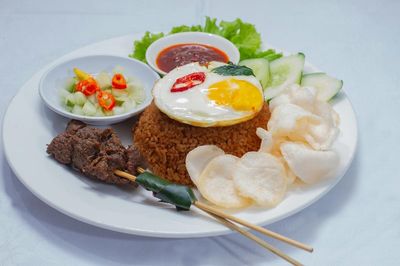
Indonesia's national fried rice, traditionally a way to put yesterday's leftovers to work and now a fixture from street stalls to weeknight kitchens. Beef mince keeps the cooking time short, while kecap manis, soy, shrimp paste and a crumbled stock cube layer the savouriness from four directions. The trick is pressing the rice into the wok and leaving it alone long enough to pick up a proper char before tossing.

Spicy Peanut Balls
Spicy peanut balls are deep-fried rice balls seasoned with garlic, ginger, chilli, soy sauce, and lime, then coated in chopped peanuts for a satisfying crunch. They make an excellent snack or starter, and pair naturally with a chilli dipping sauce.
Gai Yang
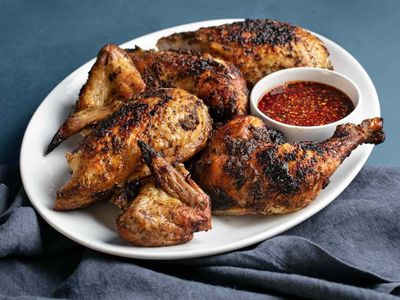
Gai yang ("grilled chicken") is one of the cornerstones of Isaan cooking, the cuisine of north-eastern Thailand that has spread across the whole country and into Thai restaurants worldwide. The defining flavour is coriander root, an ingredient barely used in Western cooking but central to Thai marinades. Pounded in a granite mortar with garlic, white peppercorns and a pinch of salt, it forms an aromatic paste that's then mixed with fish sauce, oyster sauce and a touch of sugar. The chicken is butterflied (spatchcocked) so it lies flat on the grill, marinated for at least 4 hours, then cooked slowly over moderate charcoal. The proper Isaan technique is patient: 30 minutes or more, turning often, sometimes pressed flat between two bamboo splints, so the skin slowly crisps and the meat takes on smoke without burning. The flavour is savoury-funky from fish sauce, peppery-warm from white pepper, deeply garlic-and-herb from the paste, with no chilli in the marinade itself; heat comes from the dipping sauce. Difficulty is low for the home cook: a good mortar or a small food processor makes the paste in 2 minutes, butterflying a chicken is a single cut down the backbone, and any covered grill or kettle does the cooking. Eaten by hand with balls of sticky rice and dipped into nam jim jaew, the toasted-rice-and-tamarind dipping sauce.
Shuizhu Niurou
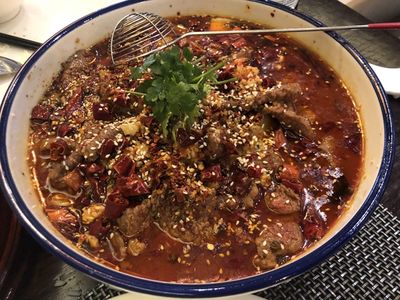
Two sensations at once: the bright, immediate burn of dried chilli (la) sitting under the slow numbing-electric prickle of Sichuan peppercorn (ma). That mala pair is the whole point. Beneath that, the broth is salty and fermented-funky from doubanjiang, the deep umami of broad-bean paste that's been aged for months in clay vessels. The hot oil pour at the table is theatre but it does real work: it blooms the dried chillies and Sichuan peppercorn powder right before you smell them, so the aroma arrives in a wave. Texturally: gloriously tender silk-thin beef slices (the cornflour-and-egg-white marinade is what keeps them that way), crisp-on-the-edge bok choy or bean sprouts wilting under the heat, oil swimming on top. Easier than its restaurant-banquet reputation suggests once you have doubanjiang and Sichuan peppercorns in the pantry; the technique is mostly "don't overcook the beef" and "pour the oil while it's smoking". Originates in 1930s Chongqing as a riverboat-worker's dish, water and chillies were cheap, lean cuts of beef tough, then spread through Sichuan in the 1980s as the wider mala movement caught hold.