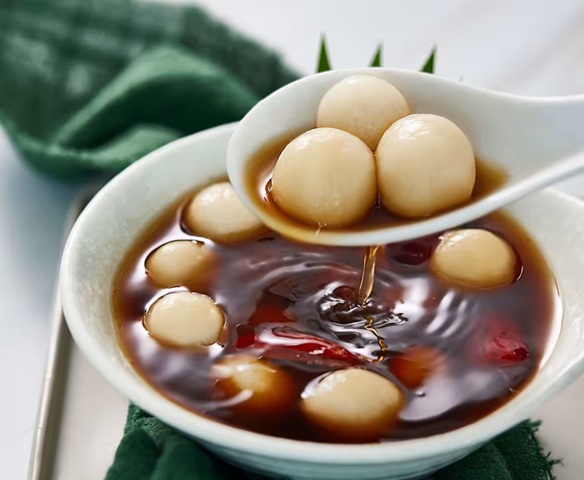
Tang Yuan
China's reunion-soup balls: chewy glutinous rice balls oozing sweet black sesame paste, served in a fragrant ginger-and-sugar syrup.
Overview
Filling: black sesame seeds toasted in a dry pan, ground to a paste with sugar and softened lard (or butter); chilled until firm enough to roll into 16 small balls; frozen on a tray. Dough: glutinous rice flour mixed with just-boiled water (the hot water gelatinises some of the starch, giving the dough its characteristic chew) into a smooth pliable ball; rested briefly. Each piece of dough flattens between palms, takes a frozen filling ball, wraps around, rolls smooth, a hidden ball-in-ball. Boiled in water until they float and the outer dough is translucent (about 4 minutes from when the water comes back to boiling). Served in small bowls in a hot ginger-osmanthus syrup.
Ingredients
Filling (sesame paste)
- 100 g black sesame seeds
- 60 g caster sugar
- 40 g lard (softened - or use unsalted butter)
- A pinch of salt
Dough
- 200 g glutinous rice flour (sometimes called sweet rice flour or sticky rice flour)
- 130-150 ml water (just-boiled)
- A pinch of salt
Syrup
- 800 ml water
- 80 g caster sugar (or rock sugar / yellow rock candy)
- 4 cm fresh ginger (sliced thin)
- 1 tablespoon dried osmanthus flowers (optional but classic; sold at Chinese shops)
- 1 small piece dried tangerine peel (chen pi, optional)
Method
Stage 1 - Toast the sesame seeds
- Place black sesame seeds in a dry frying pan over medium heat.
- Toast 3-4 minutes, shaking continuously, until they smell intensely nutty and a few start to pop.
- Tip onto a plate to cool fully.
Stage 2 - Grind the filling
- Once the sesame seeds are cool, grind them in a spice grinder, food processor or mortar to a coarse-fine powder (some texture is fine).
- Tip into a bowl; mix with sugar, softened lard (or butter) and a pinch of salt until you have a thick, dark, slightly oily paste.
Stage 3 - Shape and freeze the filling
- Divide the filling into 16 portions (about 10 g each).
- Roll each into a small ball (cherry-sized).
- Place on a tray; freeze at least 30 minutes - frozen filling is essential for wrapping, otherwise the soft paste squishes out when you try to enclose it.
Stage 4 - Make the dough
- Place the glutinous rice flour and pinch of salt in a wide bowl.
- Pour in the just-boiled water in stages, stirring with chopsticks or a spoon (don't use your hands - the water is too hot).
- As it cools enough to handle, knead by hand into a smooth, soft, slightly sticky dough - like Play-Doh consistency.
- Add more rice flour if too sticky, or a teaspoon of cold water if too dry.
- Cover with cling film; rest 10 minutes.
Stage 5 - Wrap
- Divide the dough into 16 equal pieces (about 20 g each); cover with a damp cloth.
- Take a piece of dough; flatten between your palms into a disc 5 cm across with the edges thinner than the centre.
- Place a frozen filling ball in the centre.
- Bring the edges of the dough up and over to enclose; pinch the seam closed; roll between your palms into a smooth round ball.
- Set on a lightly floured tray.
- Repeat for all 16.
- Work quickly - the filling thaws as you work.
Stage 6 - Make the syrup
- In a wide saucepan, combine water, sugar, ginger slices and dried tangerine peel (if using).
- Bring to a boil; reduce to a low simmer; cook 8 minutes to infuse.
- Stir in the osmanthus flowers (if using).
- Keep warm.
Stage 7 - Boil the tang yuan
- Bring a separate wide pot of water to a rolling boil.
- Slide in the tang yuan; stir gently so they don't stick to the base.
- They sink, then float to the surface within 1-2 minutes.
- Once they're all floating, cook 3 more minutes - the dough is translucent and the filling is hot.
Stage 8 - Serve
- Lift the tang yuan out with a slotted spoon; place 4 in each small serving bowl.
- Ladle hot ginger syrup over to half-cover.
- Eat immediately, with a spoon - and bite carefully; the filling is volcanic.
Notes
- Frozen filling is the secret: Soft filling cannot be wrapped - it squishes out when you pinch the dough closed. Pre-freezing makes the filling firm and easy to enclose; it thaws inside the boiling tang yuan, becoming the molten ooze that makes the dessert memorable.
- Hot water for the dough: Adding boiling water (rather than cold) partially gelatinises the starch and gives glutinous rice flour its characteristic chewy-smooth texture. Cold water gives a crumbly dough.
- Glutinous rice flour, not regular rice flour: They're different products. Glutinous (sticky) rice flour has the chewy starch profile; regular rice flour gives a brittle dry dough that won't enclose the filling.
Storage
- Best within 30 minutes of boiling - they firm slightly as they cool.
- Freeze raw filled tang yuan on a tray, then bag - keeps 2 months. Boil from frozen (add 2 extra minutes).
- Cooked leftover tang yuan keep 1 day; reheat in hot syrup 2 minutes.
More like this
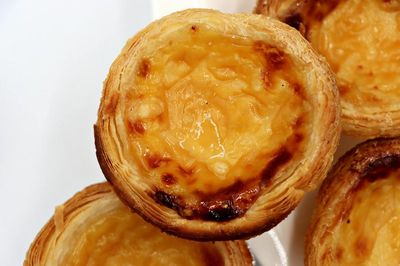
Hong Kong Egg Tarts
The shortcrust uses lard (or vegetable shortening + butter) for the right crumbly texture; sugar gives the slight sweetness; egg yolk binds. Rolled to 3 mm thick, cut into discs slightly larger than the muffin-tin wells, gently pressed in, chilled. The custard: eggs whisk with hot sugar syrup (sugar dissolved in just-boiled water, cooled) and a small amount of evaporated milk for richness, plus vanilla. Strained twice for a glassy finish, ladled into the chilled shells, baked at 220°C for the first 8 minutes (to set the pastry edges) then 180°C for 12-15 more (until the custard is just-set with no visible jiggle in the centre).
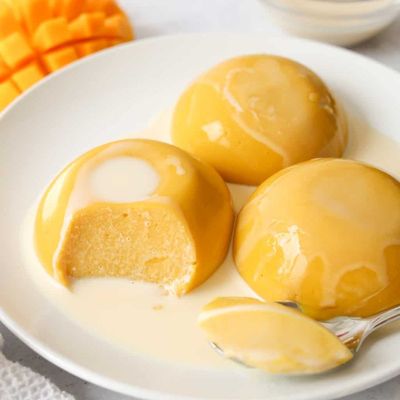
Mango Pudding
Ripe mango (Alphonso or Nam Dok Mai if available; any sweet ripe mango works) blends to a smooth puree with sugar and lime juice. Powdered gelatin blooms in cold milk 5 minutes. Half the milk warms to dissolve sugar; the bloomed gelatin stirs in to dissolve. The warm milk pours into the mango puree along with the cold remaining milk, evaporated milk and a splash of double cream. Whisked smooth, ladled into 6 small moulds or glasses, refrigerated for 4-6 hours until set. Served with diced fresh mango and a drizzle of evaporated milk.
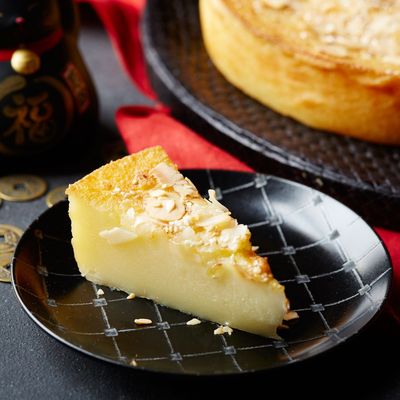
Nian Gao
Glutinous rice flour and a small amount of rice flour for bite, dissolved in brown-sugar syrup made with water (just-boiled), with a glug of oil for sheen and the faintest pinch of salt. Poured into a greased cake pan, steamed for an hour, cooled overnight. The cake firms up dramatically as it cools, going from pourable batter to a sliceable, translucent amber slab. Best eaten on Day 2, sliced and pan-fried in beaten egg.
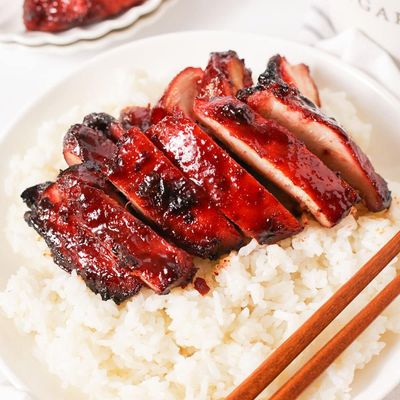
Cantonese BBQ Chicken
This is summer-BBQ adaptation of the lacquered red roast meats that hang in the windows of Cantonese siu mei shops. The marinade borrows from char siu (hoisin, soy, Shaoxing wine, five-spice, fermented bean curd, garlic, ginger) but pulls back on the sugar slightly because chicken does not need as much sweetness as pork shoulder. Bone-in skin-on thighs are the right cut: they stay juicy on the grill, the skin renders down and crisps, and the bones give the meat shape. A two-stage glaze does the rest. The thighs cook over indirect heat first to render the fat and set the meat, then move directly over the coals for the last few minutes while a honey-maltose mixture is brushed on repeatedly. Every brush of glaze caramelises, blackens slightly at the edges, then gets brushed again. The result is sticky-shiny with a smell that is half five-spice, half woodsmoke. Difficulty is low if you control your heat. A two-zone fire (one side coals piled high, the other side empty) is the only real requirement; on a gas grill, two burners on full and one off does the same job. Serve sliced over plain rice with sliced cucumber and a spoon of chilli oil, or stuffed into bao with hoisin and spring onion.