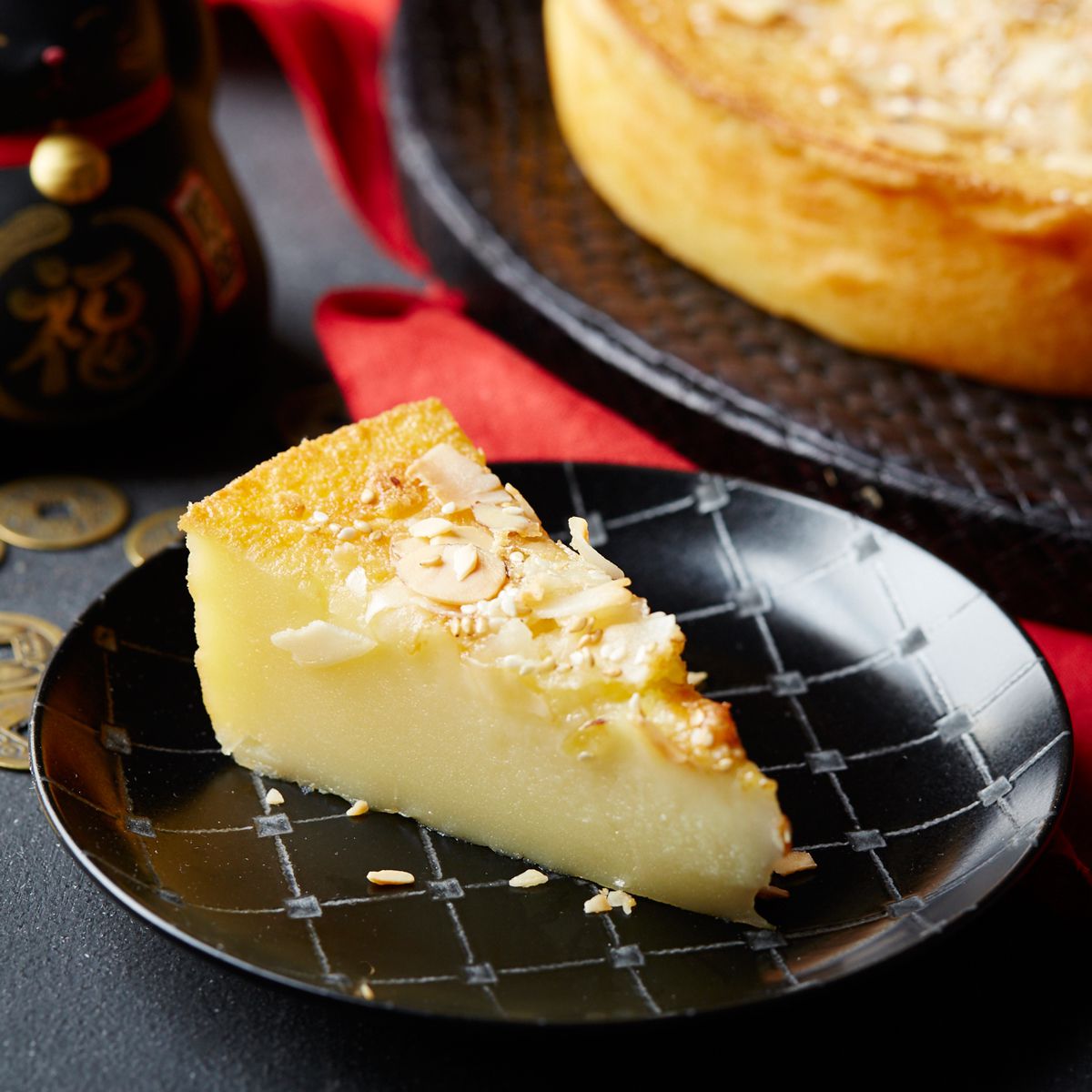
Nian Gao
Sticky rice cake for Lunar New Year. The name puns on "year higher" - eat it and you'll rise in the year ahead. A dense, faintly sweet, gloriously chewy slab steamed in a cake pan and then sliced and pan-fried in egg batter for the second-day breakfast.
Overview
Glutinous rice flour and a small amount of rice flour for bite, dissolved in brown-sugar syrup made with water (just-boiled), with a glug of oil for sheen and the faintest pinch of salt. Poured into a greased cake pan, steamed for an hour, cooled overnight. The cake firms up dramatically as it cools, going from pourable batter to a sliceable, translucent amber slab. Best eaten on Day 2, sliced and pan-fried in beaten egg.
Ingredients
The cake
- 400 g glutinous rice flour (sweet rice flour)
- 100 g plain rice flour (gives a slight bite)
- 250 g dark muscovado or palm sugar (or 150 g muscovado + 100 g brown sugar)
- 400 ml water (just-boiled)
- 2 tablespoons vegetable oil (plus extra for greasing)
- A small pinch of fine sea salt
To finish
- 4 dried jujubes or pitted dates (optional, for garnish)
- 1 teaspoon black sesame seeds (optional)
For pan-frying slices (Day 2)
- 2 eggs (beaten)
- 1 tablespoon vegetable oil
Method
Stage 1 - Make the batter
- Tip the sugar into a heat-proof jug and pour over the just-boiled water. Stir with a wooden spoon until the sugar has fully dissolved. Add the salt and the oil. Leave to cool to lukewarm - about 10 minutes.
- In a large bowl, whisk together the glutinous rice flour and rice flour to break up any lumps.
- Pour the cooled sugar syrup into the flour mixture in a steady stream, whisking continuously. The batter should be smooth and pourable, the colour of weak tea.
- Pass the batter through a sieve into a 20 cm round cake pan that you've greased generously with oil and lined with a circle of parchment.
Stage 2 - Steam
- Set up a steamer with at least 4 cm of water in the base. Bring to a hard boil.
- Press the dates (if using) gently into the surface of the batter at intervals; scatter the black sesame seeds.
- Place the cake pan in the steamer, cover, and steam over a constant medium-high heat for 60 minutes. Top up the water level halfway through; the steamer should never run dry.
- Test by inserting a chopstick into the centre; it should come out clean. If still wet, steam for another 10 minutes.
- Lift the pan out and leave to cool on a wire rack - completely. The cake is far too soft to slice when warm.
Stage 3 - Cool, slice, fry
- When fully cooled (best left overnight, covered with a damp cloth), run a knife around the edge and invert onto a board.
- Slice into rectangles about 1 cm thick. The slices should be tacky to the touch and slightly translucent.
- Beat the eggs in a wide shallow bowl. Heat the oil in a non-stick frying pan over medium heat.
- Dip each slice into the egg, letting excess drip off, and lay carefully in the pan. Fry for 2-3 minutes per side until the egg sets into a golden lace around the cake and the centre is heated through.
- Lift out, drain briefly on kitchen paper, and serve immediately.
Notes
- Glutinous rice flour is the one shaped by the name - it's also sold as "sweet rice flour" or "mochiko". Don't substitute regular rice flour for the whole quantity; the cake won't have the chew.
- Brown sugar gives the classic dark colour and slight caramel edge. White sugar makes a paler, more neutral cake; both have their place.
- The freshly-steamed cake is delicious sliced thin and eaten on the day with a cup of tea, before the chilling-and-frying ritual. Both versions are correct.
Serving
Sliced and egg-fried for breakfast or a Day-2 dim sum spread. A small steaming spread of jasmine tea on the side.
Storage
Wrapped tightly in clingfilm, refrigerated, up to a week. It firms up further over time. Slices freeze well; thaw at room temperature before frying.
More like this
Fried Rice
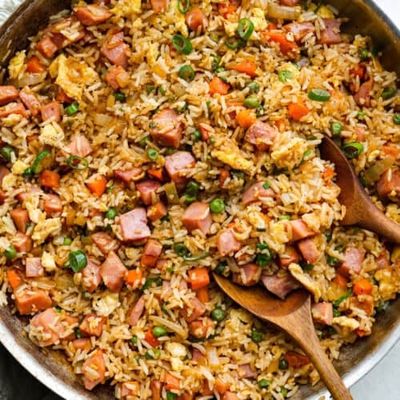
Fried rice is fundamentally about texture contrast: individual grains coated entirely with hot oil, remaining crispy and separate, never clumped or greasy. Success requires three critical elements: Cold rice (overnight-refrigerated best), sufficiently hot oil (nearly smoking), and a light hand with seasonings. The beaten egg is never pre-cooked; instead, it's added raw to the hot rice and oil where residual heat cooks it silkily, coating the grains. Bean sprouts provide fresh textural contrast. This is not comfort food; it's refined technique applied to simple ingredients.
Hong Kong Egg Tarts
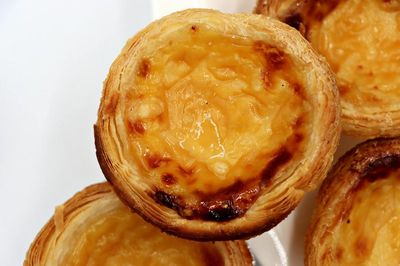
The shortcrust uses lard (or vegetable shortening + butter) for the right crumbly texture; sugar gives the slight sweetness; egg yolk binds. Rolled to 3 mm thick, cut into discs slightly larger than the muffin-tin wells, gently pressed in, chilled. The custard: eggs whisk with hot sugar syrup (sugar dissolved in just-boiled water, cooled) and a small amount of evaporated milk for richness, plus vanilla. Strained twice for a glassy finish, ladled into the chilled shells, baked at 220°C for the first 8 minutes (to set the pastry edges) then 180°C for 12-15 more (until the custard is just-set with no visible jiggle in the centre).
Mango Pudding
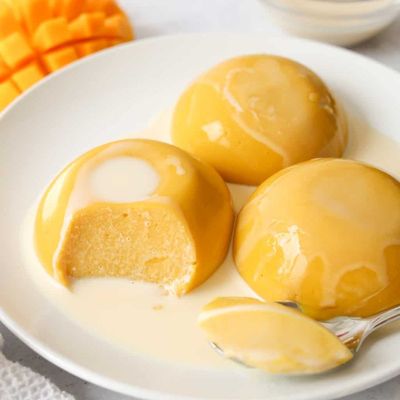
Ripe mango (Alphonso or Nam Dok Mai if available; any sweet ripe mango works) blends to a smooth puree with sugar and lime juice. Powdered gelatin blooms in cold milk 5 minutes. Half the milk warms to dissolve sugar; the bloomed gelatin stirs in to dissolve. The warm milk pours into the mango puree along with the cold remaining milk, evaporated milk and a splash of double cream. Whisked smooth, ladled into 6 small moulds or glasses, refrigerated for 4-6 hours until set. Served with diced fresh mango and a drizzle of evaporated milk.
Jian Bing
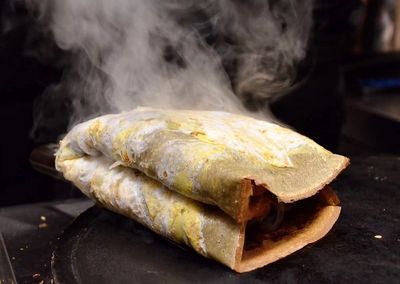
A thin batter of mung-bean flour, millet flour, plain flour, water, salt and five-spice is whisked to a single-cream consistency; rested for 1 hour. A wide flat griddle or large non-stick pan is heated; a ladle of batter is spread thinly with a wooden disc-rake (jian bing rake, or just rotate the pan to spread). An egg is cracked onto the crepe; smashed and spread with a spatula. The crepe is flipped; the cooked side is painted with sweet bean sauce and chilli paste; scattered with herbs; topped with a crisp wonton sheet; folded into quarters. Eaten warm, by hand.