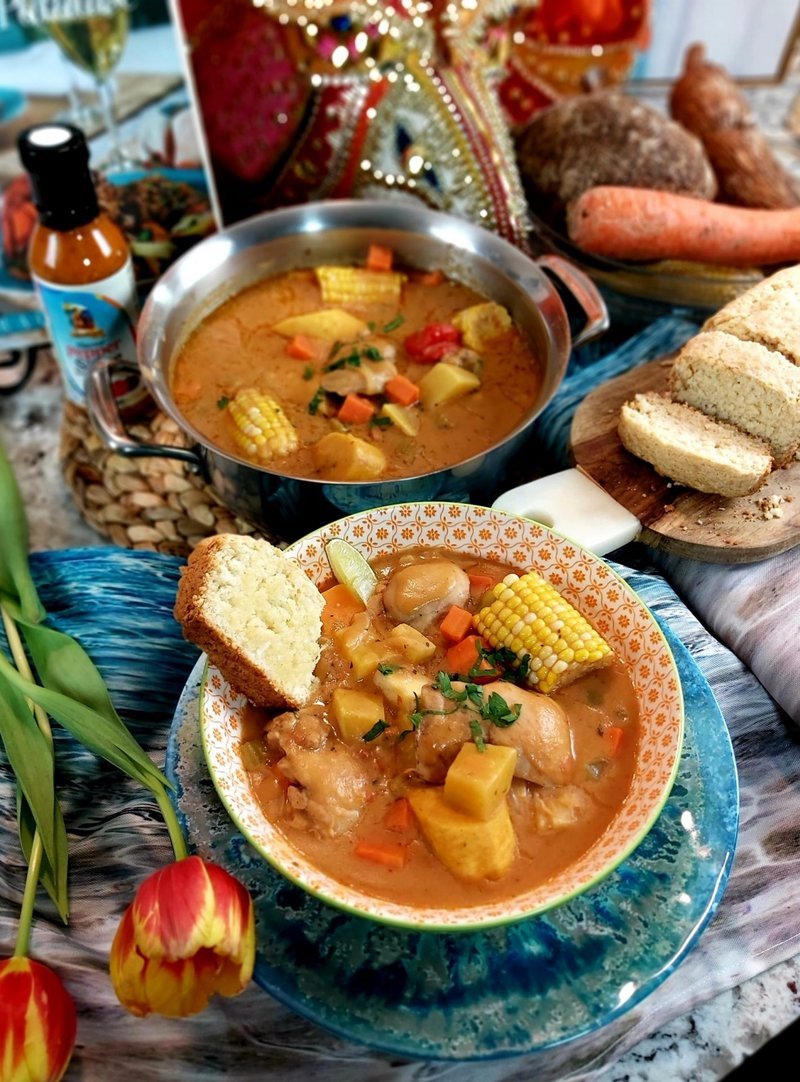
Bahamian Stew Chicken
A Bahamian Sunday stew: chicken thighs seared and simmered in a dark roux base with sweet potato, cassava, carrots, corn and plantain. Thyme is the herb.
Overview
A dark, brown-roux-thickened stew that sits closer to Louisiana gumbo than to Jamaican brown stew chicken, a tell of how strong the Gulf Coast crossover is in Bahamian cooking. The dark roux is the defining step: flour cooked in oil until it goes the colour of cocoa or dark caramel, building toasted-nut depth that the rest of the dish leans on. The flavour profile is layered savoury: thyme as the dominant herb, smoked paprika for smoke, allspice (in the seasoned salt) for Caribbean lift, a single Scotch bonnet for fruity heat, lime juice at the end to wake everything up. The vegetables make it a complete dish, sweet potato, cassava, carrot, corn-on-the-cob pieces and yellow plantain, all hearty and starchy, all picking up the dark sauce. Smell is roasted flour, thyme, and slow-cooked tomato. Not hard but not quick, the roux needs unbroken attention for 5-8 minutes to avoid burning, and the rest is patient stewing. A Sunday-lunch staple across the Bahamas, traditionally served with rice and Johnny Cake (a Bahamian cornbread), and the kind of dish where the leftovers on day two are arguably better than day one.
Ingredients
Seasoned salt
- 2 tablespoons fine sea salt
- 1 teaspoon garlic powder
- 1 teaspoon onion powder
- ¼ teaspoon ground cumin
- 1 teaspoon smoked paprika
Stew
- 8 boneless skinless chicken thighs
- 1 tablespoon white vinegar (for rinsing)
- 60 ml red wine vinegar
- 240 ml vegetable oil
- 80 g plain flour
- 1 teaspoon tomato paste
- ½ sweet onion (thinly sliced)
- 2 celery stalks (diced)
- 240 ml fire-roasted diced tomatoes (or regular diced tomatoes)
- 1.9 litres chicken stock
- 1 bay leaf
- 1 Caribbean sweet potato (peeled, diced)
- 1 regular sweet potato (peeled, diced)
- 1 piece cassava (~200 g, peeled, diced)
- 1 carrot (large, peeled, diced)
- 2 corn cobs (cut into 7 cm pieces)
- 1 yellow plantain (cut into 5 cm pieces)
- 1 teaspoon fresh thyme leaves
- 1 teaspoon dried oregano
- 2 tablespoons chopped parsley
- 1 Scotch bonnet (diced; optional, with gloves)
- 1 lime (juice)
- salt
- pepper
- Lime wedges to serve
Method
Stage 1 - Seasoned salt
- Combine the salt, garlic powder, onion powder, cumin and smoked paprika in a small bowl.
Stage 2 - Prep and season the chicken
- Rinse the chicken in cold water with the white vinegar; drain; pat dry.
- Place in a bowl. Pour the red wine vinegar over and toss.
- Sprinkle the seasoned-salt blend generously over both sides of each thigh.
Stage 3 - Sear
- Heat ½ cup (120 ml) of the oil in a wide skillet over medium-high heat.
- Sear the thighs in batches, 3 minutes per side, until golden brown.
- Set aside on a plate.
Stage 4 - Dark roux
- Tip the remaining 120 ml oil into a large heavy pot over medium heat.
- Whisk in the flour continuously.
- Cook 5-8 minutes, stirring without stopping, until the roux is a deep brown - the colour of dark caramel.
- Stir in the tomato paste; cook 1 minute.
Stage 5 - Aromatics
- Add the sliced onion and diced celery to the pot.
- Cook 1 minute, stirring.
- Add the fire-roasted diced tomatoes; stir 3 minutes.
Stage 6 - Build the stew
- Carefully pour in the chicken stock (it'll spit; use oven mitts). Stir and bring to a boil.
- Add the bay leaf, sweet potatoes, cassava, carrot, corn pieces and plantain.
- Return the seared chicken thighs and any resting juices.
- Reduce to a medium simmer; cover the lid slightly ajar; cook 15 minutes.
Stage 7 - Finish
- The stew should coat the back of a spoon by now. If it's too thin, simmer uncovered 5 minutes.
- Add the thyme, oregano, parsley and Scotch bonnet (if using).
- Squeeze in the lime juice.
- Taste; adjust salt and pepper.
- Cook 5 more minutes.
Stage 8 - Serve
- Ladle into deep bowls. Make sure each bowl gets a piece of corn, plantain and at least one chicken thigh.
- Serve with lime wedges and a piece of Johnny Cake on the side if you have one.
Notes
- Dark roux is the dish: the longer you cook the flour-oil mixture, the deeper the colour and flavour. Aim for a colour somewhere between peanut butter and dark caramel. Don't burn it - if you see black flecks, start over.
- Cassava is firmer than potato: peel it carefully (the skin is bark-like). It holds shape through the stew where a regular potato would break down.
- Plantain ripeness: yellow plantain with black spots adds sweetness; green plantain is starchy and savoury. The recipe calls for yellow; pick what you can find.
- Scotch bonnet gloves: standard practice. Two minutes of mincing transfer enough capsaicin to burn skin for hours.
Storage
- Keeps 3 days refrigerated; reheats beautifully and deepens overnight.
- Freezes 2 months. The plantain can go slightly soft on thaw; everything else holds.
Recipes mentioned here
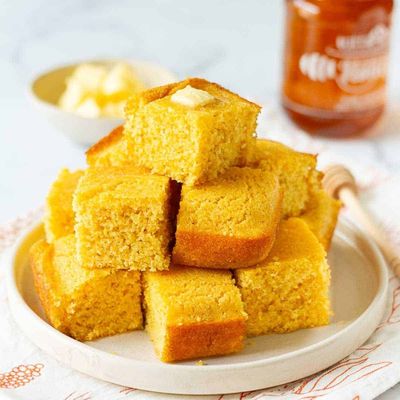
Cornbread
A 25 cm cast-iron skillet is preheated in the hot oven with a generous knob of butter, the butter browns slightly while the pan heats. The batter is fast: cornmeal, flour, sugar, baking powder, salt, plus buttermilk, eggs and melted butter. The batter is poured into the hot pan; the cornmeal sears immediately on contact, giving the crisp golden crust. 25 minutes; tipped out and sliced.
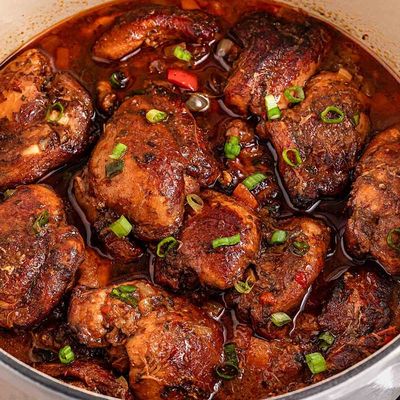
Brown Stew Chicken
The Sunday-lunch counterpart to goat curry across Jamaica; not curry-driven but built on a deep mahogany gravy that gets its colour from caramelised brown sugar and a few teaspoons of bottled "browning sauce" (Grace is the canonical brand, a concentrated burnt-sugar syrup that's a kitchen staple in every Jamaican household). The chicken is bone-in, marinated overnight in a wet rub of onion, bell pepper, scallions, allspice, ginger and thyme, then browned hard and slow-braised until the meat slips off the bone. Flavour is savoury and slightly sweet with a deep thyme back-note and a whisper of Scotch bonnet heat from the whole pierced fruit in the pot. The gravy is what you actually want; thick, dark, sweet-savoury, glossy with rendered chicken fat, the kind of gravy you'd happily eat over plain rice as its own meal. Smell is browning sugar, thyme, and the unmistakable allspice signature. Patient cooking but easy: marinate the day before, then 30 minutes of active prep and 2 hours of unattended braise. The pairing with [[rice-and-peas]] is non-negotiable across Jamaican households.
More like this
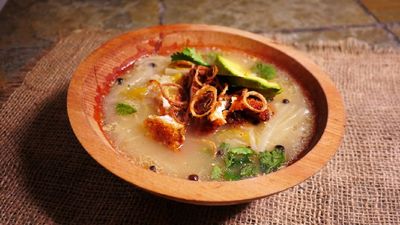
Bahamian Souse
The Bahamas' Saturday-morning hangover cure, the breakfast bowl that arrives steaming in fish shacks and family kitchens across the islands the morning after a wedding or a heavy Friday. You poach bone-in chicken pieces (legs or wings) in lightly salted water with onion, celery, allspice, bay and a whole goat pepper for an hour or so, until the meat falls easily from the bone and the broth has taken on the perfume of the spice. Potatoes go in for the last fifteen minutes so they cook through but hold their shape. Off the heat, you acidify the souse hard with the juice of four or five limes (the souse is meant to taste sharply citric, not gently lemony) and a final tweak of salt. Ladle into deep bowls with the goat pepper floated on top for whoever's brave, and serve with johnnycake or grits on the side to soak.
Domoda
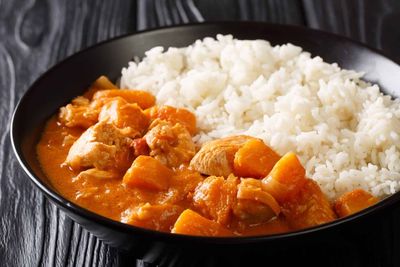
Chicken thighs (or lamb) are browned, onions and tomato cooked down with garlic and a single whole chilli, then the meat simmers in stock until tender. A loose peanut paste is stirred in for the final 20 minutes, kept thin enough to ladle. Sweet potato or pumpkin softens in the sauce. A spoon of lime juice at the end balances the richness.
Authentic Jamaican Curry Chicken
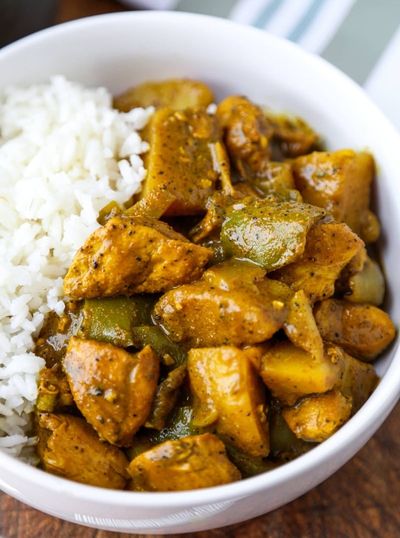
Jamaican curry sits in its own corner of the global curry map: heavier on turmeric and allspice than Indian Madras, lighter on cumin, and built on a technique called "burning the curry" that gives the dish its character. The technique is exactly what it sounds like, dry curry powder hits hot oil and is stirred for 30 seconds until it darkens from yellow to deep gold and smells like toasted spice. That move concentrates the flavours and removes any raw edge. The finished stew is bright yellow stained slightly orange, savoury and aromatic rather than searingly hot, with thyme and a whole pierced Scotch bonnet scenting the gravy without flooring it. Smell: bloomed curry powder, allspice, browned chicken fat. Not difficult, but requires confidence in the 30-second bloom (under-do it and the dish is flat; over-do it and you have to start over). A Sunday-dinner staple across Jamaica and the diaspora, served over white rice with the gravy spooned generously over.
Bunjay-Style Curry Chicken
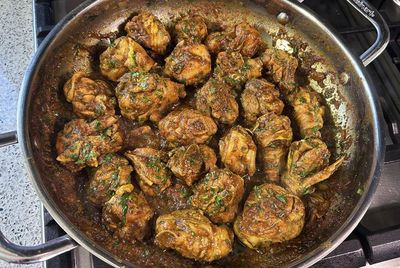
A dry curry rather than a saucy one, "bunjay" is Trinidadian patois for "fry-down", the technique of cooking meat in its own juices until the gravy completely disappears and the spices coat the surface of the meat in a sticky, glaze-like crust. The flavour is concentrated rather than diluted; nothing's been thinned with water or coconut milk, so what you taste is bone-in chicken, rendered chicken fat, and toasted spice. The spice mix is the East Indian Trinidadian signature: turmeric for colour and earth, roasted geera (toasted cumin, ground) for nuttiness, anchar masala for tang, regular curry powder for breadth. The pan oil splits and separates around the chicken at the end, which is the visual cue you're looking for. Smell when the curry powder hits hot oil is deeply aromatic, almost incense-like. Not difficult but it requires attention during the cook-down phase; if you walk away the curry burns onto the bottom of the pan. A Trinidadian household staple, eaten across the country with white rice and dhal, and a clean example of how Indian indentured labourers' descendants in the Caribbean evolved a distinct curry tradition over 150 years.