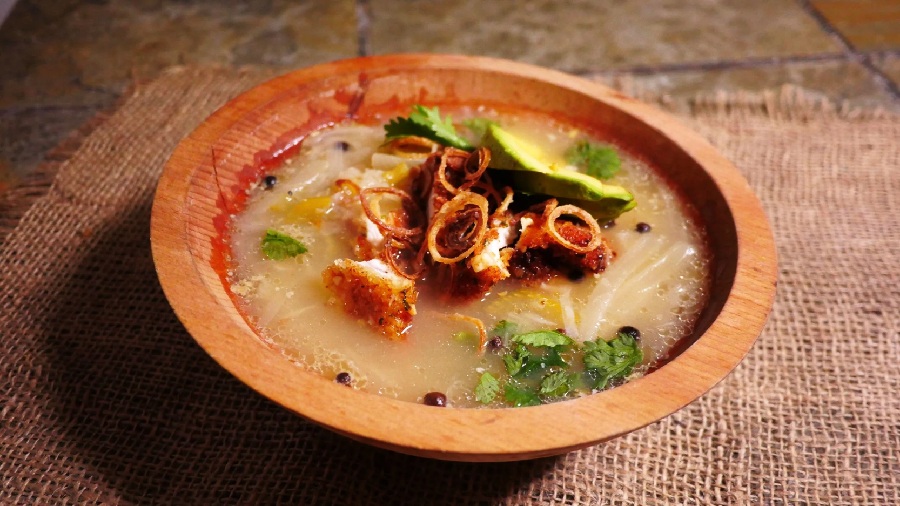
Bahamian Souse
The Bahamas' Saturday-morning hangover cure: a clear, citrus-bright broth of poached chicken with onion, celery, potato and a fierce squeeze of lime.
Overview
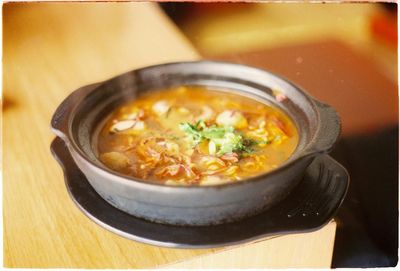
The Bahamas' Saturday-morning hangover cure, the breakfast bowl that arrives steaming in fish shacks and family kitchens across the islands the morning after a wedding or a heavy Friday. You poach bone-in chicken pieces (legs or wings) in lightly salted water with onion, celery, allspice, bay and a whole goat pepper for an hour or so, until the meat falls easily from the bone and the broth has taken on the perfume of the spice. Potatoes go in for the last fifteen minutes so they cook through but hold their shape. Off the heat, you acidify the souse hard with the juice of four or five limes (the souse is meant to taste sharply citric, not gently lemony) and a final tweak of salt. Ladle into deep bowls with the goat pepper floated on top for whoever's brave, and serve with johnnycake or grits on the side to soak.
Ingredients
Chicken and broth
- 1.2 kg bone-in chicken pieces (a mix of thighs, drumsticks and wings)
- 2 litres cold water
- 1 onion (large, sliced)
- 2 celery stalks (sliced; reserve the leafy tops)
- 4 garlic cloves (smashed)
- 4 spring onions (whole)
- 1 carrot (sliced)
- 1 tablespoon allspice berries (or 1 teaspoon ground)
- 2 bay leaves
- 1 whole scotch bonnet (or goat pepper, left whole, pierced once with a knife)
- 1 ½ teaspoons salt (plus more to taste)
- 1 teaspoon freshly ground black pepper
Vegetables (added later)
- 500 g waxy potatoes (peeled, cut into 3 cm chunks)
To finish
- 4-5 limes (juice; about 120 ml)
- A small bunch of flat-leaf parsley (chopped)
- Bahamian hot sauce (to serve)
- Extra lime wedges
Optional accompaniment
- Johnnycake, grits, or thick slices of buttered white bread
Method
Stage 1 - Wash the chicken (traditional)
- Rinse the chicken pieces under cold water; rub with the juice of ½ lime and a generous pinch of salt. Rinse again and pat dry. This step is universal in Bahamian kitchens; it's about flavour as much as cleaning.
Stage 2 - Build the pot
- Place the chicken in a large heavy pot. Cover with the cold water.
- Bring to the boil over high heat. As it heats, skim off any grey scum that rises.
- Reduce the heat to medium-low; add the onion, celery, garlic, spring onions, carrot, allspice, bay leaves, salt and pepper.
- Drop in the whole pierced scotch bonnet - whole means flavour without overwhelming heat. If anyone bites it, that's their problem.
Stage 3 - Simmer
- Cover the pot loosely and simmer gently for 50 minutes, until the chicken is tender and the broth is fragrant.
- Skim any further scum or excess fat from the surface.
Stage 4 - Potatoes
- Add the chunks of potato to the pot.
- Cover and simmer another 15-18 minutes, until the potatoes are just tender to a knife.
Stage 5 - Acidify
- Off the heat, fish out the whole scotch bonnet (leave it in if you like real fire) and the bay leaves.
- Pour in the lime juice (start with 4 limes' worth, taste, add more). The broth should taste assertively citric - that's the defining note.
- Taste and adjust salt. A souse should be clear, bright, clean and a bit fiery.
- Stir in the chopped parsley.
Stage 6 - Serve
- Ladle into deep bowls, making sure each bowl gets chicken, broth, potato and a bit of onion.
- Pass lime wedges and hot sauce at the table.
- Serve johnnycake, grits or buttered white bread on the side.
Notes
- Lime juice goes in off the heat: Cooking lime juice dulls it. The bright acidic finish is the whole character of the dish.
- Whole scotch bonnet: Pierced once, left whole, fished out at the end. This way the broth gets perfume and warmth without the brutal heat of a chopped pepper. If you like it hot, leave it in or break it apart with a spoon.
- Allspice (pimento) is essential: The warm fragrance of allspice is what makes souse taste Bahamian. Don't substitute.
- Other meats: Traditional souses use pig's feet, sheep tongue, oxtail or shrimp. Chicken is the most home-friendly version and the easiest to find. If using pig's feet, simmer 2-2 ½ hours; sheep tongue, 2 hours; oxtail, 3 hours.
- Don't overthink the broth: Souse is meant to be clear and brothy, not a thick stew. Avoid thickening; the body comes from the lime and the marrow of the bones.
Variations
Sheep tongue souse: Simmer 2 sheep tongues whole until tender (about 2 hours). Peel and slice; return to the broth. Add potatoes for the last 15 minutes. Conch souse: Use 600 g cleaned, thinly sliced conch (raw); skip the long simmer and just warm the conch through in the bright broth at the end. Add lime generously. Pig-foot souse: Use 1.2 kg trimmed pig's feet; simmer 2 ½ hours until the skin and meat are tender.
Serving
Serve with: johnnycake, grits, or thick buttered white bread. Garnish with: chopped parsley, hot sauce, lime wedges.
Storage
- Keeps 3 days refrigerated. The flavour improves overnight; the citric edge softens slightly but stays bright.
- Reheat gently; a fresh squeeze of lime brightens the broth at the table.
- Freezes 2 months; the potatoes get a little softer on thaw.
More like this
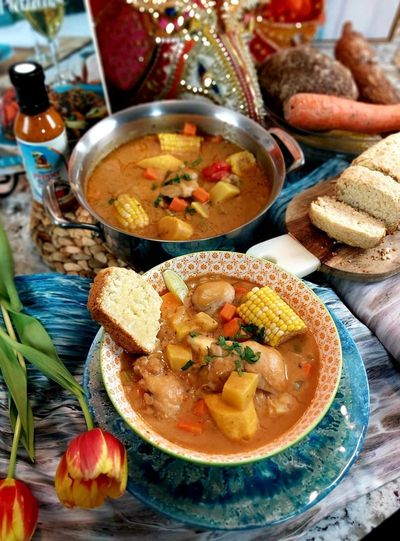
Bahamian Stew Chicken
A dark, brown-roux-thickened stew that sits closer to Louisiana gumbo than to Jamaican brown stew chicken, a tell of how strong the Gulf Coast crossover is in Bahamian cooking. The dark roux is the defining step: flour cooked in oil until it goes the colour of cocoa or dark caramel, building toasted-nut depth that the rest of the dish leans on. The flavour profile is layered savoury: thyme as the dominant herb, smoked paprika for smoke, allspice (in the seasoned salt) for Caribbean lift, a single Scotch bonnet for fruity heat, lime juice at the end to wake everything up. The vegetables make it a complete dish, sweet potato, cassava, carrot, corn-on-the-cob pieces and yellow plantain, all hearty and starchy, all picking up the dark sauce. Smell is roasted flour, thyme, and slow-cooked tomato. Not hard but not quick, the roux needs unbroken attention for 5-8 minutes to avoid burning, and the rest is patient stewing. A Sunday-lunch staple across the Bahamas, traditionally served with rice and Johnny Cake (a Bahamian cornbread), and the kind of dish where the leftovers on day two are arguably better than day one.
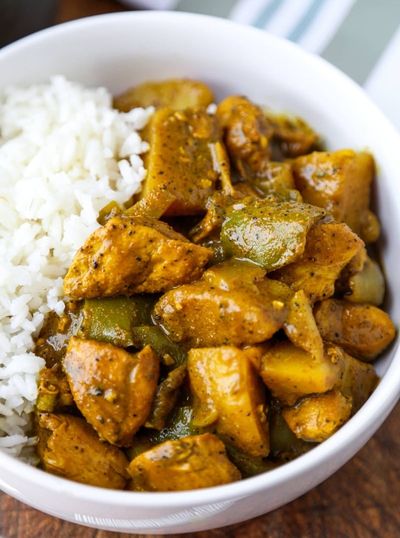
Authentic Jamaican Curry Chicken
Jamaican curry sits in its own corner of the global curry map: heavier on turmeric and allspice than Indian Madras, lighter on cumin, and built on a technique called "burning the curry" that gives the dish its character. The technique is exactly what it sounds like, dry curry powder hits hot oil and is stirred for 30 seconds until it darkens from yellow to deep gold and smells like toasted spice. That move concentrates the flavours and removes any raw edge. The finished stew is bright yellow stained slightly orange, savoury and aromatic rather than searingly hot, with thyme and a whole pierced Scotch bonnet scenting the gravy without flooring it. Smell: bloomed curry powder, allspice, browned chicken fat. Not difficult, but requires confidence in the 30-second bloom (under-do it and the dish is flat; over-do it and you have to start over). A Sunday-dinner staple across Jamaica and the diaspora, served over white rice with the gravy spooned generously over.
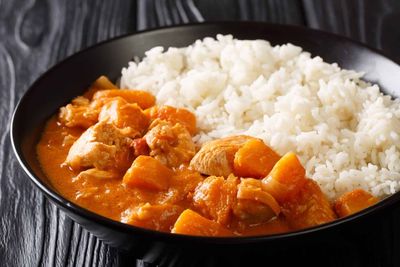
Domoda
Chicken thighs (or lamb) are browned, onions and tomato cooked down with garlic and a single whole chilli, then the meat simmers in stock until tender. A loose peanut paste is stirred in for the final 20 minutes, kept thin enough to ladle. Sweet potato or pumpkin softens in the sauce. A spoon of lime juice at the end balances the richness.
Soup Joumou
Beef shank or stewing beef marinates overnight in épis and citrus, then browns and simmers in beef broth for an hour. A whole calabaza pumpkin is boiled separately until soft, then puréed with some of the cooking liquid and stirred back into the soup pot. Carrots, turnips, celery, cabbage, leeks and potatoes go in to simmer until tender; vermicelli noodles and a whole pierced Scotch bonnet are added near the end. Final adjustments are lime juice, a knob of butter, fresh parsley and salt. The soup is served on January 1st by tradition; the rest of the year it stays the family Sunday-soup of the Haitian diaspora.