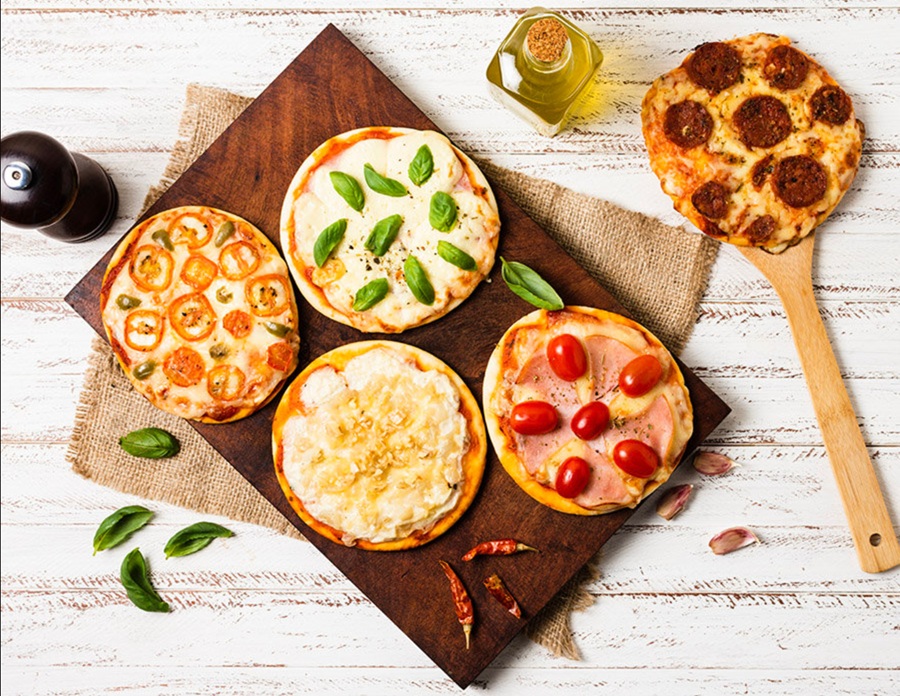
Toppings
Pile too much on and it's a sandwich on bread. Too little and the dough takes over. There's a Goldilocks zone here, plus a small but important question of timing: some toppings go on raw, some go in halfway, some go on after the bake. We'll cover all of that.
Overview
The Italian phrase that governs pizza topping is poche cose, ma buone: few things, but good ones. A great pizza has 3-4 toppings beyond the sauce and cheese, and each is there because it brings something specific. A pizza with eight different toppings tastes muddled at best and like a salad-sandwich at worst.
The rules:
- Less is more. Resist the urge to add another ingredient.
- Layer thoughtfully. Sauce, then cheese, then heavy toppings, then light toppings, then oil. Each layer at its right moment.
- Topping size matters. Most pizza toppings are sliced thin or torn small. Whole cherry tomatoes are an outlier; everything else is bite-size or smaller.
- Three things bake well together. A pizza loaded with seven ingredients does not bake evenly; the top is dry while the bottom is wet.
When Toppings Go On (And When They Don't)
Toppings split into four categories by when they meet the pizza.
1. Goes on Before the Bake
The classics. They benefit from the oven's heat or melt-and-merge into the cheese.
- Sliced meats: salami, pepperoni, chorizo, prosciutto cotto, ham, pancetta.
- Cooked meats: browned sausage (broken into pieces), meatballs (halved or quartered), shredded chicken.
- Sturdy cheeses: mozzarella di bufala, fior di latte, fontina, taleggio.
- Hardy vegetables: thin onion slices, sliced red pepper, mushroom (small caps; large ones release water), olives (pitted), capers.
- Herbs: dried oregano, fresh thyme, fresh rosemary.
- Oil: a light drizzle of extra virgin olive oil over everything.
2. Goes on Halfway Through the Bake
A small set of toppings benefit from less heat than the rest of the pizza gets.
- Cherry tomatoes: halved, scattered after 3-4 minutes. Cook just enough to soften but not collapse.
- Soft-melt cheeses: gorgonzola dolce, fresh ricotta dollops. Added halfway so they melt without splitting.
3. Goes on After the Bake
The "raw" finishing toppings. They are not for cooking; they are for contrast.
- Cured / fresh meats not meant for heat: prosciutto crudo, mortadella, bresaola, lardo, raw 'nduja.
- Burrata: torn pieces dropped onto the hot pizza. The cream interior should melt against the cheese but the casing should stay distinct.
- Salad / herb leaves: rocket, basil (whole leaves), micro-herbs.
- Citrus zest: lemon or orange zest grated over the hot pizza.
- Acidic finishing oils: chilli oil, truffle oil, garlic oil.
- Truffle: thinly shaved, never baked.
- Fresh ricotta dollops: if not melted in.
- Toasted nuts: pine nuts, walnuts, hazelnuts (scattered after bake so they don't burn).
4. Never Goes on a Pizza (Personal Rule, Take It or Leave It)
- Pineapple. The ham-and-pineapple wars are old; the case for pineapple is texture and sweet-savoury contrast, the case against is that the water content makes the base soggy and the fruit overpowers everything else.
- Sweetcorn. Watery and small enough to roll off; rarely improves anything.
- Raw garlic, in quantity. A few paper-thin slices fine; a sprinkle of fresh-pressed garlic burns and turns bitter.
- Pre-cooked frozen vegetables. They release water during the bake and turn the pizza soggy.
These are conventions, not rules. Disregard if you have a clear reason.
How Much
The single most common home-pizza mistake: too much topping.
A guide for a 30 cm pizza:
- Sauce: 5-6 tbsp.
- Cheese: 80-100 g (sliced thinly or torn small).
- Heavy savoury topping (salami, sausage, etc): 50-70 g.
- Light topping (mushroom, pepper, onion): 30-50 g.
- Fresh herb / salad finish: a small handful.
Total weight of topping (excluding sauce and cheese): no more than 100-120 g for the pizza to bake evenly. Past that, the centre stays wet.
Topping by Recipe (Worked Examples)
Margherita
- Sauce: red
- Cheese: 80 g torn fior di latte or mozzarella di bufala (the latter only added after the bake)
- Topping (before bake): nothing
- Finish: fresh basil leaves, olive oil drizzle
- The simplest pizza. The cheese-tomato-basil triangle is the whole point. See Margherita.
Pancetta and Rocket
- Sauce: red
- Cheese: 80 g torn mozzarella
- Topping (before bake): 50 g sliced pancetta
- Finish: handful of rocket leaves dressed with olive oil and lemon, scattered on after the bake
- The rocket is fresh and dressed. See Pancetta and Rocket.
Burrata and Herb
- Sauce: red, thin
- Cheese: 60 g mozzarella (under the burrata for melting)
- Topping (before bake): nothing
- Finish: 1 ball burrata, torn over the hot pizza; fresh basil; olive oil; cracked black pepper
- See Burrata and Herb.
Calabrese
- Sauce: red
- Cheese: 80 g mozzarella
- Topping (before bake): 50 g sliced spicy salami, 1 tsp nduja dabbed in spots, sliced red onion (thin)
- Finish: fresh basil, olive oil
- See Calabrese.
Sausage and Fennel
- Sauce: red
- Cheese: 80 g mozzarella
- Topping (before bake): 80 g Italian sausage (skins removed, crumbled raw), 1 tsp fennel seeds, thin red onion
- Finish: fresh basil, olive oil
- See Sausage and Fennel.
Pissaladier (Provençal)
- Sauce: no tomato; thick layer of slow-cooked caramelised onion
- Cheese: none
- Topping (before bake): anchovy fillets arranged in a lattice, pitted black olives
- Finish: olive oil drizzle, thyme
- See Pissaladiers.
The Water Problem
Most home pizzas come out wet in the middle. The cause is almost always too much water in the toppings.
Wet offenders:
- Fresh mozzarella, dripping: drain on muslin or paper towel for 10 minutes before topping. Tear into pieces; do not slice with a knife (slicing seals the cut edge and traps moisture).
- Mushrooms: dry-sauté or roast briefly first, then top.
- Cherry tomatoes: halved is fine; whole release more water.
- Wet greens (spinach, kale): wilt and squeeze first, or omit and add raw after the bake.
- Bell peppers: slice thin so they cook through; thick slices stay watery.
The two-line rule: anything with visible surface moisture goes on dry. Anything that releases water in the oven goes on after.
Common Mistakes
The pizza is wet in the middle. Too many wet toppings, or too much cheese. Drain anything that drains; reduce cheese by a quarter.
The toppings burned but the centre is undercooked. Either oven too cool overall, or too much topping. Reduce topping next time; oven hotter.
The base soaked through. Too much sauce, too wet a cheese, too long a bake. Less sauce, drained cheese, faster bake. See Cooking Methods.
The pizza tastes muddled. Too many toppings. Pick three things and trust them.
Salami / pepperoni cupped into rigid curls. That is actually correct for traditional pepperoni (the curl holds oil pockets). For salami, slice slightly thicker (3-4 mm).
The fresh herbs withered. Added before the bake. Fresh basil, rocket, etc. go on after the bake, never before.
The base is overpowered by raw garlic. Used too much, or used minced rather than thin-sliced. Garlic should be present, not aggressive.
Where Next
- Dough: the structure under everything.
- Sauce: the layer beneath toppings.
- Cheese: the dedicated cheese deep-dive.
- Cooking Methods: the bake that brings it all together.
- Margherita: the canonical topping-restraint example.
More like this
Acar Timun
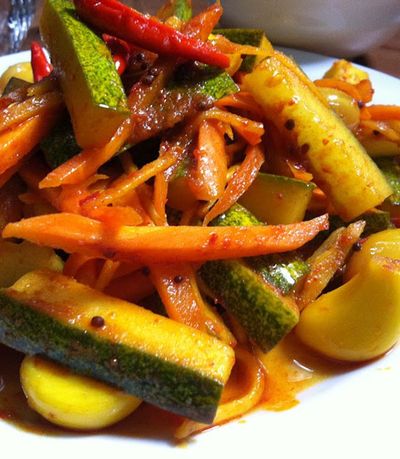
Cucumber, carrot, shallot, chilli prep into thin slices or matchsticks. Salt rests for 10 minutes to draw moisture, drains. A simple dressing of vinegar, sugar, water and ginger whisks together. Vegetables toss with the dressing; rest for 1 hour at room temperature. Eats cool, never refrigerated cold; the texture suffers.
Adobong Sitaw
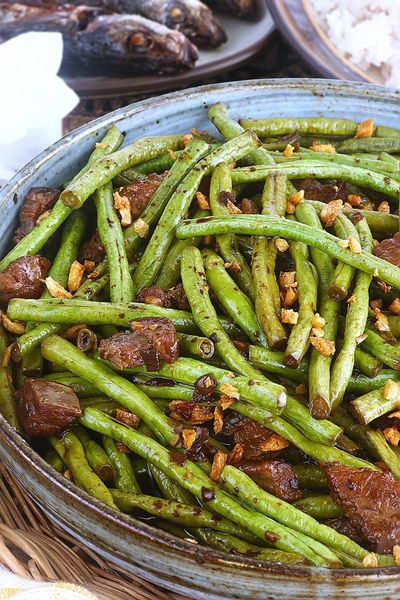
Garlic browns in oil; long beans toss in to colour briefly. Soy and vinegar pour in with bay and peppercorns; the beans braise covered until tender. Lid off; the liquid reduces to a glaze. Salt at the end, not the start, since soy is salty enough.
Ajad
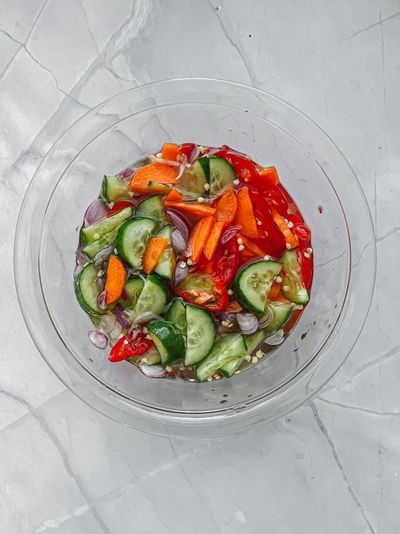
A simple syrup of rice vinegar, palm sugar, water and salt is brought to a gentle simmer to dissolve the sugar, then cooled. Cucumber, shallot and chilli are sliced thin and combined in a small bowl. The cooled syrup is poured over. Rested for 10-15 minutes for the vegetables to wilt slightly into the dressing. Served in small individual ramekins as a dip, OR in a larger bowl as a side, with peanuts sprinkled on top.
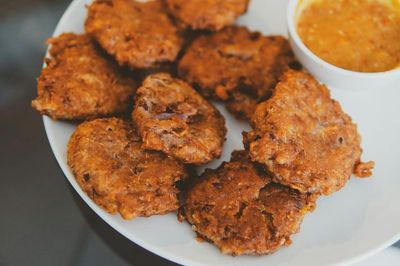
Akara
Dried black-eyed beans soak briefly to loosen the skins; the skins rub off (this is the key step, skin-on akara is bitter and grey). The peeled beans go into a blender with onion, Scotch bonnet and just enough water to make a thick batter (not a paste). The batter is whipped by hand or with a wooden spoon for 5 minutes until light and aerated, this is what makes akara fluffy rather than dense. Spoonfuls drop into 175°C oil and fry for 3-4 minutes per side until golden. Drained on paper. Eaten hot.