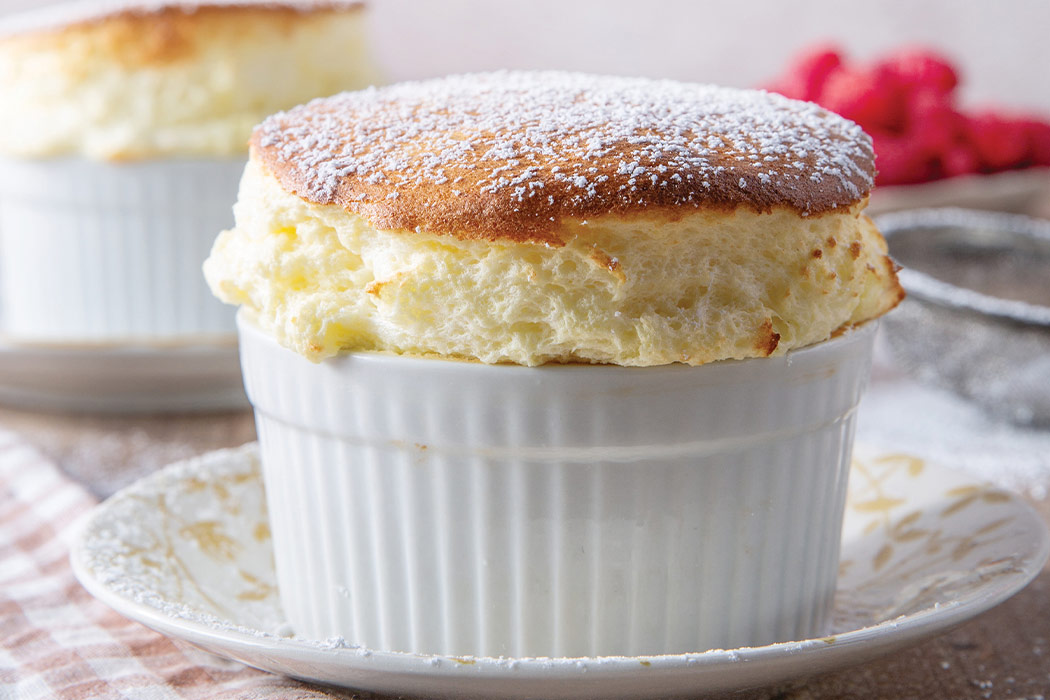
Souffles
Souffles have a reputation for collapsing on the way to the table, and that reputation is mostly earned. But there's a real method behind them: a thick flavoured base, whipped egg whites folded in, a hot oven, and a dash to the table the second they're out. Sweet, savoury, dramatic. Worth attempting at least once.
Overview
A souffle has two parts:
- A flavoured base. Either a thick bechamel (savoury souffles) or a thick custard or fruit puree (sweet souffles). Heavy with flavour, but on its own collapsed and dense.
- A meringue. Whipped egg whites with no sugar (savoury) or a touch of sugar (sweet). Light, foamy, full of air.
The two are folded together. The whites carry air; the base carries flavour. In the oven, the air expands as it heats; the base sets around the air pockets; the souffle rises to twice its raw height. The moment it comes out of the oven, the air starts to cool and contract; the souffle collapses within 90 seconds.
The whole drama is in the timing: you have to serve the souffle the moment it comes out of the oven. Otherwise it falls before the diner sees it.
The Cheese Souffle (Souffle au Fromage)
The classical reference savoury souffle.
Ingredients (Serves 4, in individual ramekins)
- 30 g unsalted butter (for buttering ramekins) + extra for the base
- 30 g grated parmigiano-reggiano (for dusting ramekins)
- 30 g unsalted butter
- 30 g plain flour
- 300 ml whole milk
- 150 g grated gruyere
- 4 egg yolks
- 5 egg whites
- Pinch fine sea salt
- 1 small pinch cayenne pepper
- 1 grating nutmeg
Method
Step 1 - Prepare the ramekins.
- Butter 4 ramekins generously, going UP the sides only (don't butter the rim or top edge; the souffle needs grip there to climb).
- Dust with grated parmigiano. Tap off excess.
- Refrigerate.
The buttered-and-dusted lining gives the souffle traction to rise. Skip this step and the souffle either won't rise or will rise lopsided.
Step 2 - Make a thick bechamel.
- Melt 30 g butter in a saucepan over medium heat. Whisk in 30 g flour. Cook 2 minutes (a blond roux).
- Slowly whisk in 300 ml warm milk. Cook over medium heat, whisking, until very thick (about 5 minutes). This is a thicker bechamel than usual; thick enough that the whisk leaves a deep track.
- Off heat, beat in the grated gruyere until melted.
- One at a time, beat in the 4 yolks.
- Add salt, cayenne, nutmeg.
- The base should taste highly seasoned (the meringue dilutes it).
Step 3 - Whip the whites.
- In a spotlessly clean bowl, whisk 5 egg whites with a pinch of cream of tartar (or a small splash of vinegar) to medium-stiff peaks. They should hold a peak but the tip droops slightly.
Step 4 - Fold.
- Stir 1 large tablespoon of the meringue into the base, whisking vigorously. This "loosens" the base so it can accept the rest of the whites.
- Add the rest of the whites all at once. Fold with a spatula, using a "cut down, lift up, rotate the bowl" motion. About 6-8 strokes. Stop when no large patches of white remain but small streaks are acceptable. Over-folding deflates the air.
Step 5 - Fill and bake.
- Spoon the mixture into the chilled buttered ramekins, filling almost to the top.
- Run your thumb around the inside rim of each ramekin (between the souffle mix and the ramekin wall, about 1 cm deep). This creates a moat that helps the souffle rise straight up.
- Place ramekins on a baking sheet. Bake at 200 C (180 fan) for 12-15 minutes.
Step 6 - The drama.
- Open the oven door. The souffle should be risen to about double the ramekin height, with a deep golden top. The interior should still wobble when the dish is moved.
- Serve immediately. Diners should be at the table when you take them out.
The Sweet Souffle (Chocolate)
Same method, different base.
Base: 100 g dark chocolate melted with 1 tablespoon unsalted butter. Beat in 4 egg yolks one at a time. Add 1 tablespoon caster sugar.
Meringue: 5 egg whites + 50 g caster sugar (added gradually as the whites whip, classical French meringue).
Fold and bake as above. Serve with a small jug of warm pouring cream alongside; the diner spoons it into the souffle just before eating.
Critical Rules
- Buttered AND dusted ramekins. Skipping either means uneven rise.
- Highly seasoned base. The meringue dilutes flavour. What tastes too strong in the base will taste right in the finished souffle.
- Stiff but not dry whites. Over-whipped whites tear during folding; under-whipped lack air capacity.
- One stir, then fold. First tablespoon of meringue stirred in; the rest folded gently. Two-stage folding preserves more air.
- Hot oven, no opening. Souffles need a hot quick blast. Opening the door drops temperature and the souffle deflates.
- Serve immediately. Souffles fall within 90 seconds of leaving the oven. No exceptions.
Common Mistakes
The souffle didn't rise. Whites under-whipped, or over-folded into the base (deflated). Or oven too cool. Check oven thermometer; whisk to medium-stiff peaks; fold gently.
The souffle rose lopsidedly. Uneven ramekin coating, or uneven fill. Coat thoroughly; spoon evenly; smooth the top.
The souffle rose then fell during baking. Oven door opened too early. Don't peek before 10 minutes.
The souffle is dense. Over-folded. Stop folding when small streaks of white still remain; they finish blending in the oven.
The souffle is wet in the centre. Under-baked. The interior should still wobble but the surface should be set and golden. Add 2 minutes; check again.
The souffle is rubbery at the base. Base was too thick (over-cooked bechamel); or under-folded (whites not incorporated). Either makes the bottom layer set without air.
The souffle fell before serving. Got distracted on the way to the table. Souffles fall fast. Open the oven, take them out, walk straight to the diners. The whole journey should be 30 seconds.
Other Souffles
Spinach souffle: cooked-and-squeezed spinach folded into a cheese-bechamel base. Add 200 g squeezed wilted spinach to the cheese souffle base.
Smoked haddock souffle: poached haddock flaked into the bechamel. Use the poaching milk as the bechamel milk for double flavour.
Lemon souffle: zest of 2 lemons + 2 tablespoons lemon juice folded into a custard base with 1 tablespoon caster sugar.
Grand Marnier souffle: 3 tablespoons Grand Marnier added to a sweet custard base. The orange liquor flavour intensifies during the bake.
Roquefort souffle: swap gruyere for 150 g crumbled Roquefort in the cheese souffle. Sharper, bolder.
Where Next
- Custards: the cooked-yolk base technique.
- Meringues: the whipped-white technique.
- Stocks-Sauces / Bechamel: the savoury base under cheese souffle.
- Eggs Course landing: back to the main course.
More like this
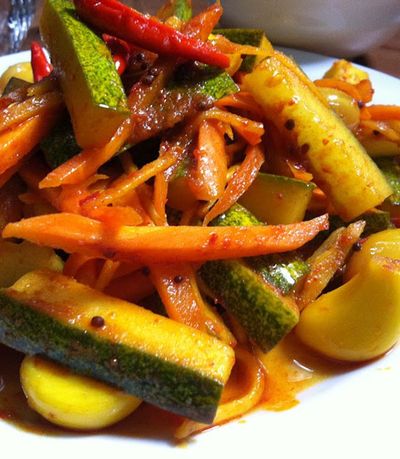
Acar Timun
Cucumber, carrot, shallot, chilli prep into thin slices or matchsticks. Salt rests for 10 minutes to draw moisture, drains. A simple dressing of vinegar, sugar, water and ginger whisks together. Vegetables toss with the dressing; rest for 1 hour at room temperature. Eats cool, never refrigerated cold; the texture suffers.
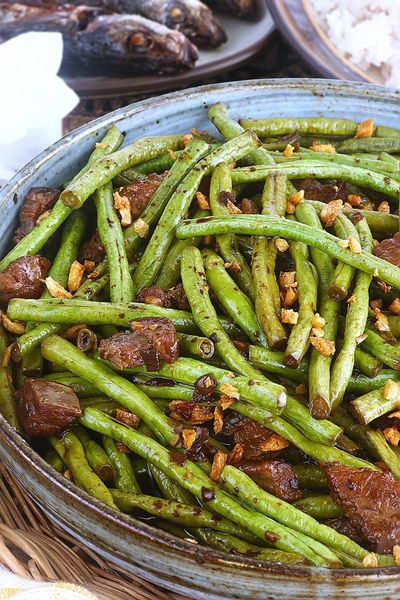
Adobong Sitaw
Garlic browns in oil; long beans toss in to colour briefly. Soy and vinegar pour in with bay and peppercorns; the beans braise covered until tender. Lid off; the liquid reduces to a glaze. Salt at the end, not the start, since soy is salty enough.
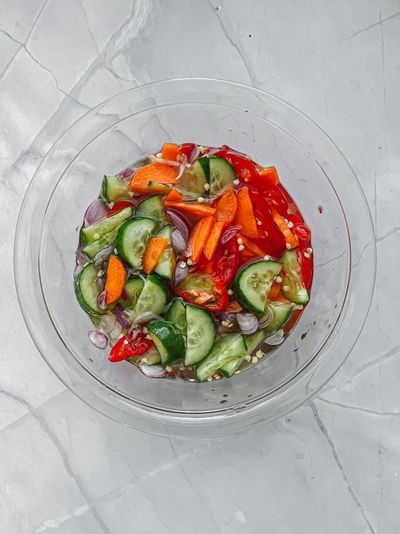
Ajad
A simple syrup of rice vinegar, palm sugar, water and salt is brought to a gentle simmer to dissolve the sugar, then cooled. Cucumber, shallot and chilli are sliced thin and combined in a small bowl. The cooled syrup is poured over. Rested for 10-15 minutes for the vegetables to wilt slightly into the dressing. Served in small individual ramekins as a dip, OR in a larger bowl as a side, with peanuts sprinkled on top.
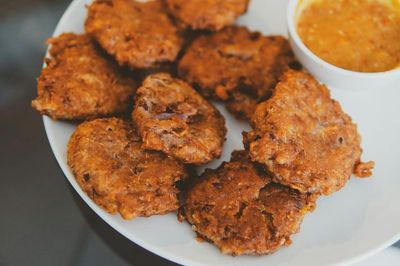
Akara
Dried black-eyed beans soak briefly to loosen the skins; the skins rub off (this is the key step, skin-on akara is bitter and grey). The peeled beans go into a blender with onion, Scotch bonnet and just enough water to make a thick batter (not a paste). The batter is whipped by hand or with a wooden spoon for 5 minutes until light and aerated, this is what makes akara fluffy rather than dense. Spoonfuls drop into 175°C oil and fry for 3-4 minutes per side until golden. Drained on paper. Eaten hot.