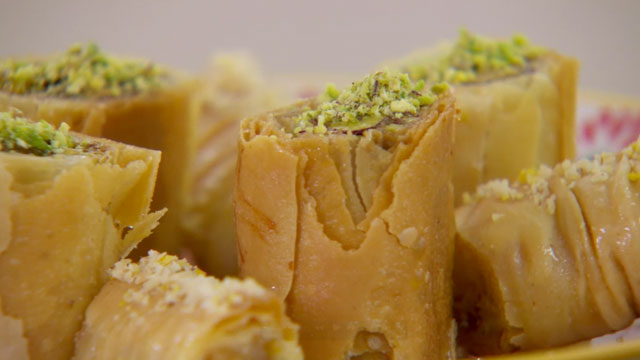
Baklava with Rose, Cardamom and Pistachio
The Levantine-leaning baklava. Filo cylinders filled with pistachio crushed with cardamom and icing sugar, baked to a deep gold, and drenched in a rose-scented sugar syrup. Floral, warm, light. The version that lands closest to the dessert tray at a Beirut bakery.
Overview
Where classical Turkish baklava layers walnut or pistachio between many sheets of filo, this version rolls each sheet around a generous spoon of pistachio-and-cardamom filling, into cylinders that pack onto a tray. The bake is short and hot; the syrup is the heart of the dessert - sugar and water boiled to a single thread, stirred off the heat with a tablespoon of rose essence so the perfume stays bright. The hot baklava meets the cool syrup; the syrup soaks the cylinders to their cores. Cut into 5 cm pieces while warm, served on small plates with strong coffee.
Ingredients
The syrup
- 225 g granulated sugar
- 150 ml water
- 2 tablespoons clear honey
- 1 teaspoon lemon juice
- 1 tablespoon rose essence (or 2 tablespoons rose water)
The filling
- 200 g shelled pistachios (toasted lightly, then 100 g blitzed coarse, 100 g left whole)
- 75 g icing sugar
- ½ tablespoon ground cardamom (from green pods, freshly ground)
The pastry
- 6 sheets ready-rolled filo pastry
- 75 g unsalted butter (melted)
Method
Stage 1 - Make the syrup
- In a small saucepan, combine the sugar, water, honey and lemon juice. Heat gently, stirring until the sugar dissolves.
- Bring to a steady simmer for 5 minutes. The syrup should coat the back of a spoon with a faint thread.
- Off the heat, stir in the rose essence. Pour into a heatproof jug and leave to cool completely. Cool syrup on hot baklava gives the best soak.
Stage 2 - Make the filling
- In a food processor, pulse the 100 g of pistachios designated "coarse" into rough crumbs - stop while there's still texture.
- Combine the blitzed pistachios with the icing sugar and cardamom in a bowl. Stir well - the icing sugar should coat every piece of nut.
Stage 3 - Shape the cylinders
- Heat the oven to 160°C fan / 180°C / 350°F. Line a large baking tray with baking paper and brush lightly with melted butter.
- Cover the filo with a damp tea towel as you work - it dries out fast.
- Lay one sheet of filo on the worktop. Brush all over with melted butter.
- Spread a generous strip of the pistachio filling along one long edge, about 2 cm from the edge and along the full length.
- Scatter a small handful of the whole pistachios over the filling.
- Roll the filo tightly into a long cylinder, starting from the filling edge.
- Lift onto the tray and brush the top with more butter. Press gently flat with your palms - flat cylinders cut cleanly later.
- Repeat with the remaining 5 sheets, leaving 1 cm between cylinders on the tray.
Stage 4 - Bake
- Bake for 25-30 minutes, until the tops are deep golden and the cylinders feel crisp when tapped. Rotate the tray halfway for even colour.
Stage 5 - Cut and soak
- While the baklava is still hot from the oven, cut each cylinder at an angle into 5 cm pieces with a sharp knife. Don't separate them - leave them in place on the tray.
- Pour the cooled syrup slowly and evenly over the hot baklava, getting into the cuts so it soaks every face. Use all of it.
- Leave to cool completely on the tray, at least 1 hour. The syrup continues to soak inward.
Stage 6 - Serve
- Lift the pieces onto a serving plate with a thin spatula. Scatter a few extra crushed pistachios on top for colour.
Notes
- Rose essence is much more concentrated than rose water; 1 tablespoon essence equals roughly 2 tablespoons rose water. Use whichever you have and adjust to taste - the rose should be present but not overpowering.
- For a Persian leaning, replace half the cardamom with ¼ teaspoon ground saffron threads bloomed in 1 tablespoon warm water, added to the filling.
- The whole-pistachio scatter inside each cylinder gives the slices their visible bright green flecks. Don't skip it.
Serving
Two pieces on a small plate after a meal, with strong unsweetened coffee or mint tea. Stored cool but not cold - fridge dries the pastry out.
Storage
In a covered container at room temperature for up to 5 days. The syrup keeps the baklava moist for longer than a dry baklava, but the pastry softens slightly after day 2.
Recipes mentioned here
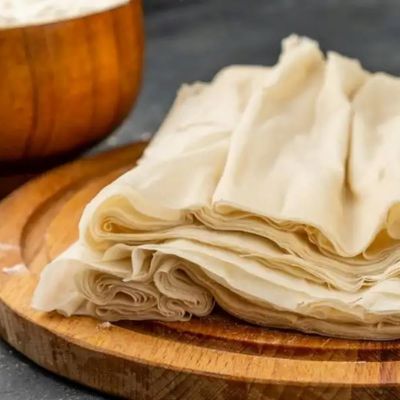
Filo Pastry
Filo pastry is an extraordinarily thin, delicate dough that requires skill and patience to master but rewards the effort with its ethereal, crispy layers. Unlike laminated doughs, filo is stretched by hand to transparent thinness, creating a unique texture. Its versatility allows it to be used for both sweet and savory preparations, showcasing fillings visually while providing a delicate crunch.
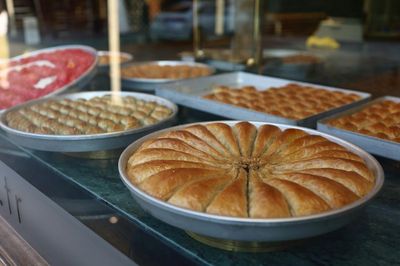
Baklava
A Middle Eastern delicacy of honey-soaked, crispy-layered filo pastry studded with pistachios and warm spices, cut into diamonds and served at room temperature. This globally beloved pastry achieves its legendary texture through careful assembly and the crucial overnight soaking that allows the honey syrup to penetrate all layers while maintaining crispness.
More like this
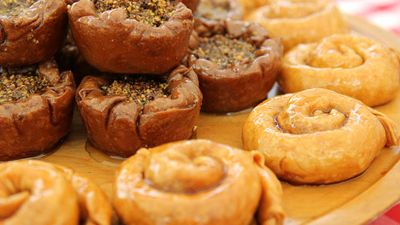
Masala Chai Baklava
Classical baklava holds the geometry: layered filo, nut filling, sugar syrup. This version trades the usual rose or orange-blossom syrup for one infused with three breakfast tea bags, a knob of fresh ginger, and a generous pinch of cardamom seeds - the spice profile of masala chai distilled into a sugar bath. The nuts shift too: a mix of toasted almond and cashew (not pistachio) carries the chai notes better. The pastry rolls into tight little cylinders rather than the conventional layered sheets, packed onto a tray, and bakes hot until deeply golden. The cooled syrup goes over in two pours - half first, rest after 5 minutes - so the soak penetrates to the core.
Baklava
A Middle Eastern delicacy of honey-soaked, crispy-layered filo pastry studded with pistachios and warm spices, cut into diamonds and served at room temperature. This globally beloved pastry achieves its legendary texture through careful assembly and the crucial overnight soaking that allows the honey syrup to penetrate all layers while maintaining crispness.
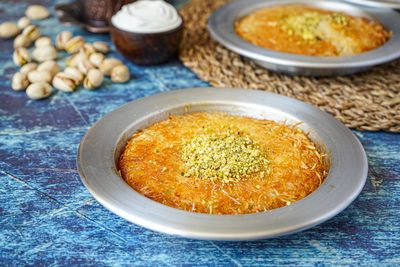
Knafeh
A round shallow pan is lined with melted-butter-soaked kataifi (shredded filo), tossed until every strand is gilded. A layer of fresh, lightly salted cheese (akkawi, mozzarella or a blend with ricotta) goes in the middle, then another layer of buttered kataifi on top. Baked hot until the pastry crisps deep golden, then flipped onto a serving plate and drenched in warm sugar syrup scented with orange-blossom water. Scattered with crushed pistachios. Sliced and served while the cheese is still warm and pulling.
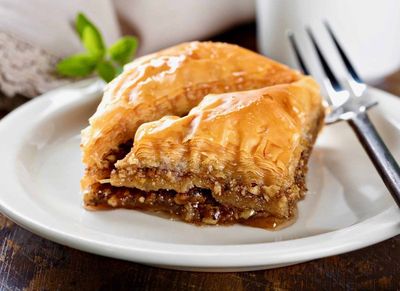
Greek Baklava
A 30 × 22 cm tin is built in layers: 8 buttered filo sheets on the bottom; walnut-cinnamon filling; 4 buttered filo sheets; more walnut; 4 more filo; walnut; finally 8 more buttered filo on top. The top is scored into squares; a clove is pressed into the centre of each. Baked for 45 minutes at 180°C till amber. Syrup of honey, sugar, water, lemon and cinnamon stick simmers separately. The COOL syrup is poured over the HOT baklava. Rested overnight, non-negotiable.