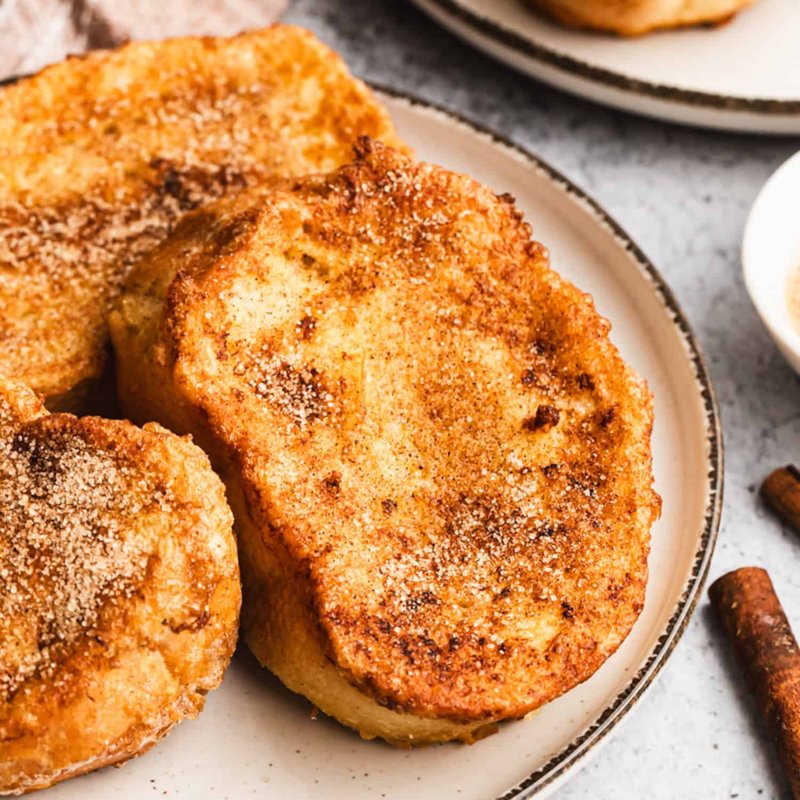
Torrijas
Spain's Holy Week pudding: thick stale country bread soaked in cinnamon milk, dipped in egg, fried in olive oil and drenched in honey.
Overview
Milk warms with sugar, cinnamon stick and lemon zest; cools. Stale country bread slices 3 cm thick. Slices soak in the infused milk 10-30 minutes (don't soak too long or they fall apart). Lift onto a tray; dip in beaten egg. Pan-fry in olive oil 2 minutes per side till golden. While still hot, dunk briefly in warm honey OR toss in cinnamon sugar. Eats warm.
Ingredients
Soaking milk
- 500 ml whole milk
- 80 g caster sugar
- 1 cinnamon stick
- 1 strip lemon peel
- 1 strip orange peel (optional)
Bread
- 8 thick slices of stale country bread (3 cm thick each, about 80 g per slice)
Egg dip
- 3 eggs (large, beaten with a pinch of salt)
Frying
- 200 ml olive oil (mild - not extra-virgin)
To finish (choose one)
Honey version
- 200 g clear honey
- 50 ml water (warm)
Cinnamon-sugar version
- 100 g caster sugar
- 2 teaspoons ground cinnamon
Method
Stage 1 - Infuse the milk
- Combine the milk, sugar, cinnamon stick, lemon peel and optional orange peel in a small saucepan.
- Heat to just below a simmer (small bubbles at the edge); stir until sugar dissolves.
- Off heat; cover; infuse 15 minutes.
- Cool to room temperature.
Stage 2 - Soak
- Pour the cooled infused milk through a sieve into a wide shallow dish.
- Lay the bread slices in the milk in a single layer.
- Soak 10-15 minutes for soft bread; 20-30 minutes for very stale bread.
- The slices should be saturated but still hold their shape (overly long soaking makes them collapse).
Stage 3 - Beat eggs
- Whisk the eggs with a pinch of salt in a wide shallow bowl.
Stage 4 - Fry
- Heat the olive oil in a wide pan over medium heat.
- Lift a soaked slice with a slotted spatula; let excess milk drip off briefly.
- Dip into the beaten egg, coating both sides.
- Lower into the hot oil.
- Fry 4-5 torrijas at a time; cook 2 minutes per side, turning carefully, until deep golden.
- Lift onto a wire rack lined with kitchen paper.
Stage 5 - Finish
- Honey version: warm the honey with a splash of water; dip each torrija quickly into the warm honey (5 seconds); lift onto a serving plate.
- Cinnamon-sugar version: while still hot, dredge each torrija in the cinnamon sugar.
Stage 6 - Serve
- Pile on a platter; eat warm.
- A scoop of ice cream alongside is a modern addition.
Notes
- Stale bread is the key: fresh bread falls apart in the milk soak. Bread that's been sitting on the counter 1-2 days is perfect. Day-fresh bread can be dried in a low oven for 30 minutes.
- Don't over-soak: soft sandwich bread takes 2 minutes; stale country bread takes 20 minutes. Test the centre - saturated but not collapsing is the goal.
- Olive oil, not butter: Spanish torrijas are fried in olive oil. Butter burns at the temperature needed and gives a different flavour profile.
- Medium heat: too hot and the outside burns before the egg sets; too cool and the bread absorbs oil and goes greasy.
Storage
- Best within 30 minutes of frying.
- Reheat in a hot oven (200°C, 4 minutes) to revive the crispness; never microwave.
- Make ahead: the soaking milk keeps 3 days refrigerated; soak fresh bread to order.
More like this
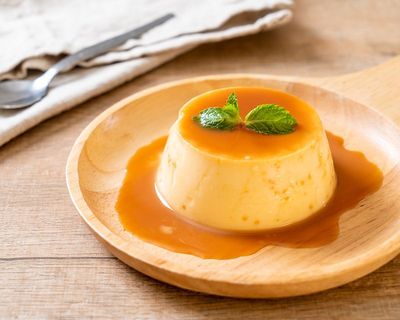
Flan de Huevo (Spanish Egg Flan)
Sugar caramelises in a small heavy pan until amber; tilts to coat the bottom of 6 ramekins. Milk warms with lemon zest and a vanilla pod. Eggs whisk gently with sugar; the warm milk drizzles in, tempering. Strain through a fine sieve to remove zest and any cooked egg. Pour over the caramel in the ramekins. Bake in a water bath at 150°C 40 minutes (the custards should be just-set with a slight wobble). Cool; chill at least 4 hours. Invert at service.
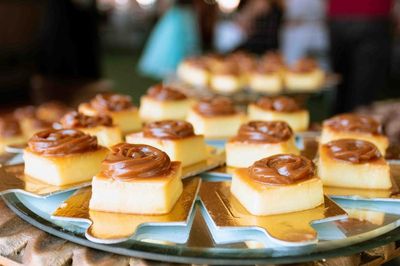
Leche Frita (Fried Milk)
Milk warms with lemon and cinnamon. Cornflour, plain flour, sugar and egg yolks whisk; warm milk strains in slowly to make a smooth thick base. Returns to the pan; cooks for 6-8 minutes till very thick. Off heat; vanilla and butter stir in. Pours into a parchment-lined tray to 1 ½ cm depth; chills for 4 hours minimum. Cuts into squares. Each square dredges in flour, dips in egg, fries in hot olive oil. Tossed in cinnamon sugar. Eats warm.
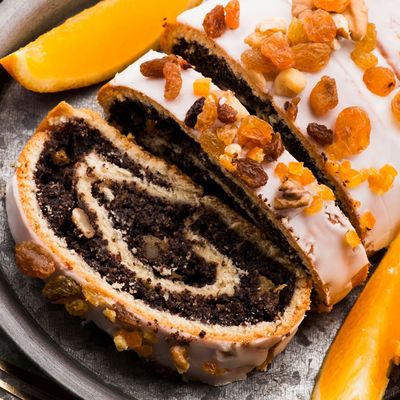
Makowiec
The filling starts the night before: poppy seeds soak then simmer in milk and cook to a thick paste with honey, butter, vanilla, raisins, walnuts and candied peel. The next day, an enriched yeast dough rolls into a thin rectangle, spreads thickly with the cold poppy filling, and rolls into a tight log. After a final prove, it bakes in a long tin until the dough is bronze. Once cool, a thin lemon glaze drizzles across the top and a scatter of candied peel finishes it.
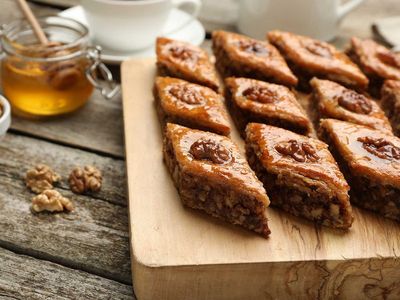
Pakhlava (Azerbaijani)
The Azerbaijani take on the pan-Caucasus pastry that goes by half a dozen names across the region. You make an enriched dough from flour, butter, milk, egg yolks and yeast, then roll it into eight layers stacked with a heavy filling of crushed walnuts spiced with cardamom and saffron between each one. The top gets scored in the traditional diamond pattern, brushed with saffron-tinted egg yolk so it bakes to a deep amber, and a single walnut pressed into the centre of each diamond as a marker. Forty-five minutes at 180°C, then a saffron-honey syrup poured generously over while it's still hot from the oven. The trick the recipe insists on is the overnight rest before slicing; that's when the syrup absorbs fully and the layers set so the diamonds cut cleanly. Eaten at Novruz, weddings and feast days, with strong black tea on the side.