Pão Alentejano
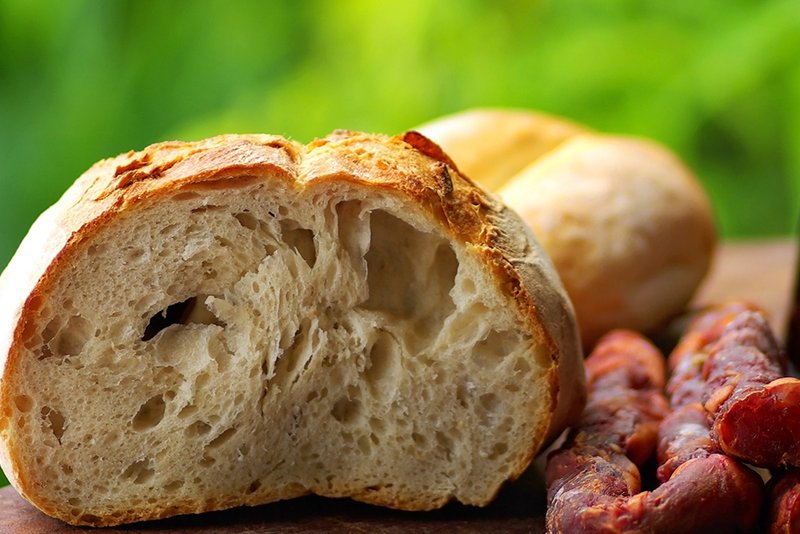
The Alentejo's country bread: a slow-fermented loaf with a tight chewy crumb and a thick deep-coloured crust. Made for soaking up açorda and migas.
Overview
Pão Alentejano is Portugal's great regional bread, a slow-fermented loaf from the southern Alentejo plains with a deeply dark crust and a chewy, slightly sour crumb. It starts twelve hours before you bake, with an overnight poolish of flour, water and the tiniest pinch of yeast. The main dough goes together the next day, gets a stretch-and-fold every half hour during a two-hour bulk ferment, then shapes into a round and proves a final hour and a half. Into a hot oven (240°C with steam for the first fifteen minutes, then 220°C dry for another half hour) and out comes a loaf that smells faintly of vinegar and tears open with a structured, irregular crumb. Worth the day it takes.
Ingredients
Poolish (starter)
- 200 g strong white bread flour
- 200 g warm water
- ¼ teaspoon (1 g) fast-action yeast
Dough
- 400 g strong white bread flour
- 100 g whole-wheat flour
- 1 teaspoon (3 g) fast-action yeast
- 12 g salt
- 280 ml warm water (more if needed)
Method
Stage 1 - Poolish (the night before)
- In a wide bowl, whisk the poolish flour, water and pinch of yeast until smooth.
- Cover with cling film or a plate; rest at room temperature 12-16 hours. It should be bubbly on top and smell faintly sour-sweet.
Stage 2 - Mix the dough
- Add the poolish to a large mixing bowl.
- Add the additional flour, yeast, salt and warm water.
- Mix to a shaggy sticky dough.
Stage 3 - Stretch and fold
- Cover the bowl; rest 30 minutes (autolyse).
- Wet your hand; lift one side of the dough, stretch it up, fold over the centre. Rotate the bowl 90°; repeat. Do 4 stretch-and-folds in total.
- Cover; rest 30 minutes; repeat. Total: 4 rounds of stretch-and-folds over 2 hours.
- By the end, the dough should be smooth, slightly sticky but cohesive, and about 50% bigger.
Stage 4 - Shape
- Tip the dough onto a lightly floured surface.
- Shape into a tight round: fold the edges into the centre, then turn over and tighten the surface by dragging it across the surface with cupped hands.
- Place seam-side up in a heavily floured banneton (or a bowl lined with a floured tea towel).
Stage 5 - Final proof
- Cover; rise at room temperature 1-1 ½ hours, until poking the dough leaves a slow-springing indent (not totally springing back).
Stage 6 - Bake
- Heat oven to maximum (260°C or as high as it goes) with a baking stone or upside-down baking tray for 30 minutes.
- Place a small tray of water on the bottom of the oven for steam.
- Carefully tip the dough seam-side down onto the hot stone (or a piece of baking paper, slid onto the stone).
- Score the top with a sharp blade in a single deep cross or 3 parallel slashes.
- Bake 15 minutes at maximum.
- Reduce heat to 220°C (200°C fan).
- Bake 30-35 minutes more, until deep dark brown and the loaf sounds hollow when tapped on the bottom.
- The internal temperature should be 95°C+ at the centre.
Stage 7 - Cool
- Cool on a wire rack at least 1 hour before slicing - cutting hot bread gives a gummy crumb.
Notes
- Poolish overnight is non-negotiable: The fermentation builds the flavour. A quick same-day bread is a different (perfectly fine) thing, but not pão alentejano.
- Steam in the first 15 minutes: The tray of water at the bottom is what gives the crust its characteristic crackled deep crust. After 15 minutes, the steam has done its work and you can remove the tray.
- Cool fully before slicing: Hot bread sliced has a doughy texture; cool to room temperature for the crumb to fully set.
Storage
- Wrapped in a clean tea towel at room temperature: 5 days. Crust softens by day 2 but the crumb stays good.
- Sliced and frozen: 2 months. Toast slices from frozen.
- Gets better at soaking up broth as it stales - perfect for açorda or migas.
More like this
Bolo Do Caco
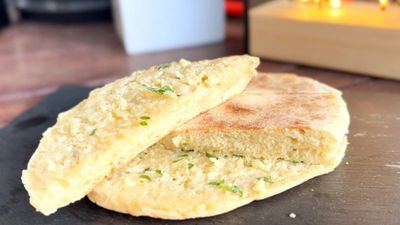
Bolo do caco is the Madeiran flatbread you'll get at every restaurant on the island, traditionally cooked on a hot basalt stone (the caco) but very happily on a heavy dry griddle at home. The dough is straightforward (strong flour, yeast, salt, water) with one twist: a small boiled and mashed orange sweet potato folded in, which gives the bread its faintly sweet edge and golden colour. After a single rise, you divide the dough, shape into 18 cm rounds, and press them onto a hot dry pan for five minutes a side until both faces are charred-spotted. Split horizontally, slathered with garlic-parsley butter, and closed back like a sandwich. Eat hot; it does not keep.
Atchara
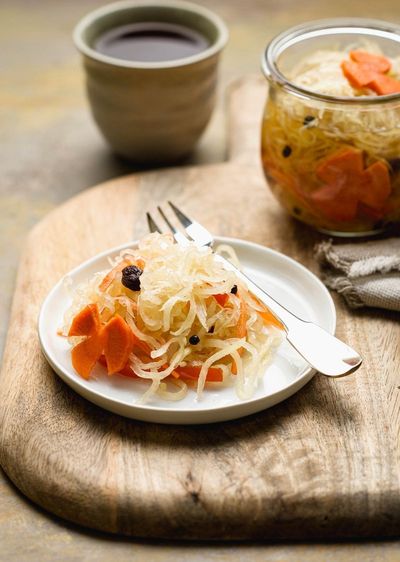
Green papaya is peeled, seeded and shredded on a coarse grater. Carrot, ginger, garlic, red pepper, onion and raisins are all prepared in matching shreds. The vegetables are salted and rested for 1 hour to draw water; rinsed and squeezed dry. A syrup of cane vinegar, sugar and whole peppercorns simmers for 5 minutes. Hot syrup is poured over the vegetables in a sterilised jar. The jar is sealed, cooled and refrigerated overnight before eating. Improves over the following week.
Aysh Baladi
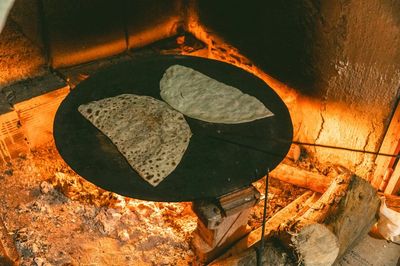
A simple dough of half plain flour and half wholemeal, yeast, salt and warm water. Rises for 1 hour. Divides into 6 portions; rolls into thin 18 cm discs; rests for 20 minutes. Baked at maximum heat on a hot baking stone for 3-4 minutes, they puff dramatically and fall flat as they cool, leaving a hollow pocket.
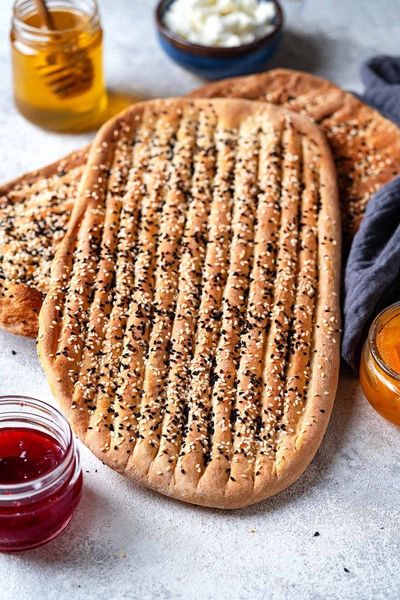
Barbari
A wet yeasted dough, high hydration (75%) of strong flour, yeast, salt, water and a touch of oil. Long first rise. Two portions; each stretches to a 40-50 cm long oval on an oiled work surface. A flour-water paste (roomal) brushes over the top, this gives the signature glossy crust. Deep parallel ridges press down with fingertips. Sesame and nigella seeds scatter. Baked at maximum heat 5-7 minutes on a screaming-hot stone.