Bolo Do Caco
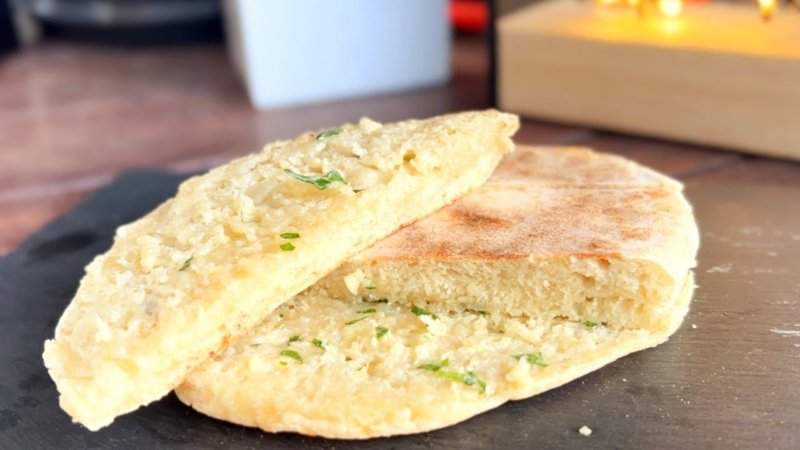
Madeira's sweet-potato flatbread: a soft round disc cooked on a hot stone, split open and slathered with garlic-and-parsley butter while still warm.
Overview
Bolo do caco is the Madeiran flatbread you'll get at every restaurant on the island, traditionally cooked on a hot basalt stone (the caco) but very happily on a heavy dry griddle at home. The dough is straightforward (strong flour, yeast, salt, water) with one twist: a small boiled and mashed orange sweet potato folded in, which gives the bread its faintly sweet edge and golden colour. After a single rise, you divide the dough, shape into 18 cm rounds, and press them onto a hot dry pan for five minutes a side until both faces are charred-spotted. Split horizontally, slathered with garlic-parsley butter, and closed back like a sandwich. Eat hot; it does not keep.
Ingredients
Dough
- 1 orange sweet potato (medium, about 250 g)
- 500 g strong white bread flour
- 1 sachet (7 g) fast-action yeast
- 1 ½ teaspoons salt
- 1 tablespoon caster sugar
- 200 ml warm water (more if needed)
- 2 tablespoons sunflower oil
Garlic butter
- 100 g unsalted butter (very soft)
- 6 garlic cloves (crushed to a paste)
- 3 tablespoons fresh flat-leaf parsley (chopped fine)
- ½ teaspoon salt
- Pepper
Method
Stage 1 - Cook the sweet potato
- Bring a pot of water to a boil.
- Add the whole unpeeled sweet potato; boil 25 minutes until tender.
- Drain; cool slightly; peel; mash to a smooth purée (no lumps).
- Measure 200 g of the purée for the dough.
Stage 2 - Dough
- In a wide bowl, whisk flour, yeast, salt and sugar.
- Add the mashed sweet potato, warm water and oil.
- Mix to a soft sticky dough. Add a few more tablespoons of water if too stiff, or a few tablespoons of flour if too wet - the dough should be soft enough to be slightly tacky but cohesive.
- Knead 8 minutes by hand (or 6 minutes in a stand mixer) until smooth.
- Cover; rise 1 hour until doubled.
Stage 3 - Garlic butter (make ahead - improves with rest)
- In a small bowl, mash the soft butter with crushed garlic, parsley, salt and pepper until uniformly green-flecked.
- Cover; refrigerate until needed (but soften before use).
Stage 4 - Shape
- Knock back the dough; divide into 4 balls.
- Cover; rest 10 minutes.
- Flatten each ball into a round disc, 18 cm across, about 1 cm thick.
- Cover loosely; rest 15 minutes (proof a little).
Stage 5 - Cook
- Heat a wide heavy dry frying pan (or cast-iron griddle) over medium-high heat 3 minutes.
- Cook each disc 5-6 minutes per side, pressing gently with a spatula - the bread puffs slightly; both sides become spotted-brown.
- Lift onto a plate; cover with a tea towel to keep soft.
- Repeat with remaining discs.
Stage 6 - Serve
- While the bread is still warm, split each disc horizontally (like a pita).
- Slather the inside with garlic butter (1-2 tablespoons per bread, generous).
- Close.
Stage 7 - Eat
- Eat warm, with napkins - the butter drips out.
- Excellent with the cataplana, with espetada (Madeira's grilled meat skewers), or just on its own.
Notes
- Orange sweet potato, not white: The orange variety gives bolo do caco its distinctive faint sweetness and warm golden colour. White-fleshed sweet potatoes (boniato) make a paler, less interesting bread.
- Don't skip the garlic butter: The butter is the dish's identity. Bolo do caco served without garlic butter is just a bread.
- Dry pan, no oil: The discs cook on a dry hot surface (mimicking the basalt stone). Don't add oil to the pan; the bread chars naturally.
Storage
- Best within 4 hours of cooking.
- Refrigerate 3 days; refresh in a dry pan 1 minute per side.
- Freeze cooked 2 months; reheat from frozen in a hot dry pan 2 minutes per side, then add butter.
- Garlic butter alone refrigerates 1 week, freezes 2 months.
More like this
Gratin Dauphinois
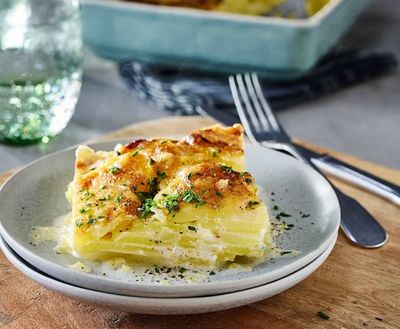
Waxy potatoes (Yukon Gold, Charlotte, or any low-starch variety) are peeled and sliced very thinly, 2-3 mm. A wide shallow gratin dish (or oven-safe heavy pan) is rubbed all over with a halved garlic clove, then heavily buttered. A cream-and-milk mixture warms in a saucepan with crushed garlic, salt, pepper, and a generous grating of nutmeg, brought just to a simmer, then strained. Potatoes layer in the dish, overlapping like shingles, with a sprinkle of salt and a few grinds of pepper between layers. The infused cream pours over to come up to (not over) the top layer. Baked at 160°C for about 90 minutes until the potatoes are fork-tender and the top is bubbling and golden-brown.
Pav Bhaji
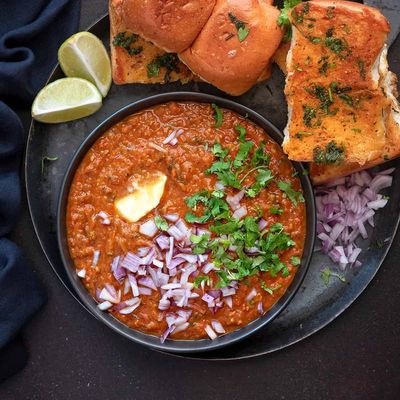
Potatoes, cauliflower, peas boil until tender. A masala base softens onions and tomatoes in butter with ginger-garlic paste, then chilli powder, turmeric and pav bhaji masala. Capsicum joins. Boiled vegetables mash in roughly; everything cooks together 10-15 minutes, mashing as you go, until the bhaji turns a deep orange-red and the consistency is thick-spreadable. Finishes with extra butter, lemon juice, coriander. Pav rolls split horizontally, griddle-fry in butter with a sprinkle of pav bhaji masala till the cut sides char. Serve bhaji in shallow bowls topped with diced raw onion, lemon wedges, a coriander shower; pav on the side.
Beef and Guinness Stew
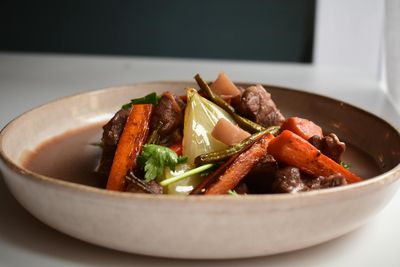
Chuck steak in big chunks, dredged in seasoned flour and browned in batches in a heavy pot until properly dark. Onions cooked low and slow in the same pot to draw out their sugar. The beef returned, a bottle of Guinness poured over with stock and a spoon of treacle, brought to a simmer and tucked into a low oven for two hours. The last half-hour gets carrots, potatoes and a handful of pearl barley to thicken the broth. Finished with parsley and a chunk of soda bread for mopping.
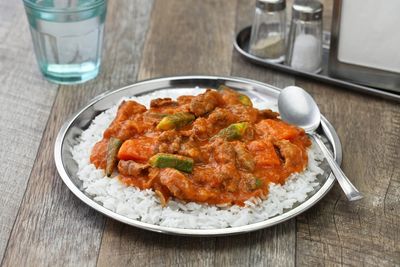
Mafé
Bone-in beef or lamb is browned, then simmered with onions, garlic, tomato and stock. Smooth peanut butter is whisked in halfway and the stew thickens to a velvety coating. Chunks of cassava, sweet potato and cabbage cook in the sauce towards the end. Serve over plain steamed white rice.