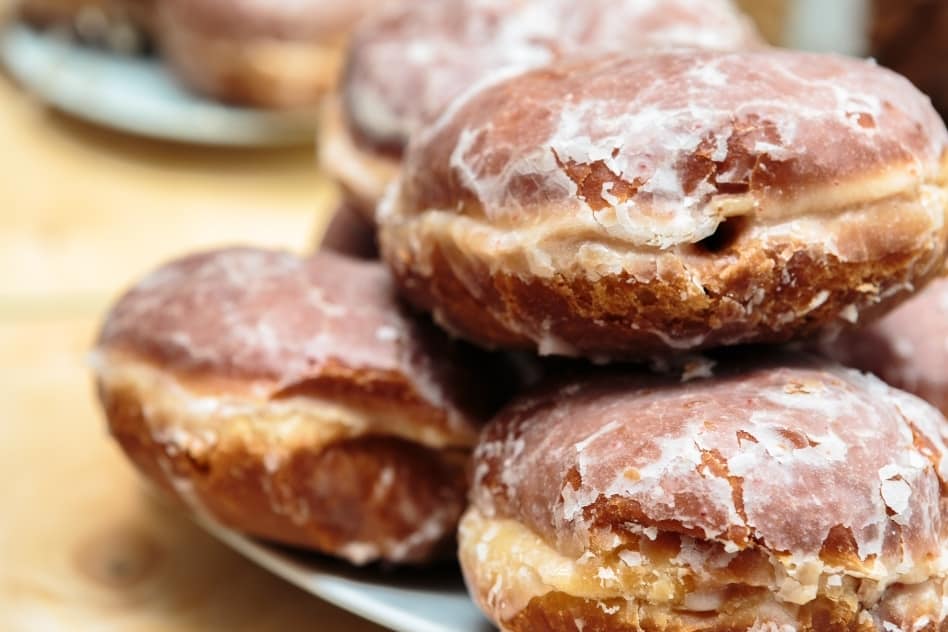
Pączki
Poland's Fat Thursday doughnut: enriched yeasted dough fried with a pale band, filled with rose-petal jam or plum butter, dusted in icing sugar.
Overview
An enriched yeast dough (lots of egg yolks, butter, sugar, a splash of rum) proves twice. Divides into 12 balls, proves again until pillowy. Deep-fries in clean oil at exactly 170°C: hot enough to set the outside before the dough soaks, cool enough that the inside cooks before the outside burns. Each pączek gets a teaspoon of jam piped into the centre while still warm; the tops dust with icing sugar, dip in a thin lemon-orange glaze, or get a strip of candied orange peel.
Ingredients
Dough
- 500 g strong white flour
- 10 g instant dried yeast (1 ½ sachets)
- 80 g caster sugar
- 1 teaspoon salt
- 220 ml warm whole milk
- 5 egg yolks (large)
- 100 g unsalted butter (very soft)
- 2 tablespoons spirit (rum, vodka, or grain alcohol; reduces oil absorption)
- 1 teaspoon vanilla extract
- 1 lemon (zest)
To fry
- 2 litres neutral oil (sunflower or rapeseed) or lard for the traditional version
Filling
- 350 g good-quality jam (rose petal, plum butter (powidła), or thick blackcurrant)
To finish (choose one)
Icing
- 100 g icing sugar (for dusting)
Orange Icing
- 150 g icing sugar
- 3 tablespoons fresh orange juice
- candied orange peel (finely chopped)
Method
Stage 1 - Make the dough
- Whisk the flour, yeast, sugar, salt and lemon zest in a large bowl.
- Beat the warm milk and egg yolks; pour in.
- Add the spirit and vanilla.
- Mix to a shaggy dough; turn out and knead 8-10 minutes until smooth and elastic.
- Add the soft butter piece by piece, kneading in (this takes patience; the dough goes slack, then comes back tighter).
- Continue kneading 5 minutes more until silky, soft and slightly tacky.
- Cover; prove 1 hour in a warm place until doubled.
Stage 2 - Shape
- Knock the dough back gently.
- Divide into 12 equal pieces (about 75 g each; use scales).
- Roll each into a ball by cupping under your palm on the unfloured work surface (the slight stickiness helps tension).
- Place each ball on a square of parchment paper (this makes lowering them into oil easier).
- Cover loosely; prove 45 minutes in a warm place until pillowy and almost doubled.
Stage 3 - Heat the oil
- Pour the oil into a deep heavy pan; it should be at least 8 cm deep.
- Heat to exactly 170°C (use a thermometer; pączki temperature is critical).
- Once at temperature, monitor and adjust the heat to keep it steady.
Stage 4 - Fry
- Lift a pączek by its parchment square and lower gently into the oil (the parchment will release in seconds; lift it out with tongs).
- Fry 3-4 at a time; don't crowd the pan or the oil temperature drops.
- Cook 2-3 minutes on the first side until pale gold underneath; flip with a slotted spoon or chopsticks.
- Cook 2-3 minutes on the other side.
- The signature pączek look: pale gold with a clear white ring around the middle (where the dough sat on the oil surface). This is what you want.
- Lift onto kitchen paper to drain.
- Repeat with all 12; let the oil come back to 170°C between batches.
Stage 5 - Fill
- While the pączki are still warm (not hot), use a piping bag fitted with a long thin nozzle.
- Push the nozzle into the side of each pączek, halfway in.
- Squeeze in about 1 tablespoon of jam; you'll feel the doughnut swell slightly. Stop just before it would burst.
- Set on a rack.
Stage 6 - Finish (choose one)
- Dusted: Sift icing sugar generously over the top of each pączek.
- Glazed: Whisk the icing sugar and orange juice to a pourable glaze. Dip the top of each pączek in; let drip; set on a rack. Scatter chopped candied orange peel on the wet glaze.
Stage 7 - Serve
- Best eaten on the day, still slightly warm.
- Make a strong coffee.
Notes
- The spirit isn't for flavour: A tablespoon or two of rum or vodka in the dough actually reduces how much oil the pączki absorb during frying (alcohol evaporates faster than water, leaving less moisture-soaking-up-oil). Don't skip; it works.
- 170°C is the only temperature: Hotter and the outside browns before the inside cooks. Cooler and they soak oil and go heavy. A thermometer matters.
- The pale ring is the badge: A proper pączek is pale gold with a white band around the equator. Fully-bronzed all over means too hot; doughy means too cool.
Variations
Rose-petal jam (the classic): Konfitura z róży, sold in Polish shops, is the traditional filling for Tłusty Czwartek. Plum butter (powidła): Thick spiced plum, an old peasant filling. Custard: Pastry cream is a modern bakery filling; some purists object, but bakeries everywhere do them.
Serving
Serve with: Strong coffee or a glass of milk. On Fat Thursday (the last Thursday before Lent), tradition says eat at least one to ensure a year of luck.
Storage
- Best on the day. Keeps 2 days at room temperature in an airtight box but they soften.
- Don't refrigerate (dries them out). Don't freeze filled (the jam weeps).
- Unfilled fried pączki freeze 1 month; defrost and fill the same day.
More like this
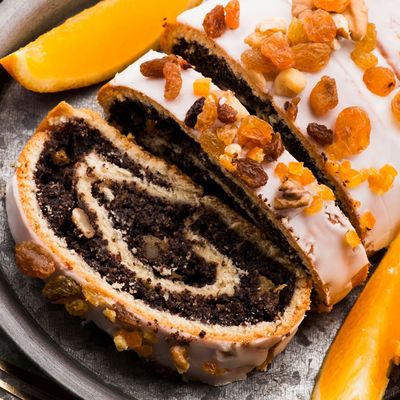
Makowiec
The filling starts the night before: poppy seeds soak then simmer in milk and cook to a thick paste with honey, butter, vanilla, raisins, walnuts and candied peel. The next day, an enriched yeast dough rolls into a thin rectangle, spreads thickly with the cold poppy filling, and rolls into a tight log. After a final prove, it bakes in a long tin until the dough is bronze. Once cool, a thin lemon glaze drizzles across the top and a scatter of candied peel finishes it.
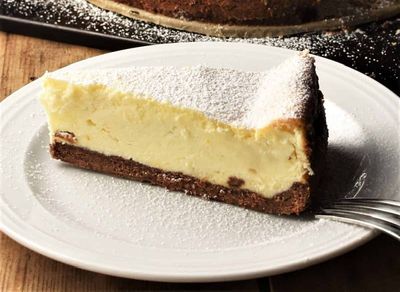
Sernik
A buttery shortcrust pastry is pressed into a tin; a small piece is reserved for a lattice. Twaróg (the dry, tangy Polish curd cheese) is blended with butter, sugar, egg yolks, vanilla, lemon zest and a little semolina or cornflour. Whipped egg whites are folded in for lightness. The filling is poured onto the pastry, the lattice is criss-crossed on top, and it bakes at a moderate heat until just set. The cooling matters: rapid cooling cracks the top.
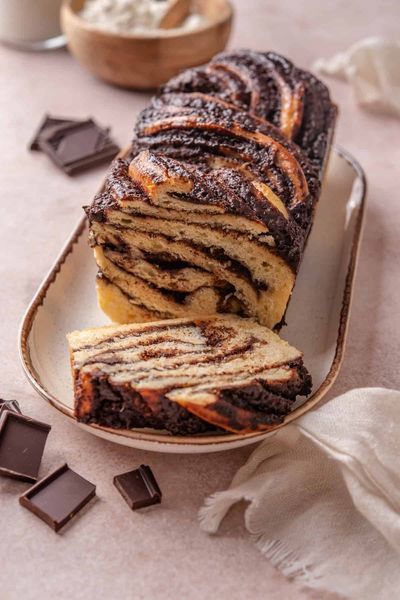
Chocolate Babka
A rich enriched dough is mixed and kneaded; first rise overnight in the fridge for the best flavour and easier handling. The next day, the cold dough rolls into a wide rectangle; chocolate filling spreads thick to the edges; rolls into a tight log. The log is sliced lengthwise, twisted into a braid (cut sides facing up to expose the chocolate), tucked into a loaf tin and proofed. Bakes; brushes with sugar syrup hot from the oven.
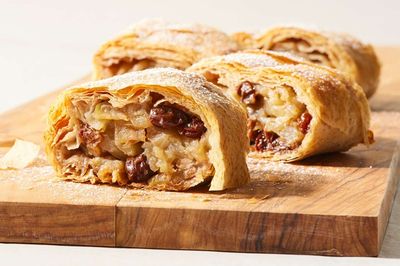
Apfelstrudel
A simple flour-egg-oil dough kneads until silky, rests so the gluten relaxes, then stretches over a floured cloth until you can read newsprint through it. A filling of grated and sliced tart apples, sugar, cinnamon, raisins, lemon zest and butter-toasted breadcrumbs spreads across the dough. The cloth helps roll the whole thing into a long log. Bakes brushed with butter until shatteringly crisp.