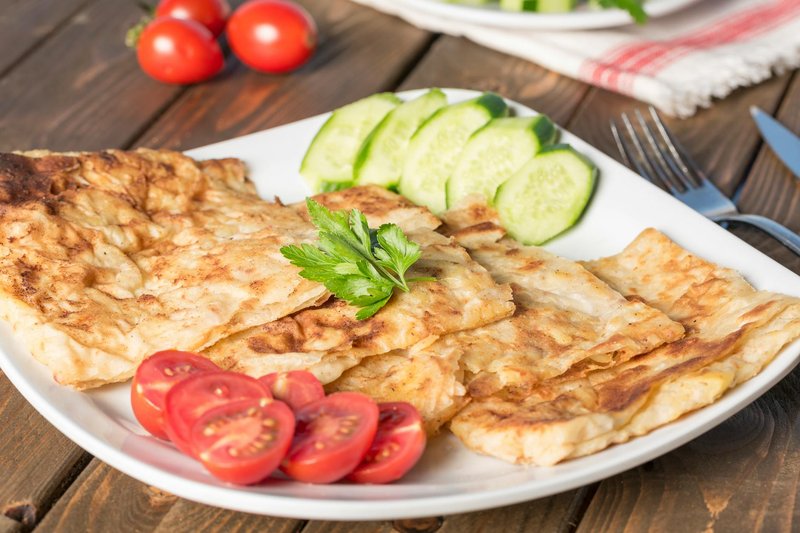
Msemen
Morocco's pan-fried laminated flatbread: a soft semolina dough stretched paper-thin, folded with butter into a square, griddled crisp.
Overview
A soft warm dough of fine semolina, plain flour, salt, sugar, yeast (optional but helps with flexibility) and warm water rests for 30 minutes. Divides into 8 balls. Each ball stretches on a heavily oiled surface into a paper-thin (almost translucent) circle. A teaspoon of melted butter-and-oil mix smears across; a sprinkle of semolina dusts on top; the disc folds into thirds, then thirds again, into a square. Each square cooks on a hot dry griddle 2 minutes per side, pressing gently so the layers bond, until golden and crisp at the edges.
Ingredients
- 200 g fine semolina
- 200 g plain flour
- 1 teaspoon salt
- 1 teaspoon caster sugar
- 1 teaspoon fast-action yeast (optional - helps the flexibility)
- 270 ml warm water
For lamination
- 80 g unsalted butter (melted, or 50 g butter + 30 ml sunflower oil for a slightly less rich version)
- Extra fine semolina, for dusting (about 4 tablespoons)
- Sunflower oil, for the work surface (about 4 tablespoons)
To serve
- Clear honey, butter, jam, or alongside savoury tagine
Method
Stage 1 - Dough
- Whisk semolina, flour, salt, sugar and yeast (if using) in a wide bowl.
- Pour in the warm water; mix to a soft dough.
- Knead 10 minutes by hand (it'll be sticky at first; resist adding flour - keep going). The dough should become smooth and elastic.
- Lightly oil the dough; cover; rest 30 minutes (or up to 1 hour).
Stage 2 - Divide
- Generously oil a wide work surface (msemen depends on heavily oiling everything).
- Tip the dough out.
- Divide into 8 equal balls.
- Smear each ball with oil; let rest 10 more minutes.
Stage 3 - Stretch and fold
- Working with one ball at a time on the oiled surface:
- Flatten with your palm, then use the heel of your hand and your fingertips to push the dough outward in all directions until it's a thin, almost translucent square 25-30 cm across. (Don't worry if it tears in places - you'll fold over it.)
- Brush 1 teaspoon of melted butter across the surface.
- Sprinkle ½ teaspoon of fine semolina.
- Fold the left third to the centre, then the right third over that (forming a vertical rectangle).
- Now fold the bottom third up to the centre, then the top third down (forming a smaller square).
- Set aside on a clean lightly oiled plate.
- Repeat with all balls. Stack them with a small space between, lightly oiled, while you finish the rest.
Stage 4 - Rest and re-flatten
- Let the folded squares rest 5 minutes (the gluten relaxes; they stretch better).
- Take each square and gently push it outward with the heel of your hand into a thinner square about 15 cm across, keeping the layers intact.
Stage 5 - Cook
- Heat a wide flat dry griddle or non-stick pan over medium-high heat 3 minutes.
- Place a square on the griddle; cook 2 minutes - bubbles should form, the underside spotted gold.
- Flip; press gently with a spatula to bond the layers; cook 2 more minutes.
- Lift onto a plate; stack as you go (the steam from each helps keep them soft).
Stage 6 - Serve
- Eat warm, immediately. Drizzle with honey, smear with butter, or use to scoop up tagine sauce.
Notes
- Heavily oil everything: Msemen lamination depends on the dough sliding around on a thin film of oil. A floured surface is wrong - it dries the dough. Oil your hands, the surface, and the dough itself.
- Thin stretch matters: The first stretch should be almost transparent. If you can't see your hand through the dough, push it further. Tearing is fine - it'll be folded over.
- Dry griddle, not buttered: Cook on a dry pan; the butter is already inside the layers. A buttered pan makes msemen soggy.
Storage
- Best the day they're made.
- Refrigerate 2 days; reheat in a dry pan 30 seconds per side.
- Freeze cooked msemen 2 months; reheat from frozen in a hot dry pan 1 minute per side.
More like this
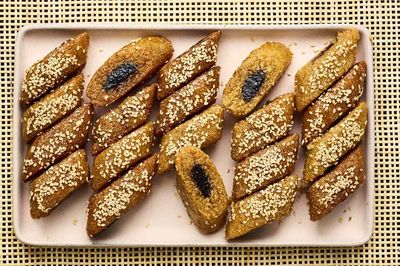
Makroud
Semolina mixes with melted butter and rests so it absorbs fully, the result is a fragrant, buttery, slightly grainy dough. Dates soften with butter, cinnamon and rosewater into a smooth filling. The dough rolls into a long log; the date paste extrudes into the centre; the cylinder rolls together and slices into diamonds. Fried briefly and dipped hot into orange-blossom syrup.
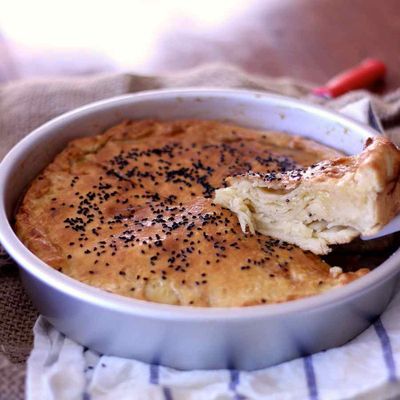
Bint Al-Sahn
A soft eggy dough is rolled into 7-8 paper-thin discs (closer to filo than to bread). Each disc is brushed with melted ghee and stacked into a wide round tin. The whole stack bakes at high heat for 25 minutes until deep gold and crisp at the edges. While hot, it's drenched in raw dark honey and scattered with toasted black caraway seeds (or nigella seeds).
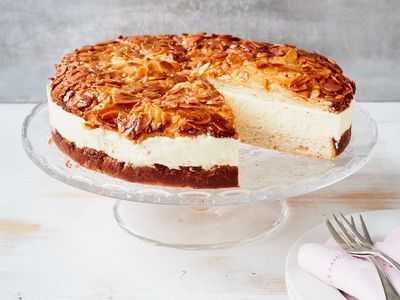
Bienenstich
A milk-and-butter enriched yeast dough proves to soft and pillowy. A honey-almond topping (butter, honey, sugar, cream, flaked almonds) cooks on the stovetop until thickly bubbling, then spreads on the proved dough and bakes together: the dough rises, the topping caramelises golden and chewy. Once cooled, the cake splits horizontally and fills with thick vanilla pastry cream (Konditorcreme) lightened with whipped cream.
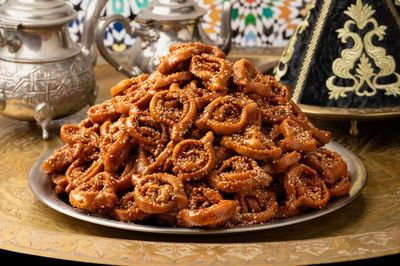
Chebakia (Sesame Honey Rosettes)
A dough rich in toasted sesame seeds, almond, aniseed, cinnamon, orange-flower water, melted butter and a touch of saffron rests for 1 hour. Rolled thin (3 mm); cut into rectangles; each rectangle slits 4 times lengthways but not through. Each piece folds and twists into a rosette by threading one corner through the centre slits. Fries in moderately hot oil. Hot rosettes plunge into warmed honey + orange-flower water; soaked for 2 minutes; lifted; sprinkled with sesame.