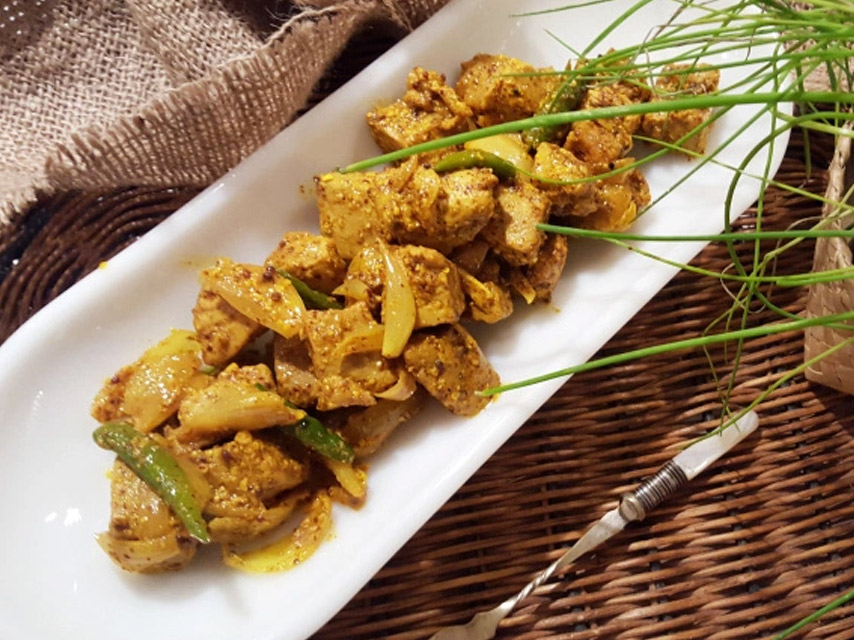
Vindaye Poule
The Mauritian pickle-curry: poached chicken steeped in a mustard-yellow paste of vinegar, turmeric, garlic and chilli, folded through softened onions.
Overview
Vindaye, sometimes written vindaille, is a Mauritian cousin of the Goan vindaloo and the wider Portuguese-Indian vinha d'alhos tradition: meat or fish preserved in vinegar, garlic and spice. On Mauritius it has settled into something very particular, defined by a bright yellow paste of ground mustard seeds, turmeric, ginger and garlic, and almost always served cold or at room temperature. The dish was historically made with octopus or fish caught off the lagoon, both of which keep beautifully in the acid bath; vindaye poule, the chicken version, is the more everyday weekday or picnic preparation. The chicken is poached first, then dressed in the paste with sliced onions, slivered ginger and green chillies, and left overnight for the flavours to settle. By morning the vinegar has cut through the fat, the mustard has bloomed, and the dish is sharp, fragrant and refreshing in a way that hot curry simply isn't. It is not difficult for a home cook, but it requires planning: vindaye eaten the day it's made tastes raw, almost unbalanced. Twelve to twenty-four hours in the fridge is what makes it a Mauritian classic.
Ingredients
Chicken
- 800 g boneless skinless chicken thighs
- 1 tsp salt
- 1 bay leaf
- 1 litre water
Vindaye paste
- 3 tbsp yellow mustard seeds (ground)
- 1 tbsp ground turmeric
- 8 garlic cloves (minced)
- 30 g fresh ginger (half minced, half cut into fine slivers)
- 3 green chillies (slit lengthways)
- 120 ml white wine vinegar
- 60 ml neutral oil
- 1 tsp salt
- ½ tsp ground black pepper
To finish
- 2 onions (medium, thinly sliced)
- 60 ml neutral oil
- 1 tsp black mustard seeds
- 2 tbsp white wine vinegar (extra, to adjust)
Method
Stage 1 - Poach the chicken
- Bring the water to a simmer in a wide pan with the salt and bay leaf.
- Add the chicken thighs and poach gently at a bare simmer for 15-18 minutes, until cooked through.
- Lift the chicken out and let it cool until comfortable to handle. Discard the poaching liquid or save for stock.
- Shred or cut the chicken into rough 3-4 cm pieces.
Stage 2 - Make the vindaye paste
- Combine the ground mustard seeds, turmeric, minced garlic, minced ginger, salt and pepper in a bowl.
- Stir in the white wine vinegar and 30 ml of the oil to form a loose mustard paste.
- Taste; it should be sharp and pungent. Set aside.
Stage 3 - Fry the onions and aromatics
- Heat the remaining 30 ml oil plus the 60 ml oil in a wide pan over medium heat.
- Add the black mustard seeds. When they pop, after about 30 seconds, add the sliced onions, slivered ginger and slit green chillies.
- Cook 6-8 minutes, stirring often, until the onions are soft and translucent but not browned.
- Pour in the vindaye paste, lower the heat, and cook 2-3 minutes, stirring, until the raw vinegar smell has mellowed and the paste is glossy.
Stage 4 - Dress and rest
- Take the pan off the heat. Fold the shredded chicken through the paste and onions until every piece is coated yellow.
- Taste and add the extra 2 tbsp of vinegar if you want it sharper.
- Transfer to a non-reactive container (glass or ceramic), press down lightly to compact, cover, and refrigerate at least 12 hours, ideally overnight.
- Serve cold or at room temperature with fresh pao, farata or plain rice.
Notes
- Rest is non-negotiable: vindaye eaten on the day it is made tastes one-dimensional. Twelve to twenty-four hours in the fridge transforms it.
- Yellow mustard, not Dijon: the dish needs whole yellow mustard seeds, ground fresh in a spice grinder. Dijon paste contains acid and salt that throw off the balance.
- Use a non-reactive container: the vinegar will pick up metallic notes from aluminium or some stainless steel. Glass or ceramic is correct.
- Adjust acidity at the end: the right finish is sharp but not eye-watering. Add the final vinegar only after tasting.
Storage
- Improves over the first 24-36 hours; keeps 4-5 days refrigerated in a sealed glass container.
- Eat straight from the fridge or let it sit at room temperature for 10 minutes before serving.
- Not suitable for freezing; the onions go limp and the texture suffers.
More like this
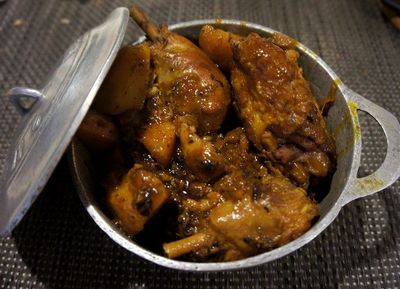
Cari Poulet Et Pomme de Terre
Mauritian cuisine is a layered conversation between Indian, African, Chinese and French traditions, and cari poulet is one of its clearest expressions. The Creole community took the Indian template of a wet curry and rebuilt it with local fresh herbs, particularly thyme and curry leaves grown in the yard, plus tomato, and a masala that is gentler and more aromatic than its mainland Indian cousins. Chicken on the bone is browned for fond, then potatoes are added and the whole pot is simmered in a curry-leaf and tomato gravy until the meat is falling off the bone and the potatoes are creamy on the outside but holding shape. The colour leans red-brown from paprika and turmeric rather than the bright yellow of a Punjabi-style curry. Heat is moderate, intended to complement rice and a chilli-based satini, not overwhelm them. For a home cook the difficulty is low to moderate; the only real demand is patience while the masala blooms in the oil at the start, which is what gives the dish its depth. Serve over plain steamed rice with a coriander satini and a spoon of green chilli pickle, the classic Mauritian Sunday plate.
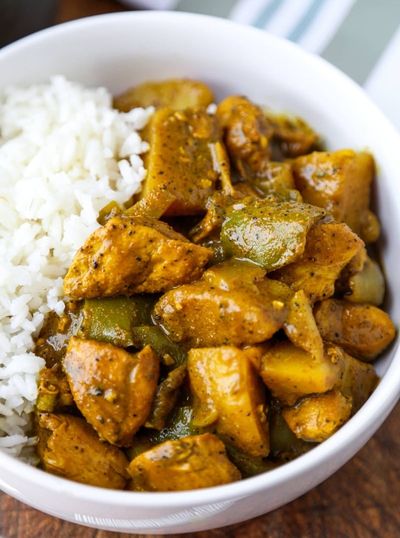
Authentic Jamaican Curry Chicken
Jamaican curry sits in its own corner of the global curry map: heavier on turmeric and allspice than Indian Madras, lighter on cumin, and built on a technique called "burning the curry" that gives the dish its character. The technique is exactly what it sounds like, dry curry powder hits hot oil and is stirred for 30 seconds until it darkens from yellow to deep gold and smells like toasted spice. That move concentrates the flavours and removes any raw edge. The finished stew is bright yellow stained slightly orange, savoury and aromatic rather than searingly hot, with thyme and a whole pierced Scotch bonnet scenting the gravy without flooring it. Smell: bloomed curry powder, allspice, browned chicken fat. Not difficult, but requires confidence in the 30-second bloom (under-do it and the dish is flat; over-do it and you have to start over). A Sunday-dinner staple across Jamaica and the diaspora, served over white rice with the gravy spooned generously over.
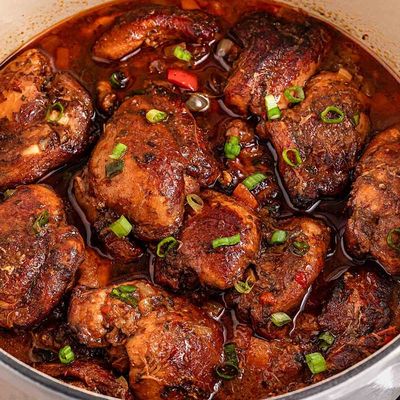
Brown Stew Chicken
The Sunday-lunch counterpart to goat curry across Jamaica; not curry-driven but built on a deep mahogany gravy that gets its colour from caramelised brown sugar and a few teaspoons of bottled "browning sauce" (Grace is the canonical brand, a concentrated burnt-sugar syrup that's a kitchen staple in every Jamaican household). The chicken is bone-in, marinated overnight in a wet rub of onion, bell pepper, scallions, allspice, ginger and thyme, then browned hard and slow-braised until the meat slips off the bone. Flavour is savoury and slightly sweet with a deep thyme back-note and a whisper of Scotch bonnet heat from the whole pierced fruit in the pot. The gravy is what you actually want; thick, dark, sweet-savoury, glossy with rendered chicken fat, the kind of gravy you'd happily eat over plain rice as its own meal. Smell is browning sugar, thyme, and the unmistakable allspice signature. Patient cooking but easy: marinate the day before, then 30 minutes of active prep and 2 hours of unattended braise. The pairing with [[rice-and-peas]] is non-negotiable across Jamaican households.
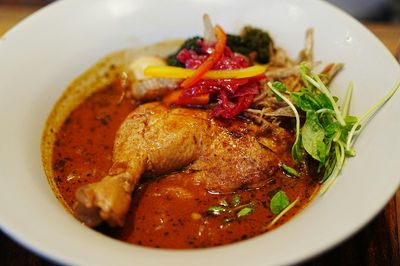
Caribbean Chicken Curry Stew
In many Caribbean stew dishes there is an initial step of burning sugar in oil which is used to brown the meat in. This adds a very unique sweetness to the stews from this region and this sweetness paired with the unmistakable flavour (and heat) from the wonderful scotch bonnet chilli is simply astounding. This curry uses curry powder for a fragrant and delicious result that captures the essence of Caribbean cooking.