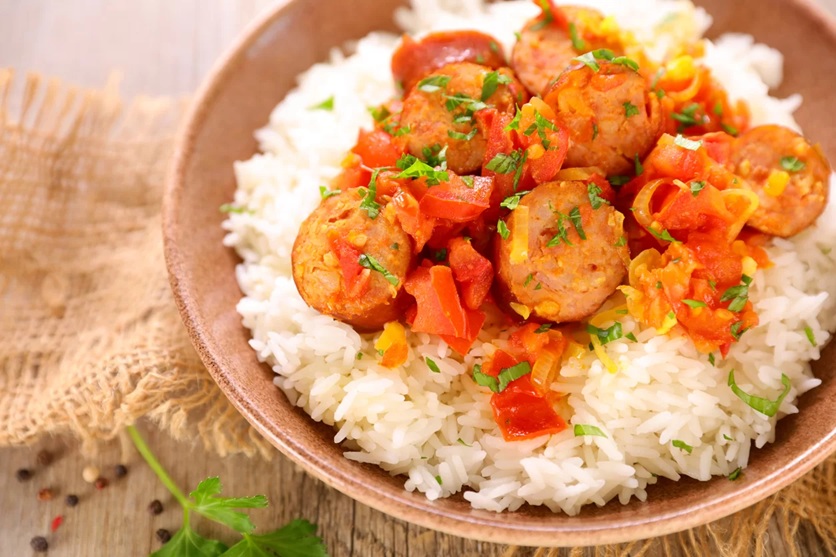
Rougaille Saucisse
Mauritius's everyday tomato stew: onion, ginger, garlic and fresh thyme bloomed in oil, simmered long with ripe tomatoes and braised smoked sausages.
Overview
Rougaille is the workhorse tomato sauce of Mauritian Creole cooking, used as a condiment with dholl puri, as a sauce for fried fish, and (most often) as the base of a one-pot meal with sausage, salt cod or eggs. The structure is simple but specific: onion softened slowly in oil, then ginger, garlic, chilli and fresh thyme bloomed in that oil, then a long-cooked mound of ripe tomatoes broken down until the oil splits and the sauce darkens. No curry powder, no garam masala, no coconut milk; rougaille belongs to the Creole rather than the Indo-Mauritian tradition, and its identity is the herbal punch of thyme and ginger against tomato. Rougaille saucisse, the version with smoked Mauritian-style sausages, is the textbook home preparation. Use any decent smoked, coarse-cut pork sausage; in the UK, smoked chipolatas or Polish kielbasa are good stand-ins. Difficulty is low and the cook is mostly passive. Serve with rice, a few leaves of bredes (sauteed greens) and a chilli pickle on the side.
Ingredients
Sausage
- 500 g smoked pork sausages (Mauritian saucisses if you can find them; smoked chipolatas, kabanos or kielbasa are good substitutes)
Sauce base
- 3 tbsp neutral oil
- 2 onions (large, about 350 g, halved and thinly sliced)
- 6 garlic cloves (minced)
- 25 g fresh ginger (grated)
- 2-3 sprigs fresh thyme (leaves stripped, plus 1 whole sprig)
- 2 green chillies (or red chillies, 1 slit, 1 finely chopped; adjust to taste)
- 6 ripe medium tomatoes (about 700 g, finely chopped)
- 1 tbsp tomato paste
- 1 tsp sugar (optional, balances tomato acidity)
- ¾ tsp salt (or to taste)
- Freshly ground black pepper
- 150 ml water
- Small handful chopped fresh coriander
- 3 spring onions (thinly sliced)
Method
Stage 1 - Brown the sausages
- Score each sausage with 2-3 shallow diagonal cuts to help the flavour penetrate.
- Heat 1 tbsp of the oil in a heavy wide pan over medium heat.
- Brown the sausages on all sides, about 6-8 minutes. They will not be cooked through; you only want colour. Lift out and set aside.
Stage 2 - Build the sauce
- Add the remaining 2 tbsp oil to the same pan. Tip in the sliced onions and a small pinch of salt.
- Cook 10-12 minutes over medium-low heat, stirring occasionally, until the onions are very soft and just turning gold. Do not rush; this is where the body of the sauce comes from.
- Add the garlic, ginger, picked thyme leaves, whole thyme sprig and slit chilli. Cook 1-2 minutes until fragrant.
- Stir in the tomato paste and cook 1 minute.
Stage 3 - Tomato cook-down
- Add the chopped tomatoes, sugar, salt and a few grinds of black pepper. Stir well.
- Cover and cook 8-10 minutes until the tomatoes have collapsed.
- Uncover and mash the tomatoes lightly with the back of a wooden spoon. Cook a further 5-6 minutes until the sauce has darkened and the oil starts to separate at the edges.
Stage 4 - Braise the sausages
- Return the browned sausages to the pan along with any juices.
- Pour in the water and add the finely chopped chilli.
- Bring to a gentle simmer, cover, and cook 12-15 minutes, turning the sausages once. The sauce should be thick and glossy.
- Uncover for the last 3 minutes if the sauce needs to reduce further; it should cling to the sausages rather than pool around them.
- Taste for salt. Discard the whole thyme sprig.
Stage 5 - Finish
- Scatter the coriander and spring onions over the top.
- Serve from the pan to the table.
Notes
- Smoked, not fresh: the sausage needs to be smoked and well-seasoned; a fresh, mild banger gets lost in the sauce. Kabanos, smoked Polish kielbasa or Spanish-style smoked sausages all work well as substitutes.
- Fresh thyme is non-negotiable: rougaille without thyme is just tomato sauce. Use at least the stripped leaves of 2 sprigs.
- Onions first, properly: the slow soft-cooking of the onions is what gives the sauce its sweetness and body. Rushing this stage gives you a thin, raw-tasting sauce.
- Tomato quality: if your tomatoes are pale and watery, supplement with an extra spoon of tomato paste; out-of-season tinned plum tomatoes are better than poor fresh ones.
Variations
Rougaille poisson sale: Replace the sausage with 300 g salt cod (soaked overnight, drained, flaked) added in Stage 4. A classic of the Mauritian east coast. Rougaille zef: Crack 4-6 eggs into divots in the sauce in the final 5 minutes and cover until just set. Breakfast on the island. Rougaille boucane: Use 250 g smoked dried meat (boucane) or lardons in place of sausage for a deeper, smokier sauce.
Serving
Serve over plain steamed white rice. A side of sauteed bredes (chayote tops, watercress or spinach with garlic), a small bowl of pickled chilli or chatini pomme d'amour (raw tomato chutney) and a wedge of lime complete the plate.
Storage
- Keeps 3 days refrigerated. The sauce thickens on chilling and reheats beautifully.
- Reheat gently on the hob with a splash of water if needed.
- Freezes up to 2 months. The sausage texture stays excellent.

More like this
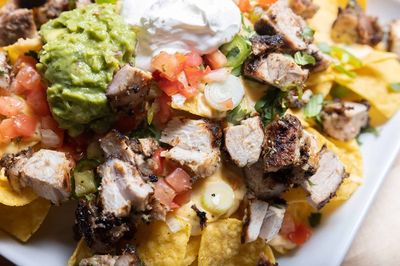
Cheesy Jerk Chicken Nachos
A Caribbean-American fusion that works because both food cultures speak the language of "everything on one tray". The base is American nachos: tortilla chips, melted cheese, black beans. On top sits jerk-marinated chicken thigh, which carries the dish's flavour, allspice, Scotch bonnet, nutmeg, cinnamon, thyme, soy and brown sugar blended into a wet jerk paste, marinated into the meat overnight, then oven-baked and sliced. The fresh element on top is a Trinidadian-style fruit chow: diced mango, pineapple, red bell pepper and red onion dressed with lime juice and cilantro. The chow is what makes this work; without it the nachos are just spicy meat-and-cheese, with it the dish has acid, crunch and sweetness to cut through the richness. Smell is melted cheese hitting jerk seasoning, with a citrus-tropical lift from the chow on top. Not difficult but it's three components running on different timelines, so plan ahead. A modern party-and-Super-Bowl-tray dish rather than something a Kingston grandmother makes, popularised by Caribbean-American food bloggers in the 2010s.
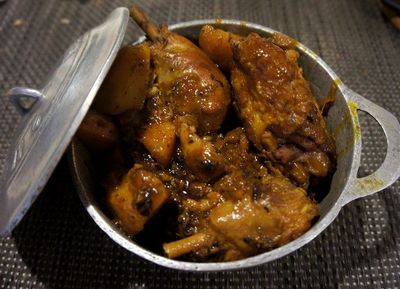
Cari Poulet Et Pomme de Terre
Mauritian cuisine is a layered conversation between Indian, African, Chinese and French traditions, and cari poulet is one of its clearest expressions. The Creole community took the Indian template of a wet curry and rebuilt it with local fresh herbs, particularly thyme and curry leaves grown in the yard, plus tomato, and a masala that is gentler and more aromatic than its mainland Indian cousins. Chicken on the bone is browned for fond, then potatoes are added and the whole pot is simmered in a curry-leaf and tomato gravy until the meat is falling off the bone and the potatoes are creamy on the outside but holding shape. The colour leans red-brown from paprika and turmeric rather than the bright yellow of a Punjabi-style curry. Heat is moderate, intended to complement rice and a chilli-based satini, not overwhelm them. For a home cook the difficulty is low to moderate; the only real demand is patience while the masala blooms in the oil at the start, which is what gives the dish its depth. Serve over plain steamed rice with a coriander satini and a spoon of green chilli pickle, the classic Mauritian Sunday plate.
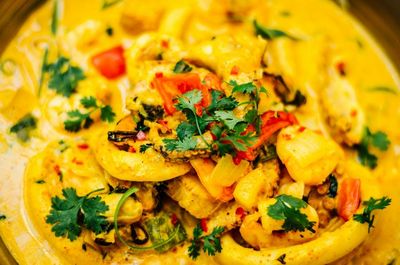
Octopus Curry (Cari Ourite)
Cari ourite is the dish that turns up at every Mauritian fisherman's Sunday lunch, and at every Creole restaurant on the south coast. The technique is to braise octopus low and slow in a tomato-and-onion masala that leans on fresh thyme and a finishing pinch of garam masala instead of the heavier dried-spice masalas you find in cari boeuf or cari poulet. Octopus has a sweet, slightly mineral flavour that needs space, so the seasoning is restrained: thyme for aroma, tomato for body, ginger and garlic for the base, mild curry powder for depth, garam masala right at the end for top-note warmth. The tentacles cook for around 45 minutes (small octopus) to an hour (larger). The biggest variable is the octopus itself; small frozen octopus, sold cleaned at most fishmongers and many supermarkets, is reliable and the freezing actually helps tenderise the flesh. Difficulty is moderate; the cook is mostly passive once the masala is built. Serve with plain steamed rice and a satini cotomili (coriander chutney) or a spoon of pickled chilli. A simple green salad with vinaigrette on the side keeps it honest.
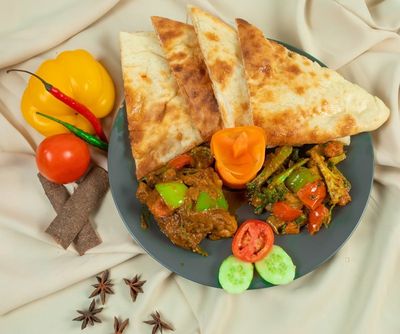
Chicken Jalfrezi
A curry-house jalfrezi inspired by a Balti House classic, featuring quick stir-fried peppers, chillies, onions and tender chicken in a light spiced sauce. It is traditionally dry and crisp, but can be adjusted for more sauce by adding extra base curry or stock.