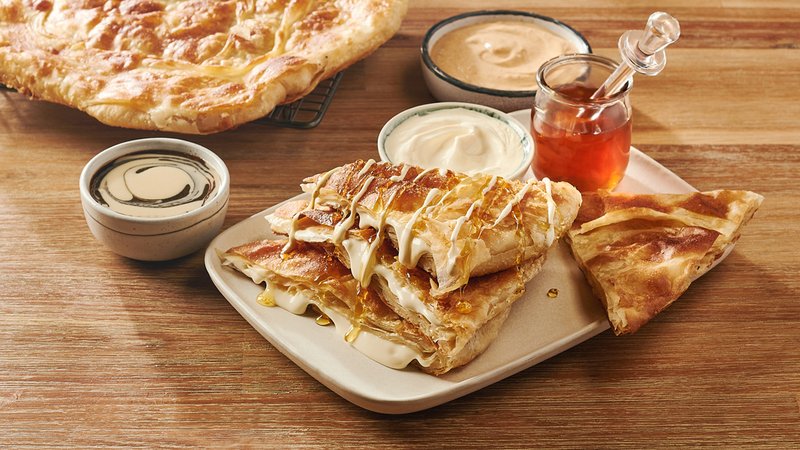
Feteer Meshaltet
Egypt's pillowy pastry-bread: a simple flour-and-water dough stretched paper-thin, folded with ghee into many layers, then baked. Eaten with honey.
Overview
A simple dough of flour, salt, oil, water rests for 30 minutes. Two portions; each portion rolls and stretches paper-thin on an oiled surface (similar to filo or strudel). Drizzles of melted ghee between thin layers; folded in thirds, rolled flat, folded again, baked at 220°C until deeply gold and crisp at the edges.
Ingredients
- 500 g plain flour
- 1 teaspoon salt
- 2 tablespoons vegetable oil
- 300 ml warm water (approximate)
- 200 g ghee (or unsalted butter, melted)
- Extra oil for stretching
To serve
- Honey, molasses (asal aswad) or thick cream for sweet
- Or eat plain alongside savoury dishes
Method
Stage 1 - Dough
- Whisk flour and salt.
- Add oil and warm water; mix to a soft, slightly sticky dough.
- Knead 10 minutes until very smooth and elastic.
- Cover; rest 30 minutes.
Stage 2 - Divide
- Cut the dough in half; cover one half.
Stage 3 - Stretch
- Oil a wide work surface generously.
- Press the first dough half into a flat round; oil the top.
- With oiled hands, gently stretch outwards from the centre, rotating, until the dough is paper-thin and large (40-50 cm round) - you should see your hand through it.
- Don't worry about small holes.
Stage 4 - Fold and layer
- Drizzle 3 tablespoons of melted ghee across the surface.
- Fold in thirds (one long edge to the centre, the other long edge over it) into a long rectangle.
- Drizzle 1 more tablespoon of ghee.
- Fold the rectangle in thirds the other way into a square.
- Press lightly to a 18 cm square.
Stage 5 - Second piece
- Repeat for the second half of dough.
Stage 6 - Bake
- Heat oven to 220°C (200°C fan).
- Place each square on a lined baking tray.
- Brush with melted ghee.
- Bake 18-22 minutes until deep gold and crisp at the edges.
Stage 7 - Serve
- Eat warm. Tear into pieces; drizzle with honey or molasses; or eat plain alongside a savoury dish.
Notes
- Stretch don't roll: Feteer is built on a strudel-style stretch. A rolling pin won't get it thin enough; oiled hands will.
- Ghee not butter alone: Ghee gives the flaky layers their proper character. Butter works but the flavour is shallower.
- Tear, don't slice: The point is the layers - pull apart to expose them.
Storage
- Best fresh, eaten warm.
- Keep wrapped 24 hours; reheat at 200°C 4 minutes.
More like this
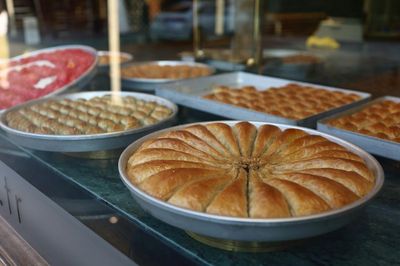
Baklava
A Middle Eastern delicacy of honey-soaked, crispy-layered filo pastry studded with pistachios and warm spices, cut into diamonds and served at room temperature. This globally beloved pastry achieves its legendary texture through careful assembly and the crucial overnight soaking that allows the honey syrup to penetrate all layers while maintaining crispness.
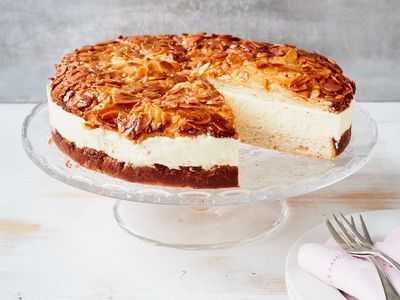
Bienenstich
A milk-and-butter enriched yeast dough proves to soft and pillowy. A honey-almond topping (butter, honey, sugar, cream, flaked almonds) cooks on the stovetop until thickly bubbling, then spreads on the proved dough and bakes together: the dough rises, the topping caramelises golden and chewy. Once cooled, the cake splits horizontally and fills with thick vanilla pastry cream (Konditorcreme) lightened with whipped cream.
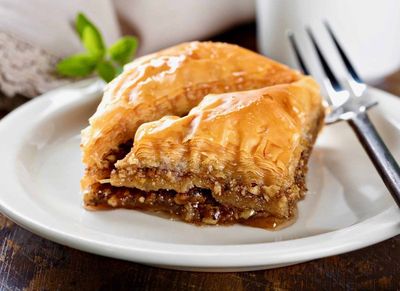
Greek Baklava
A 30 × 22 cm tin is built in layers: 8 buttered filo sheets on the bottom; walnut-cinnamon filling; 4 buttered filo sheets; more walnut; 4 more filo; walnut; finally 8 more buttered filo on top. The top is scored into squares; a clove is pressed into the centre of each. Baked for 45 minutes at 180°C till amber. Syrup of honey, sugar, water, lemon and cinnamon stick simmers separately. The COOL syrup is poured over the HOT baklava. Rested overnight, non-negotiable.
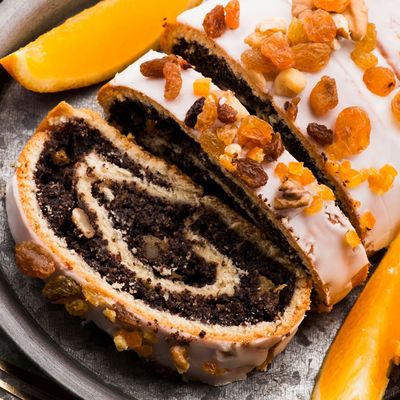
Makowiec
The filling starts the night before: poppy seeds soak then simmer in milk and cook to a thick paste with honey, butter, vanilla, raisins, walnuts and candied peel. The next day, an enriched yeast dough rolls into a thin rectangle, spreads thickly with the cold poppy filling, and rolls into a tight log. After a final prove, it bakes in a long tin until the dough is bronze. Once cool, a thin lemon glaze drizzles across the top and a scatter of candied peel finishes it.