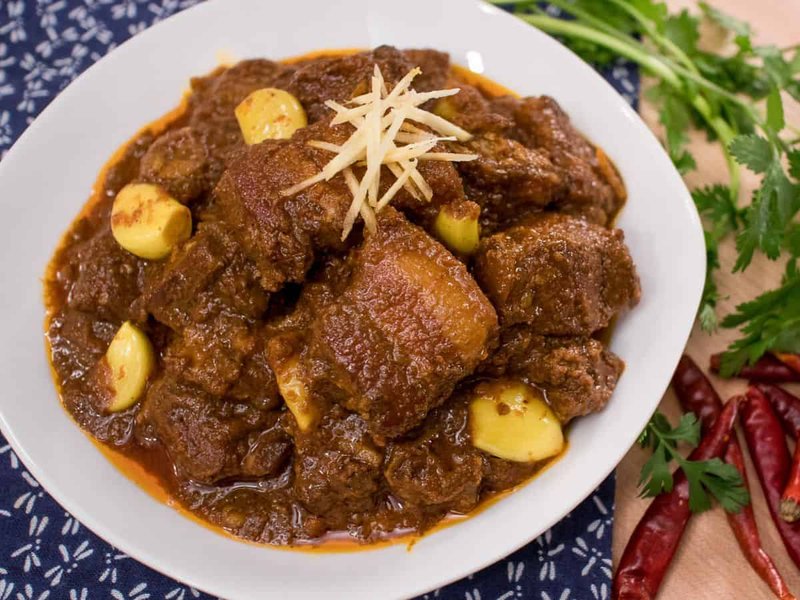
Wet Tha Hin Lay
Burma's pork curry: cubed pork shoulder slow-cooked in a deep aromatic gravy of turmeric, paprika, fried onion, garlic, ginger and fish sauce.
Overview
The Burmese pork curry, the simplest of the country's red-oil-slick curries and the dish that turns up in every household's lunch rotation. You marinate pork briefly in turmeric, salt and a splash of fish sauce, then cook onions hard in oil until they're deep golden brown - this is the colour and depth of the curry, and rushing it leaves the dish pale. The pork browns in the same oil, then garlic, ginger, paprika and chilli powder go in, then tomato softens. Water covers the meat and the curry simmers covered for an hour until tender, then uncovers for the se-byan stage that returns the oil to the surface in the characteristic red-orange slick. Served with white rice, a side of balachaung, and a green vegetable.
Ingredients
- 800 g pork shoulder (cut into 4 cm cubes)
- 2 teaspoons ground turmeric (split)
- 1 ½ teaspoons salt (split)
- 2 tablespoons fish sauce
- 6 tablespoons vegetable oil
- 3 onions (large, chopped)
- 6 garlic cloves (crushed)
- 1 thumb fresh ginger (grated)
- 2 tablespoons paprika
- 1 teaspoon Kashmiri chilli powder
- 1 dried bird's-eye chilli (broken) or 1 fresh chilli
- 2 tomatoes (large, chopped) or 1 small tin chopped tomatoes
- 1 teaspoon dark soy sauce
- 500 ml hot water
- 1 stick lemongrass (bruised, optional)
- 1 small bunch fresh coriander (to finish)
Method
Stage 1 - Marinate
- Toss the pork with 1 teaspoon turmeric, 1 teaspoon salt and the fish sauce.
- Rest 30 minutes.
Stage 2 - Onion paste
- Heat 4 tablespoons of the oil in a heavy pot over medium-high heat.
- Add the onion; cook 15 minutes, stirring often, until deep brown but not burnt. This is the curry's base; rushing makes a pale, weak gravy.
Stage 3 - Pork and spices
- Push the onion to the side. Add the remaining oil to the cleared part of the pot.
- Brown the marinated pork in batches, 4-5 minutes per side.
- Return all pork to the pot; mix with the onions.
- Add garlic, ginger, paprika, remaining turmeric and chilli powder; toss together 1 minute.
Stage 4 - Tomato
- Stir in the chopped tomato; cook 5 minutes until soft.
- Add the dark soy and dried chilli (or fresh).
Stage 5 - Slow cook
- Pour in the hot water; tuck in the lemongrass.
- Bring to a simmer; cover; cook on low 1 hour.
- Uncover; cook another 20 minutes - the sauce reduces and a slick of oil rises to the top (the "si byan" signal that the curry is ready).
Stage 6 - Finish
- Taste; adjust salt and fish sauce.
- Scatter coriander.
Stage 7 - Serve
- Eat over white rice. A small dish of pickled mango or fresh sliced cucumber alongside.
Notes
- Brown the onions hard: Burmese curry colour and depth come from this step. Most curries fail because the onions are pale. Push to dark brown but stop short of black.
- "Si byan" - the oil returns: When the curry is ready, the oil separates and floats on top. This is the Burmese sign that the curry has cooked through. Don't skim it - it's flavour.
- Pork cuts: Shoulder is right. Belly is too fatty; loin is too lean. Bone-in shoulder gives extra body.
Storage
- Refrigerate 4 days; the curry improves overnight.
- Freezes 3 months.
More like this
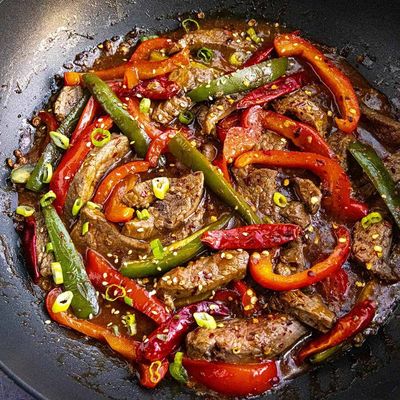
Beef Si Byan
A Burmese curry from the country's Indian-origin community, sitting somewhere between a Madras and a Burmese ohn-no in spice profile. You marinate chunks of beef chuck or shin in turmeric, fish sauce and salt while you fry onions in oil until they're deep brown - that long onion fry is the foundation. The beef browns in the same oil, then ginger-garlic paste, paprika and chilli powder go in, then tomato and water turn it into a stew. Two hours of slow simmer until the meat falls apart at a fork. The signature finish is the see byan, a deep red-orange oil slick that rises to the top of the curry as it reduces, which is what the dish is named for. Eaten with rice or paratha, and a small bowl of pickled vegetable on the side.
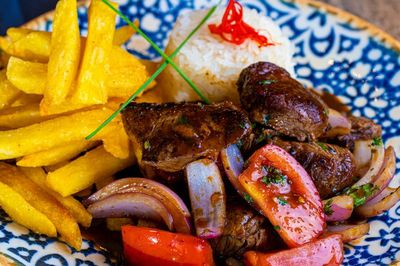
Lomo Saltado
Beef strips are marinated briefly in soy and aji amarillo paste. Fries are cooked separately, pre-fried, set aside. The wok hits high heat; beef is seared in batches; red onion and tomato are added briefly so they keep their bite; soy, vinegar, lime and stock are poured in to sauce. The fries go in last, just before serving, a 30-second toss so they pick up flavour without going soggy.
Cheesy Jerk Chicken Nachos
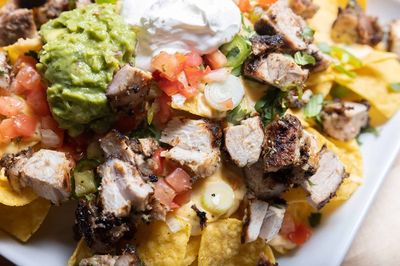
A Caribbean-American fusion that works because both food cultures speak the language of "everything on one tray". The base is American nachos: tortilla chips, melted cheese, black beans. On top sits jerk-marinated chicken thigh, which carries the dish's flavour, allspice, Scotch bonnet, nutmeg, cinnamon, thyme, soy and brown sugar blended into a wet jerk paste, marinated into the meat overnight, then oven-baked and sliced. The fresh element on top is a Trinidadian-style fruit chow: diced mango, pineapple, red bell pepper and red onion dressed with lime juice and cilantro. The chow is what makes this work; without it the nachos are just spicy meat-and-cheese, with it the dish has acid, crunch and sweetness to cut through the richness. Smell is melted cheese hitting jerk seasoning, with a citrus-tropical lift from the chow on top. Not difficult but it's three components running on different timelines, so plan ahead. A modern party-and-Super-Bowl-tray dish rather than something a Kingston grandmother makes, popularised by Caribbean-American food bloggers in the 2010s.
Chicken Jalfrezi
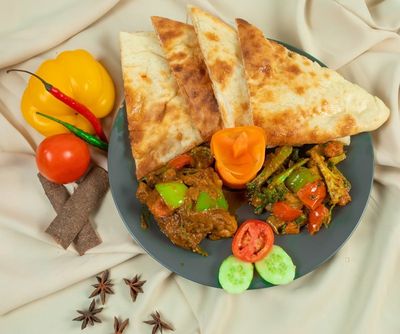
A curry-house jalfrezi inspired by a Balti House classic, featuring quick stir-fried peppers, chillies, onions and tender chicken in a light spiced sauce. It is traditionally dry and crisp, but can be adjusted for more sauce by adding extra base curry or stock.