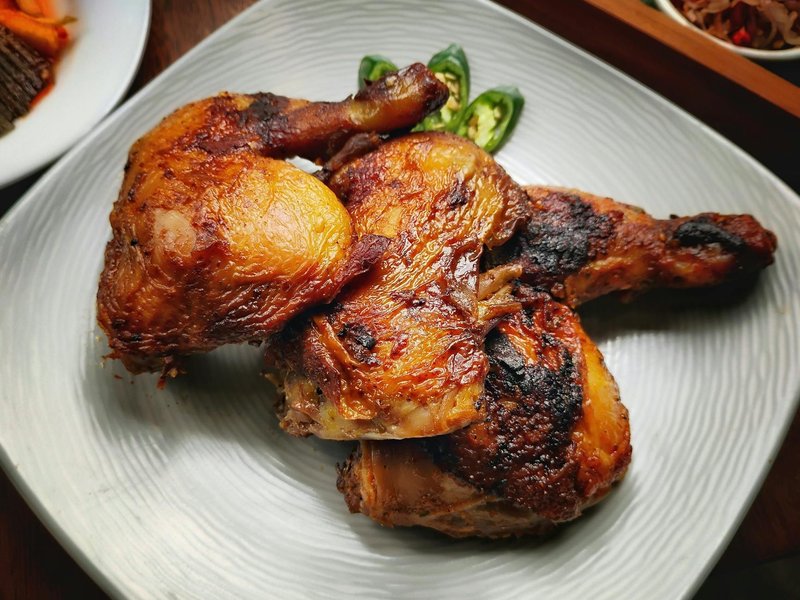
Piri Piri Chicken
Portugal's grill plate: spatchcocked chicken marinated in a fiery piri-piri sauce, then charred hard over flame.
Overview
Piri-piri chicken is the dish that travelled from Mozambique to Portugal to the high street, and the original is still the best: a whole chicken spatchcocked flat, marinated overnight in a vivid red paste of bird's-eye chillies, garlic, paprika, lemon and olive oil, then grilled hard over charcoal until the skin is darkly blistered and the meat just-cooked through. The marinade itself takes five minutes in a blender. The bird wants a minimum of four hours in it, ideally overnight. A home broiler on max works if you do not have a barbecue, but the smoke from the coals is half the dish. Serve with a second bowl of the same marinade as a sauce, a green salad, and chips.
Ingredients
Chicken
- 1 ½ kg whole chicken (spatchcocked - backbone removed, bird flattened)
Marinade and sauce
- 8-12 African bird's-eye chillies (piri-piri, also sold as African Devil chilli, adjust to heat tolerance)
- 8 garlic cloves
- 1 tablespoon smoked paprika
- 1 teaspoon sweet paprika
- 1 lemon (zest)
- 2 lemons (about 4 tablespoons, juice)
- 3 tablespoons white wine vinegar
- 4 tablespoons olive oil
- 2 teaspoons salt
- 1 teaspoon dried oregano
- 1 bay leaf (torn)
- ½ teaspoon black pepper
To serve
- Lemon wedges
- French fries (skin-on)
- Tomato and onion salad
- Extra piri-piri sauce on the side
Method
Stage 1 - Marinade
- In a blender, blitz chillies, garlic, both paprikas, lemon zest, lemon juice, vinegar, 2 tablespoons of the olive oil, salt, oregano, bay leaf and black pepper to a smooth red paste.
- Reserve a third of the sauce in a small jar for serving (refrigerate).
Stage 2 - Marinate
- Place the spatchcocked chicken in a wide dish skin-side up.
- Rub two-thirds of the marinade thoroughly all over and under the skin where possible.
- Cover; refrigerate 4-24 hours.
Stage 3 - Bring to room temperature
- Remove from the fridge 30 minutes before cooking.
Stage 4 - Cook
- Charcoal grill (best): Build a medium-hot fire. Place chicken skin-side up on the grill 15 cm above the coals; cook 18 minutes. Flip; cook 15 minutes skin-side down for crispness. Baste with the remaining 2 tablespoons olive oil mixed with a spoon of the reserved sauce.
- Oven + grill (broiler) alternative: Heat oven to 220°C. Place chicken skin-side up on a rack over a tray. Roast 25 minutes. Switch to broil; flip; broil skin-side down 5 minutes, then skin-side up 4 minutes until charred at the edges.
Stage 5 - Rest
- Lift onto a board; rest 8 minutes.
- Cut into pieces along the joints.
Stage 6 - Serve
- Pile chicken on a platter.
- Serve with french fries, tomato-onion salad, lemon wedges and a small bowl of the reserved piri-piri sauce for those who want more heat.
Notes
- Spatchcock for even cooking: A whole bird grilled flat cooks more evenly than a roasted one. Ask the butcher to remove the backbone, or do it at home with sturdy kitchen scissors.
- Real bird's-eye chillies: African piri-piri (also known as African Devil chilli) is the traditional. Bird's-eye chilli (Thai-style) is the same plant and a fine substitute. Cayenne in a pinch but the flavour is slightly off.
- Adjust heat: 12 chillies is hot but not punishing. Tone down to 6 for moderate; up to 18 if you've got the tolerance.
Storage
- Refrigerate cooked chicken 3 days; reheat covered at 180°C 8 minutes (microwave makes it rubbery).
- Marinade keeps refrigerated 2 weeks in a sealed jar.
More like this
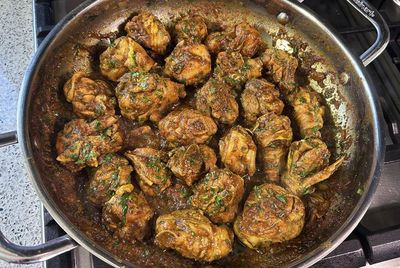
Bunjay-Style Curry Chicken
A dry curry rather than a saucy one, "bunjay" is Trinidadian patois for "fry-down", the technique of cooking meat in its own juices until the gravy completely disappears and the spices coat the surface of the meat in a sticky, glaze-like crust. The flavour is concentrated rather than diluted; nothing's been thinned with water or coconut milk, so what you taste is bone-in chicken, rendered chicken fat, and toasted spice. The spice mix is the East Indian Trinidadian signature: turmeric for colour and earth, roasted geera (toasted cumin, ground) for nuttiness, anchar masala for tang, regular curry powder for breadth. The pan oil splits and separates around the chicken at the end, which is the visual cue you're looking for. Smell when the curry powder hits hot oil is deeply aromatic, almost incense-like. Not difficult but it requires attention during the cook-down phase; if you walk away the curry burns onto the bottom of the pan. A Trinidadian household staple, eaten across the country with white rice and dhal, and a clean example of how Indian indentured labourers' descendants in the Caribbean evolved a distinct curry tradition over 150 years.
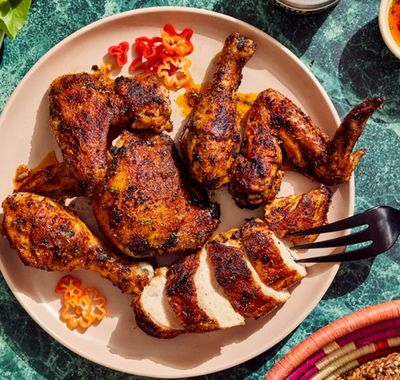
Yassa Spice-Rubbed Grilled Chicken
Yassa is one of the foundational dishes of Senegalese cooking, born in the Casamance region in the south of the country and carried by the Wolof and Joola diaspora across West Africa and beyond. At its heart it is a study in three things: acidity, alliums and smoke. Chicken is rubbed with a spice mix and marinated for hours in lemon juice, Dijon mustard, garlic and a heap of sliced onions, then charred over fire so the marinade caramelises in patches on the skin. The onions, meanwhile, are cooked low and slow in the leftover marinade with a little stock until they collapse into a glossy, tangy sauce that is both sweet and sharp. It is not a fiercely spicy dish, though a Scotch bonnet usually rides along in the pot for backbone, and the flavour profile is closer to a French-North African pickle than to the chilli-heavy stews further east. Difficulty is moderate: the cooking itself is easy, but yassa rewards patience at two stages, the marinade and the onion reduction. Serve over plain white rice or attieke so the sauce has somewhere to go.
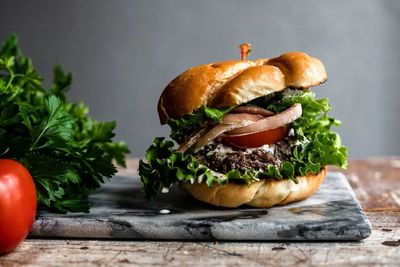
Kofta Burger
Lebanese kofta, sometimes spelled kafta, is minced lamb (often with a little beef) seasoned with grated onion, parsley and the warm spice blend known variously as baharat, sabaa baharat or seven-spice: allspice, black pepper, cinnamon, cloves, nutmeg, cumin and coriander. Traditionally it is moulded around flat metal skewers and grilled over charcoal at a mangal, where it sears fast and stays juicy. Shaping the same mince into a patty for a flatbread sandwich is a natural extension and one you will find in Beirut bakeries and Levantine takeaways from Sydney to Detroit. What makes this burger taste authentic and not just a "Middle-Eastern-spiced lamb burger" is the grated onion: pulled across a box grater so it dissolves into the mince and seasons every gram from the inside, releasing moisture as it cooks. Squeezing out the excess liquid first keeps the patty from falling apart. The sauce is a loosened tahini-yoghurt, tart with lemon and garlic, and the contrast comes from sumac-dusted onions whose sharp, almost berry-like sourness cuts through the lamb's richness. Wrap it in toasted khobz or a soft brioche, depending on the occasion. Difficulty is low. The only skill is restraint with the mince: knead just enough to bind, no more.
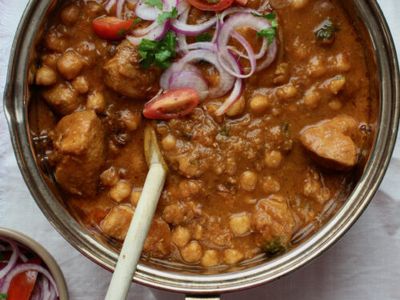
Murgh Cholay
Onion fries in oil until deep gold; ginger-garlic paste joins and is fried for 1 minute. Ground spices (cumin, coriander, turmeric, chilli powder, garam masala) toast in the oil. Chopped tomatoes go in and cook down 8 minutes. Chicken pieces brown briefly. Pre-cooked chickpeas (or tinned, drained) join with water; everything simmers covered 25 minutes. Fresh coriander, green chilli and slivered ginger finish.