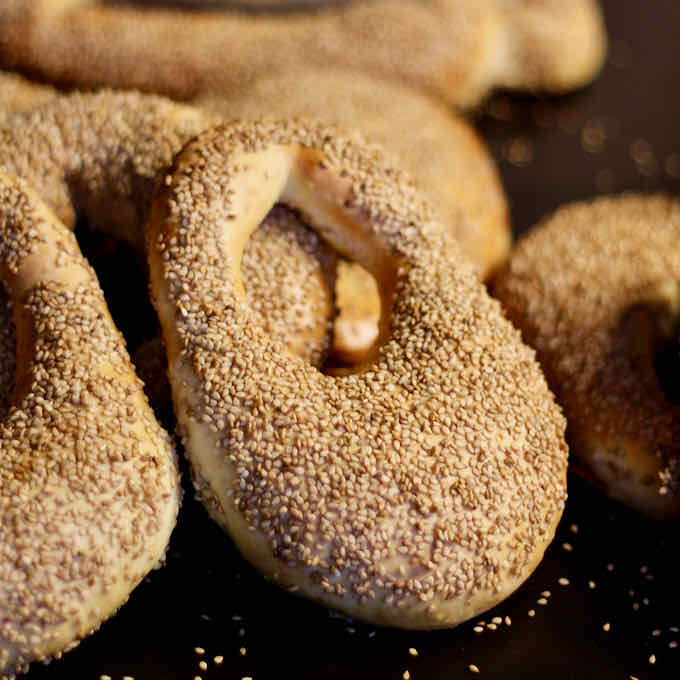
Ka'ak Bi Simsim
Jerusalem's sesame bread ring: a soft yeasted oblong crusted with toasted sesame. Torn at the table and stuffed with za'atar oil and hard-boiled egg.
Overview
A soft yeasted dough (plain flour, milk, water, oil, yeast, sugar, salt, a touch of mahleb or nigella) rises for 1 hour. Divides into 4 or 8 portions. Each rolls into a long rope, then is shaped into an oblong ring with one slightly elongated side (the traditional shape is closer to a stretched horseshoe than a perfect circle). Dipped briefly in a molasses-and-water glaze, then dredged heavily in toasted sesame seeds. Rises for 30 minutes. Baked at 220°C 15-18 minutes until deep gold.
Ingredients
Dough
- 600 g plain flour
- 1 sachet (7 g) fast-action yeast
- 1 ½ teaspoons salt
- 1 tablespoon caster sugar
- 1 teaspoon ground mahleb (optional but very traditional - sold at Middle Eastern shops)
- 60 ml olive oil
- 100 ml warm milk
- 220 ml warm water (more as needed)
Glaze
- 2 tablespoons date (or pomegranate molasses, or treacle)
- 100 ml warm water
Coating
- 250 g sesame seeds (raw, white)
- 1 tablespoon nigella seeds (optional, scatter)
Method
Stage 1 - Toast the sesame
- Tip the sesame seeds onto a dry baking tray.
- Toast in a 180°C oven 5-6 minutes, stirring halfway, until pale gold and very fragrant. (Or toast in a dry pan over medium heat 4-5 minutes - watch carefully, they go from gold to burnt fast.)
- Cool.
- Tip into a wide shallow bowl.
Stage 2 - Dough
- Whisk flour, yeast, salt, sugar and mahleb (if using) in a wide bowl.
- Pour in olive oil, warm milk and warm water; mix to a soft dough. Add more water 1 tablespoon at a time if needed.
- Knead 10 minutes by hand (or 7 minutes in a stand mixer) until smooth and elastic.
- Cover; rise 1 hour until doubled.
Stage 3 - Glaze
- Whisk the molasses with the warm water in a wide shallow bowl. The glaze should be the consistency of weak tea.
Stage 4 - Shape
- Knock back the risen dough.
- Divide into 4 (for large rings) or 8 (for snack-size rings) pieces.
- Roll each piece into a rope about 30 cm long, slightly thicker at one end.
- Bring the ends together and pinch to seal - the ring should be more oblong than perfectly round, mimicking the traditional Jerusalem shape.
Stage 5 - Glaze and coat
- Working one ring at a time:
- Dip the entire ring in the molasses glaze, making sure all surfaces are coated.
- Lift; allow excess to drip off.
- Press into the sesame bowl; turn to coat the entire ring thoroughly in sesame seeds.
- Transfer to a paper-lined baking tray.
- Scatter a few nigella seeds across the top of each (if using).
Stage 6 - Final rise
- Cover loosely with a tea towel; rise 30 minutes.
Stage 7 - Bake
- Heat oven to 220°C (200°C fan).
- Bake 15-18 minutes until deep golden brown and the sesame is fully toasted.
Stage 8 - Cool and serve
- Cool 10 minutes on a rack.
- Eat warm or at room temperature.
- Traditional accompaniment: a sachet of za'atar mixed with olive oil to dip the bread in; or hard-boiled egg sliced and stuffed inside the torn ring.
Notes
- Mahleb is the bakery-aroma: Ground from the kernel of a particular cherry pit, mahleb gives Levantine breads their distinctive faint almond-cherry perfume. Optional, but the bread tastes much more Palestinian with it.
- Toast the sesame first: Untoasted sesame on the outside of the bread doesn't toast enough during baking to develop the deep nutty flavour. Pre-toasted is what gives ka'ak its character.
- Heavy sesame coat: These breads are about the sesame as much as the bread. Press firmly into the seeds; the glaze should hold them on.
Storage
- Best the day they're made.
- Refrigerate 3 days; freshen in a 180°C oven 4 minutes.
- Freeze cooked 2 months; reheat from frozen at 180°C 8 minutes.
More like this
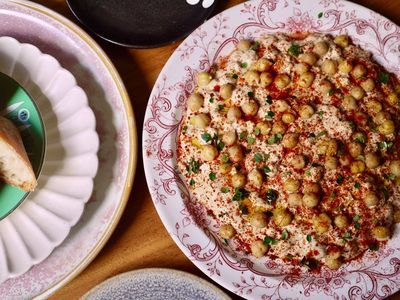
Msabaha
Dried chickpeas soak overnight with a pinch of bicarbonate of soda. The next morning, they simmer in fresh water with garlic, cumin and bay until very soft (about 1 hour, longer if the chickpeas are old). Some chickpeas (about a third) blitz with garlic, lemon juice, tahini and ice water into a smooth purée. The remaining whole chickpeas keep warm in their cooking liquid. To plate: smooth purée on the bottom of the bowl, hot whole chickpeas piled in the centre, more tahini-lemon-garlic sauce poured over, drizzle of olive oil, sprinkle of cumin, scatter of parsley. Eaten with hot bread.
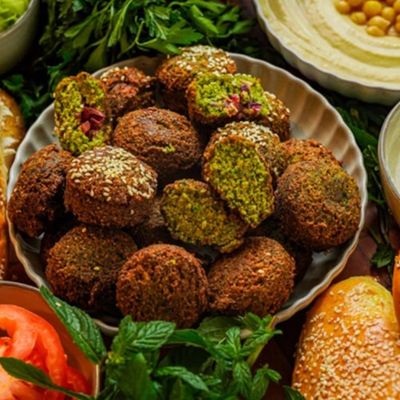
Falafel Palestinian
Dried chickpeas (or a chickpea-fava blend) soak overnight. Drained, blitzed with onion, leek, a heaped pile of fresh parsley AND coriander (the Palestinian style is herb-heavy and notably green), garlic, ground cumin, ground coriander, salt and Aleppo pepper. Left to rest. Baking soda mixed in right before frying. Shaped into small patties or balls; pressed into sesame seeds; deep-fried until amber. Stuffed into khobz with tahini sauce, salad and pickled vegetables.
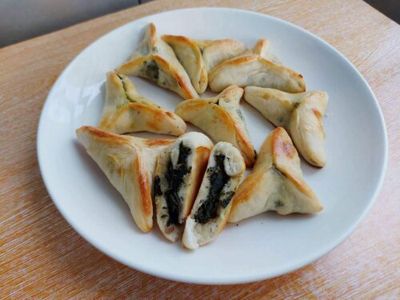
Fatayer Sabanikh
A soft yeasted olive-oil dough rises for 45 minutes. The filling: spinach wilts briefly in salted water and is squeezed bone-dry; chopped onion massages with salt to soften and weep; the two combine with sumac, lemon juice, pomegranate molasses, olive oil and toasted pine nuts. The dough divides into 12 balls; each rolls into a 12 cm disc; a spoon of filling sits in the centre; the disc folds into a tricorn (three corners pinched up to meet at the top). Baked at 220°C 15-18 minutes until deep gold.
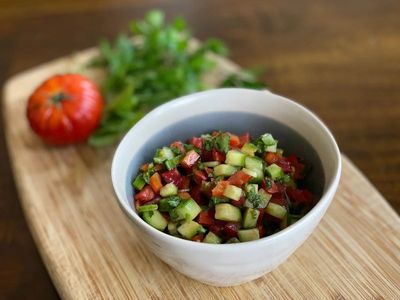
Salata Arabieh
Tomato, cucumber and onion all diced very small (the cut is small, 5 mm pieces, not chunky). Fresh parsley, mint and an optional chilli chop. Everything mixes in a wide bowl with lemon juice, olive oil, sumac, salt and pepper. Rest for 5 minutes for the flavours to integrate. Eat immediately, the tomato weeps quickly and the salad goes watery after an hour.