
Tunisian Fricassé
Tunisia's deep-fried sandwich bun: yeasted dough puffed in hot oil, split open and stuffed with tuna, harissa, capers, olives and egg.
Overview
A simple yeasted dough rises for 1 hour. Divides into 8 oval-shaped pieces about 10 cm long. Deep-fries for 2-3 minutes per side till golden and puffed (the fried buns triple in size and develop a hollow interior). Splits each bun horizontally with a small knife; stuffs with: a generous spoonful of tuna mashed with harissa; a few thin slices of hard-boiled egg; a few capers; a few olives; thin slices of preserved lemon; a sprinkle of parsley. Eats hot.
Ingredients
Dough
- 400 g plain flour
- 7 g instant yeast
- 1 teaspoon salt
- 1 teaspoon caster sugar
- 240 ml warm water
- 2 tablespoons olive oil
Frying
- 800 ml neutral oil
Filling (per fricassé)
- 1 small tin (100 g) tuna in olive oil (drained, but reserve a little oil)
- 1 ½ teaspoons Harissa (or to taste)
- ½ hard-boiled egg (sliced)
- 4-5 capers (drained, rinsed)
- 4 green olives (small, or black olives, pitted, halved)
- 1 thin slice preserved lemon peel (or substitute: zest of fresh lemon + pinch of salt)
- 1 teaspoon chopped parsley
Per batch of 8 - total filling
- 4 small tins tuna
- 4 tablespoons Harissa
- 4 hard-boiled eggs
- 4 tablespoons capers
- 100 g olives
- 1 preserved lemon
- A handful of parsley
Method
Stage 1 - Dough
- In a wide bowl, whisk flour, yeast, salt and sugar.
- Pour in the warm water and olive oil.
- Mix to a shaggy dough; knead 6 minutes till smooth and elastic.
- Rest in a covered bowl 1 hour till doubled.
Stage 2 - Shape
- Knock back; divide into 8 portions (~80 g each).
- Shape each into an oval shape about 10 cm long and 5 cm wide, slightly pointed at the ends.
- Rest 15 minutes on parchment.
Stage 3 - Fry
- Heat the oil to 175°C.
- Lower 2 ovals at a time into the oil.
- Fry 1-2 minutes per side; the dough will puff dramatically into a hollow shape.
- Lift onto a wire rack to drain and cool slightly.
Stage 4 - Fillings
- Mash each tin of drained tuna with 1 tablespoon harissa in a small bowl.
- Have the egg slices, capers, olives, preserved lemon and parsley ready.
Stage 5 - Stuff
- With a small knife, cut a slit lengthways along the side of each fricassé (don't cut through - make a pocket).
- Open the pocket carefully - it should be hollow inside.
- Spread harissa-tuna mash inside.
- Add: 2-3 slices of hard-boiled egg, 2-3 capers, 2-3 olive halves, a small piece of preserved lemon, a sprinkle of parsley.
Stage 6 - Serve
- Eat IMMEDIATELY while still hot.
- The bread softens within 30 minutes - fricassé is best straight after building.
Notes
- Hot oil + light dough = hollow interior: the secret is the fry. The dough puffs into a balloon, leaving a perfect pocket for stuffing. Cold dough won't puff.
- Harissa is non-negotiable: the spicy paste defines the fricassé. Mild palates can use less, but skipping it altogether removes the Tunisian character.
- Preserved lemon is iconic: the salty-floral note is what makes a fricassé distinctly Tunisian. Substitute fresh lemon zest + a pinch of salt if you can't find preserved.
- Eat right after building: the bread softens fast. Build at the last second.
Storage
- Eat fricassés within 30 minutes of building.
- Plain fried buns (unstuffed) keep 1 day at room temperature; reheat briefly in a 180°C oven before stuffing.
- Don't pre-stuff and store - the filling weeps into the bread.
More like this

Bourek Tunisien
Potato is boiled, peeled and mashed. Mixed with drained tuna, harissa, capers, parsley, salt and pepper. A warka or filo sheet is laid flat; a line of filling is spooned across one edge; a small well is pressed into the filling; a whole raw egg is cracked into the well; the sheet is folded and rolled into a cigar. Fried seam-down immediately in moderately hot oil, the egg cooks inside as the pastry turns crisp. Eaten hot with lemon and harissa.
Pasteis de Bacalhau
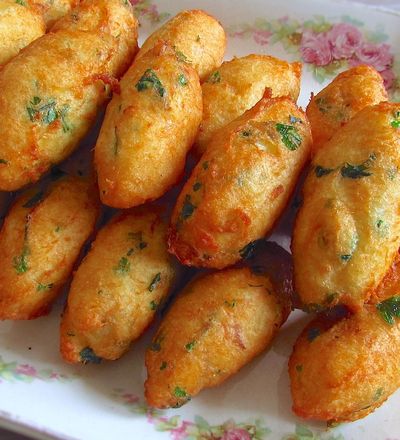
These are the little salt-cod fritters you'd order at a marble counter in Lisbon, sitting with a glass of vinho verde while the bartender slides a plate across with no ceremony. The recipe itself is simple, dry mashed potato through flaked bacalhau with onion, garlic, parsley and egg, then a brief fry, but it does start the day before because the salt cod wants 24 to 36 hours of cold water soaks to draw the salt out. That step is the one thing you cannot shortcut. Once the cod is desalted, everything else is an afternoon's work: simmer the cod, flake it through warm potato, shape into the three-sided football "quenelles" that are the Portuguese signature, and fry until amber. Eat them warm with a wedge of lemon and a dish of piri-piri on the side.
Rissois de Camarão
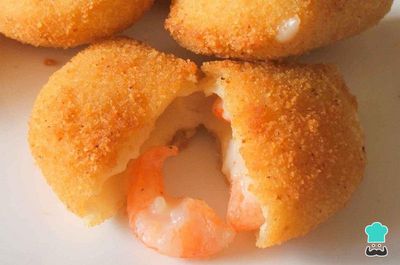
Rissois are the half-moon prawn fritters you'd see in the glass cabinet of every Lisbon snack bar, sold a couple at a time with a paper napkin. The dough is unusual, closer to a hot-water pastry than a normal flour-and-fat dough: you bring water, butter, lemon zest and salt to a boil, dump the flour in all at once, and stir hard until it pulls into a smooth elastic ball. Tip it onto a floured bench, roll paper-thin, cut into discs, then fill each with a spoonful of quick prawn-and-béchamel mixture, fold into a half-moon and crimp the edges. The béchamel needs to be properly cold before you fill, otherwise the dough won't hold its shape. Once they're breaded and frying they cook fast: two minutes a side until amber and crisp. Eat them warm, ideally with a chilled vinho verde.
Lablabi
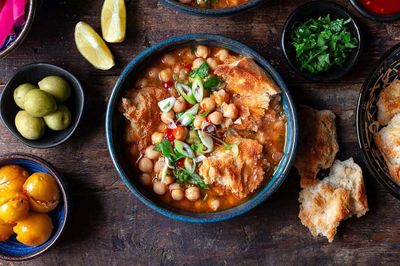
Chickpeas (pre-soaked overnight and slow-cooked, OR tinned for speed) simmer in their cooking water with crushed garlic, cumin, salt and a spoon of harissa for 20 minutes. The broth thickens slightly as a few chickpeas break down. Deep bowls are loaded with torn stale baguette. The hot broth ladles over to soften the bread. Each bowl is topped with a soft-poached or soft-boiled egg, a drizzle of olive oil, lemon juice, a fresh spoon of harissa, a heap of canned tuna, olives, capers and a sprinkle of cumin.